
Mouse Woman Myth Meaning & Symbolism
A myth of the tiny grandmother spirit who, through cunning and ancient law, restores balance by confronting the monstrous and protecting the vulnerable.
The Tale of Mouse Woman
Listen. In the deep, rain-scented forests of the Northwest Coast, where the cedars are pillars holding up the sky and the mist holds the memory of the first dawn, there lived a people. And among them, in the spaces between the roots and under the soft, damp earth, lived the Mouse Woman.
She was tiny, no larger than your thumb, an old woman wrapped in a cloak of fine, shredded cedar bark. Her eyes were black pools of ancient knowing. She was narnauk, a spirit of the in-between places, grandmother to all the small, hidden things. And she was the Keeper of the Law.
Now, in those days, a shadow fell upon a village. A young person, a girl of high birth, had wandered too far into the forest’s heart, lured by a strange, beautiful song. She did not return. The people mourned, for they knew the signs. A land otter or a wild man of the woods had taken her, twisting her spirit, making her one of its own. The monster would come for the village next, a hulking, insatiable hunger wrapped in stolen flesh.
The warriors sharpened their spears, but their hearts were heavy with a cold dread. This was not a foe of flesh alone, but of spirit. It knew the old, dark magics. It broke the laws that held the world together.
In the deepest night, as the fire guttered low, a tiny voice, like the scratching of a twig on bark, spoke from the shadows by the hearth. It was Mouse Woman.
“You shout and you sharpen,” she said, her voice dry and precise. “But you have forgotten the first law. Everything has its proper place. The monster has broken this. It has taken what does not belong to it. It has stepped outside the great pattern.”
She moved into the firelight, her small form casting a long, commanding shadow. “The law is not a suggestion. It is the weave of the world. And I am its weaver for the small and the young. This creature has offended the grandmothers. It has forgotten that even the smallest thread, if pulled, can unravel the whole blanket.”
The people were silent, awed. Mouse Woman turned her gaze to the forest’s black maw. “I will go. Not with a spear, but with a reminder.”
She slipped into the darkness, a whisper against the moss. For days and nights, she followed the twisted trail, through brambles that tore at the sky and across streams that wept black water. She came at last to the monster’s lair—a cave stinking of rot and wrongness. Inside, the stolen girl sat, her eyes empty, her spirit shrouded.
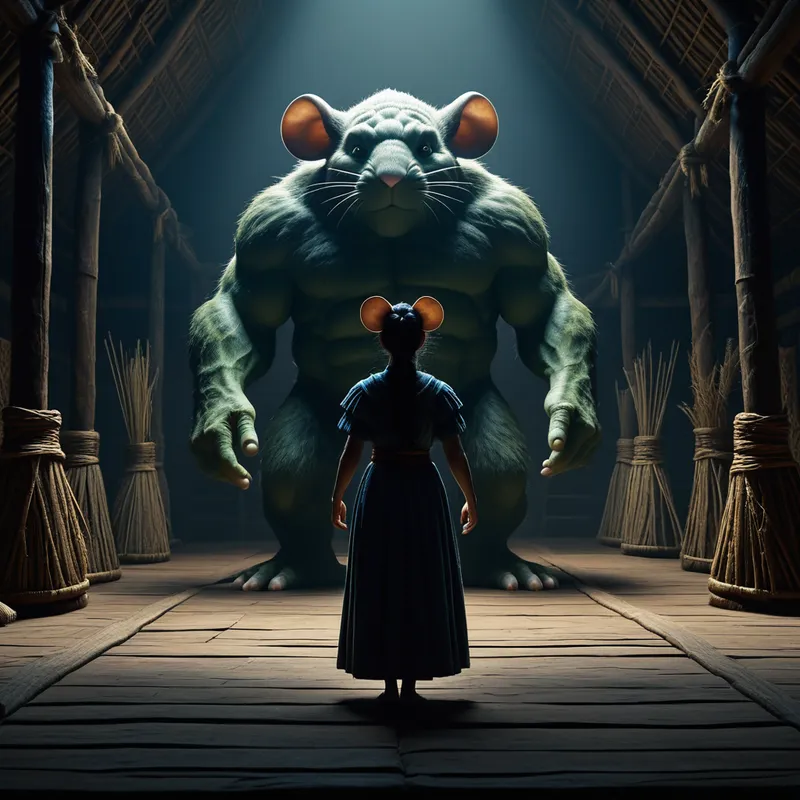
The monster rose, a mountain of matted hair and terrible strength. It laughed, a sound like stones grinding. “A snack has come to me! A crumb!”
Mouse Woman did not flinch. She stood before the towering horror, a speck of dust before a storm. And she spoke. She did not shout. She recited. She spoke the ancient laws of hospitality, of kinship, of the proper relationship between hunter and prey, between the forest and the village. She named every transgression, every broken taboo, her voice weaving a net of pure, unassailable truth.
The monster roared, but its roar became confused. It swiped a massive paw, but the paw passed through her as if through smoke. For Mouse Woman was not there to fight its strength, but to confront its wrongness. She was the embodiment of cosmic order, and against that, brute chaos had no power.
“You are outside the pattern,” Mouse Woman declared, her voice now filling the cave. “You are an error. And errors are corrected.”
As she spoke the final law, a change began. The monster’s form wavered. The stolen spirit of the girl began to stir, drawn back by the call of the proper, the lawful, the true. The monstrous shell cracked and shrank, collapsing in on itself until nothing was left but a foul stain on the earth and a trembling, human girl.
Mouse Woman took the girl’s hand, her tiny grip surprisingly firm. “Come, grandchild,” she said. “It is time to go home. The blanket is mended.”
And she led her back through the forest, every root and stone making way for the Keeper of the Law, restoring what was lost to its proper place.
Cultural Origins & Context
The myth of Mouse Woman (known as Kúkuth in Tlingit) originates from the rich oral traditions of the Indigenous peoples of the Pacific Northwest, particularly the Tlingit, Haida, and Tsimshian. These are cultures built on a complex web of social law, clan reciprocity, and a profound understanding of ecological and spiritual balance. Myths were not mere stories but the living, breathing constitutional documents of reality, passed down through generations by skilled orators and storytellers.
Mouse Woman’s tales were often told as “narnauk stories,” specifically aimed at instructing the young and reinforcing social order. She is a totemic grandmother, the personification of the rules that prevent society from descending into chaos. Her societal function was multifaceted: she taught respect for boundaries, the wisdom of the small and observant, the power of protocol over violence, and the absolute necessity of restoring balance when it is lost. She was the spiritual enforcer of reciprocity.
Symbolic Architecture
Psychologically, Mouse Woman represents the archetypal principle of ordering wisdom. She is not the warrior-hero who conquers through might, but the sage who resolves through recognition of fundamental truth.
She symbolizes the psychic law that chaos cannot ultimately withstand the conscious articulation of order.
Her small size is her greatest power, representing the often-overlooked, inner authority—the quiet voice of conscience, the precise insight, the foundational rule we have forgotten. The monsters she confronts—the land otters, the wild men—are manifestations of psychic inflation, of untamed complexes that have “stolen” a part of the personality (the young person) and operate outside the self’s governing laws. They are the ravenous greed, the unchecked anger, the dissociated trauma that acts autonomously, threatening the integrity of the whole psyche.
Mouse Woman’s weapon, the recitation of law, symbolizes the act of naming and contextualizing the chaos. In depth psychology, to bring a complex out of the autonomous shadow and into the light of conscious understanding is to disarm it. She does not destroy the monster; she reveals its inherent illegitimacy within the greater system of the Self, causing it to dissolve.

The Dreamer's Resonance
When the pattern of Mouse Woman stirs in the modern dreamer, it often signals a confrontation with a “monstrous” complex that has taken up residence in the psyche. The dreamer may feel preyed upon by an overwhelming anxiety, a compulsive behavior, or a relationship dynamic that feels alien and consuming.
Dreams may feature:
- Being pursued by a large, indistinct, but terrifying figure.
- Discovering a tiny, wise, old woman or animal in a place of crisis.
- Hearing a clear, authoritative voice stating a simple, undeniable truth that changes everything.
- The sensation of being “stolen” or lost from one’s own life.
Somatically, this process can feel like a tightening, a gathering of one’s core, a movement from diffuse panic to a sharp, focused point of awareness. It is the moment when the overwhelmed ego stops running and turns to face the pursuer, not with battle cries, but with the quiet, firm statement: “You do not belong here. This is not the law of my house.” The resolution is not a violent victory, but a re-integration—the reclaiming of the lost “young one” (vitality, innocence, a talent) that was held captive by the complex.

Alchemical Translation
The alchemical process modeled by Mouse Woman is coagulatio—the condensation of spirit into matter, or chaos into order. It is the operation of giving precise, lawful form to the formless terror of the unconscious.
For the individual on the path of individuation, Mouse Woman represents the crucial stage where one must move beyond simply experiencing inner turmoil and begin to legislate the inner realm. This is the work of building a conscious ego-Self axis.
The transmutation occurs not in the slaying of the dragon, but in the recognition that the dragon is governing by a false, outdated, and self-serving constitution.
The modern “monster” may be a crippling self-doubt, a pattern of toxic attraction, or a legacy of familial dysfunction. The “Mouse Woman” work involves:
- Becoming small and observant: Stepping back from the emotional magnitude of the complex to study its patterns, its triggers, its “broken laws.”
- Reciting the Law: Consciously articulating one’s own core values, boundaries, and truths. “It is the law that I am worthy of respect.” “It is the law that my time has value.” “It is the law that this pain belongs to my past, not my present.”
- Confrontation from Principle: Facing the complex not with equal emotional fury, but with the calm application of this new, inner law. The complex, robbed of its chaotic fuel, often loses its power, and the psychic energy it held captive is freed.
In the end, the myth teaches that the mightiest power is not scale and fury, but the unwavering application of the true pattern. The grandest victory is the restoration of a single, lost thread to its rightful place in the weave of the self.
Associated Symbols
Explore related symbols from the CaleaDream lexicon: