Moon Lodge Myth Meaning & Symbolism
A myth of sacred retreat where women gather in a lodge of moonlight, honoring the body's cycles as a reflection of cosmic wisdom and spiritual power.
The Tale of Moon Lodge
In the time before time, when the world was still soft with creation, the women walked with the moon. Her light was not just a beacon in the night, but a living pulse, a silver thread connecting the deep earth to the high heavens. The Grandmothers say that in those days, a woman’s body was a sacred vessel, its tides pulled by the same force that pulled the great seas. But this power was not always understood; it was a mystery, sometimes feared, often set apart.
One season, when the cold winds bit deep and the game was scarce, a great weariness fell upon the people. The women, bearing the weight of gathering, tanning, cooking, and tending, felt their spirits grow thin as birch bark. Their steps lost the rhythm of the drum, and their laughter no longer danced on the smoke of the lodge culture.") fires. The Great Mystery saw this fraying of the sacred web.
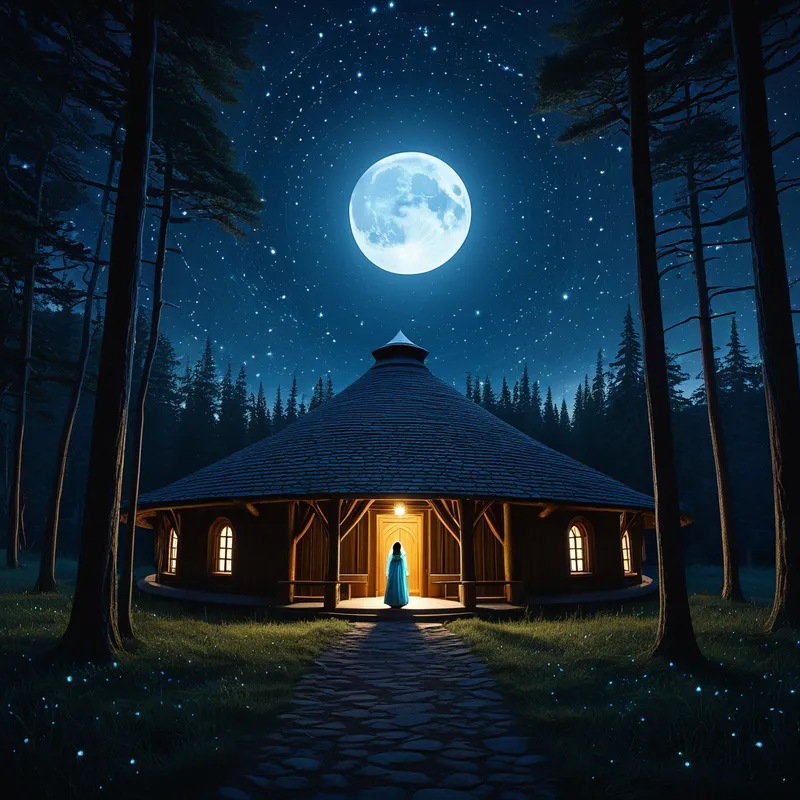
It was then that Grandmother Moon herself descended, not in her full, blazing glory, but as a soft, silver mist. She gathered the women as they slept, whispering on the wind that carried the scent of sage. In their dreams, she showed them a lodge not made of poles and hides, but woven from moonlight and shadow. It stood apart from the village, in a circle of ancient cedars. Within its walls, there was no labor for the camp, only stillness. The only fire was the gentle glow of their own shared presence.
The women awoke with the same vision humming in their bones. Guided by the eldest among them, a woman whose hair was like snow and whose eyes held the patience of stones, they went to the cedar circle. They did not build, but invited. They sang the songs Grandmother Moon had breathed into their dreams—songs of release, of blood-ties to the earth, of rest. As they sang, the moonlight gathered, thickening like fog, and the outline of the lodge appeared. A doorway of darkness opened.
One by one, they entered. The world of tasks fell away. Inside, time curved into a circle. They spoke truths that had no place by the cooking fire. They shed tears that watered the dream-seeds of the people. They slept deeply, and in their sleep, they journeyed, receiving visions of healing herbs, of where the buffalo would travel, of songs to mend a quarrel. When the moon’s cycle turned and the silver light at the doorway began to fade, they emerged. They did not return burdened, but filled. Their eyes were clear pools. Their hands, once tired, now carried the quiet strength of the earth. They brought back not just renewed bodies, but visions—a map to the healing springs, a new pattern for a stronger basket, a lullaby that soothed the most restless child. The people saw that the women’s retreat was not a separation, but a sacred gathering of power for the whole circle of life. And so, the Moon Lodge was woven into the law of the people, a monthly returning to the source, to dream the world whole again.
Cultural Origins & Context
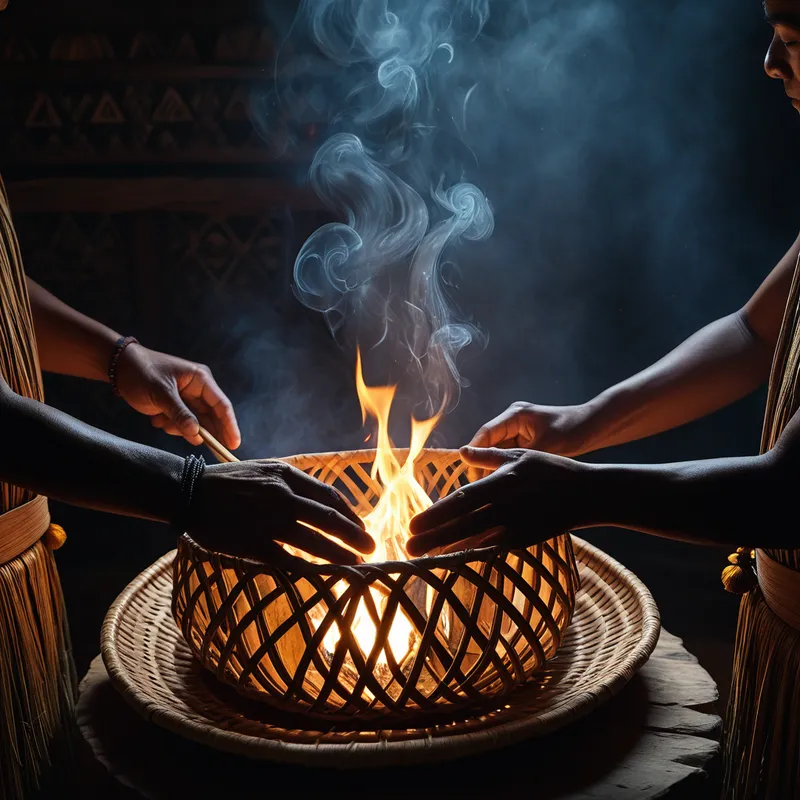
The concept of the Moon Lodge is not a single, monolithic myth from one culture, but a profound and widespread tradition found among many Indigenous peoples across North America, including but not limited to Lakota, Cherokee, Ojibwe, and Cree nations. It is less a story with a fixed plot and more a living practice rooted in cosmological understanding. It was passed down not merely as a tale, but as a law and a sacred protocol, taught by grandmothers, aunties, and medicine women to the younger generations.
Its societal function was multifaceted. Practically, it provided a sanctioned period of physical rest during menstruation, a time considered to be one of immense natural power and spiritual sensitivity. Spiritually, it honored the synchronicity between the human body and the cosmic body—the lunar cycle. It served as a container for women’s spiritual and political life, a space where they could counsel one another, make decisions, and practice ceremonies away from the daily social structure. The Lodge was a testament to a worldview that saw retreat not as exile, but as a sacred recharge, essential for the health of the individual and, by extension, the entire community.
Symbolic Architecture
At its core, the Moon Lodge is a supreme symbol of sacred containment. It represents the womb of the world—a temporary, cyclical temple where the potent, creative, and often chaotic power of life (symbolized by menstrual blood, considered by many traditions as "wise blood") is held, honored, and transformed into vision and wisdom for the community.
The lodge is not a wall that keeps power in, but a vessel that allows it to safely deepen, to move from potential to form, from instinct to insight.
The act of withdrawing symbolizes the necessary inward turn of consciousness. The moon time itself is a symbol of this cycle: the waning (withdrawal), the dark moon (introspection and renewal), and the waxing (return with new life). The women inside become alchemists, transmuting the raw, somatic experience of their bodies into social and spiritual currency—dreams, songs, remedies, counsel. The lodge, therefore, symbolizes the temenos, the sacred precinct where the ordinary rules are suspended, and the deeper laws of nature and psyche are allowed to govern.
The Dreamer's Resonance
When the pattern of the Moon Lodge appears in modern dreams, it often signals a profound somatic and psychological need for sacred containment. The dreamer may find themselves in a secluded, round room, a hidden garden, a cave, or any space that feels both protective and separate from the demands of daily life.
This dream is a message from the deep self that a cycle is complete. The psyche is overloaded with the "labor for the camp"—the endless tasks, expectations, and external projections. The body-mind is demanding a moon time of its own. Somatic signs in the dreamer’s waking life may include deep fatigue, a sense of being emotionally "raw" or overly permeable to others' energies, creative blockage, or a feeling of being out of sync with natural rhythms. The dream lodge is the psyche’s instinctive creation of the container it lacks, pointing to the critical need to withdraw, to honor one’s own cycles of expenditure and renewal, and to listen to the inner visions that can only surface in stillness.
Alchemical Translation
For the modern individual navigating a linear, productivity-obsessed world, the Moon Lodge myth models the essential alchemy of individuation: the transmutation of raw experience into conscious wisdom through rhythmic containment. The process begins with the Call to Withdraw—the recognition of burnout, soul-fatigue, or a crisis of meaning. This is the moon waning.
The next stage is the Creation of the Vessel. This is the conscious, often difficult, act of setting boundaries. It is saying "no" to external demands to say "yes" to an inner need. It is carving out literal or metaphorical space—a quiet hour, a journal, a therapy session, a walk in nature—and sanctifying it as a modern lodge.
Individuation requires not just heroic journeys outward, but sacred surrenders inward. The lodge teaches that the deepest power is gathered in receptive stillness, not in relentless pursuit.
Within this vessel occurs the Alchemy of the Dark. This is the non-doing. It is allowing feelings, memories, and fragments of the self long ignored to surface without immediate analysis or action. It is the somatic, often messy, process of simply being with what is. This is the dark moon phase, where the old psychic material is composted.
Finally, there is the Return with the Gift. One does not leave the lodge empty. The modern "gift" might be a clear insight, a creative idea, a healed perspective, or simply a renewed capacity for engagement. The individual returns to their community—family, work, society—not as a drained resource, but as a renewed source of vision and grounded strength. They have completed a cycle of psychic metabolism, turning the lead of accumulated stress and unconscious material into the gold of integrated awareness, following the ancient, lunar law written in the body and the stars.
Associated Symbols
Explore related symbols from the CaleaDream lexicon: