Mokosh Myth Meaning & Symbolism
The myth of Mokosh, the Slavic Earth Mother, weaves creation, fate, and sacred craft into a tapestry of life, death, and silent, generative power.
The Tale of Mokosh
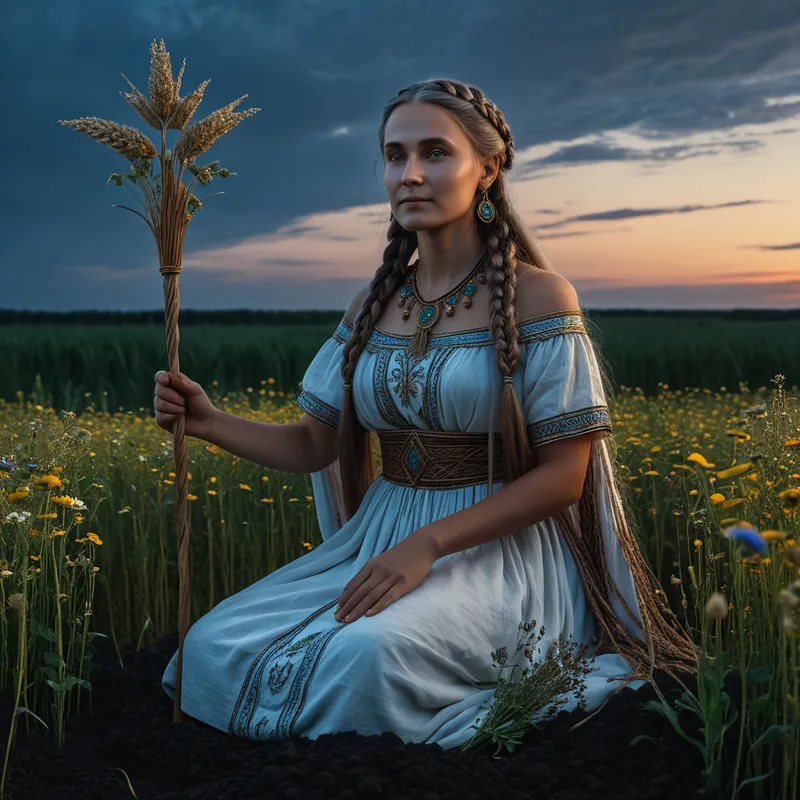
Listen, and let the hearth-fire grow low. Before the first stone church cast its shadow, when the world was a whispering Forest and the sky a father’s cloak, she was there. She was the deep, humming silence beneath the roots of the great oak. She was the dark, giving Earth that drank the Rain and gave back the green shoot.
They called her Mokosh. No thunder announced her. She arrived with the dew, with the weight of the ripening ear of grain. Her hair was the long grass of the meadow, braided with the first and last light of day. In her hands, she did not hold a sword or a lightning bolt, but a spindle and a distaff. With these, she performed the great work.
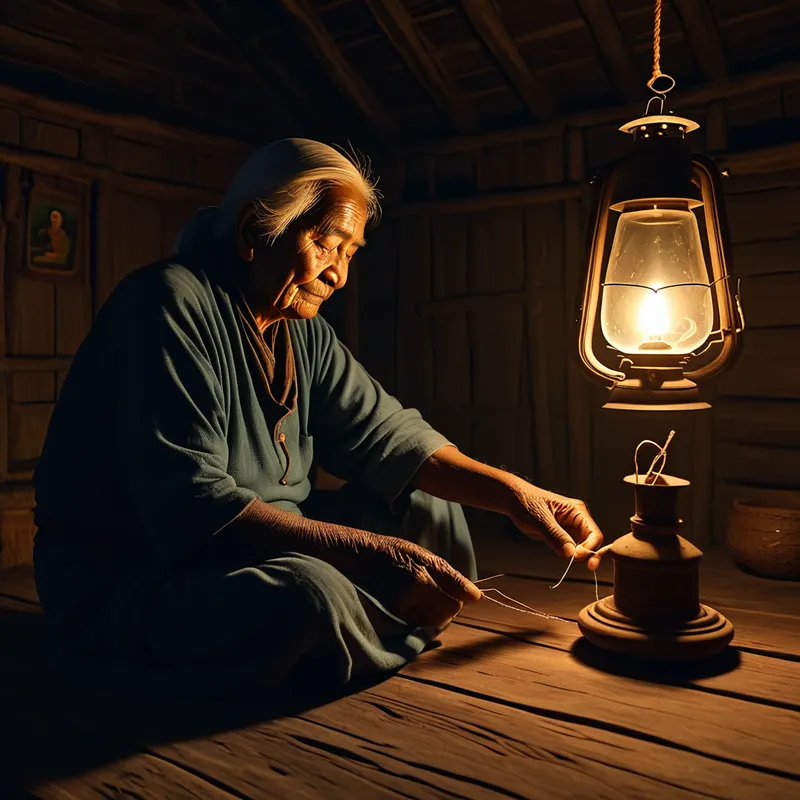
While Perun battled chaos from the mountaintops, and Veles slithered through the hollows, Mokosh sat at the center of all things. In the quiet of the home, in the sacred corner where the icons would later dwell, her presence was a warm stone. Women knew her in the pull of the flax, in the turning of the spindle that sang a thin, high song. They felt her in the ache of childbirth and the fierce protectiveness that followed. She was the moisture in the soil, the sap in the tree, the milk in the breast.
Her tale is not one of battle, but of relentless, patient creation. Each life was a thread drawn from the cloud-wool of potential. Her fingers, stained with soil and berry juice, would spin it—some threads strong and golden as summer sun, others short and frayed, dark as a winter night. These threads she wove into a vast, living tapestry that hung between the roots of the Tree and its highest branches. This was the cloth of fate. The pattern was complex, beautiful, and terrible, for it held every birth cry, every love whispered in the rye, every final sigh returned to her dark lap.
She measured not with a ruler, but with the rhythm of the seasons. She cut not with shears, but with the silent turning of time. And when a thread reached its end, it did not vanish. It was gathered back into her basket, a skein of memory and essence, to be perhaps spun anew when the world took another breath. Her story has no end, for it is the hum of the spinning wheel that underlies all other sounds—the true song of the world, steady, generative, and utterly complete in its endless making.
Cultural Origins & Context
Mokosh stands as one of the most enduring and significant figures in the reconstructed Slavic pantheon, uniquely listed among the seven idols erected by Prince Vladimir in Kyiv before the Christianization of Kyivan Rus’. This historical note, from the Primary Chronicle, places her alongside gods like Perun, confirming her supreme importance in official, state-sponsored worship. Unlike many Slavic deities whose traces are faint, Mokosh’s veneration was widespread, from the Baltic Slavs to the Eastern Slavic tribes.
Her worship was profoundly domestic and feminine-centric. She was the guardian of women’s work—spinning, weaving, childbirth, and the fertility of the land. Rituals for her were likely conducted in the home, at household shrines, or in sacred groves and near water sources, reflecting her connection to moisture and growth. Friday was considered her sacred day, a tradition that persisted into the Christian era where she was syncretized with Saint Paraskeva-Piatnitsa, the protector of women and weaving. This seamless transition from goddess to saint speaks to the deep, non-negotiable need her archetype fulfilled in the Slavic psyche. She was not a deity of distant myth, but an intimate, daily presence governing the most essential cycles of life, death, and sustenance.
Symbolic Architecture
Mokosh is the archetypal embodiment of the Mater Terra, the generative and all-receiving Earth. Her symbols form a powerful triad of meaning: the Spindle, the Earth, and Moisture.
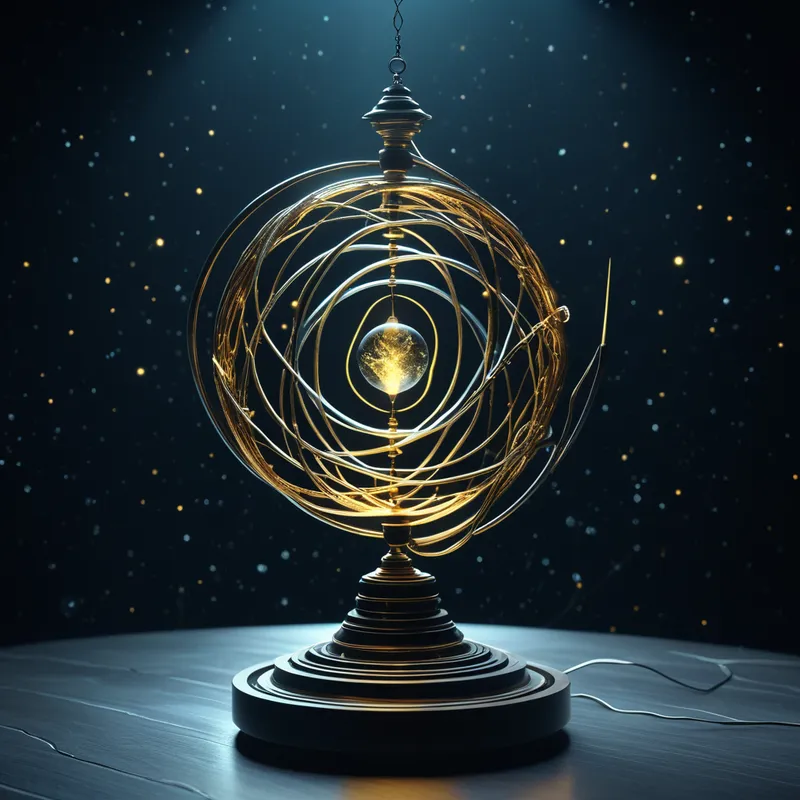
The spindle is the axis of fate; its rotation draws the unmanifest into form, spinning the raw potential of the cosmos into the specific thread of a single life.
Her spindle represents the active, formative principle of destiny. It is not a predetermined script, but the very act of creation—pulling the intangible (clouds, wool, spirit) into a tangible, linear reality (thread, life, time). The Earth she personifies is not inert dirt, but the living, breathing body of the world—the source, the sustainer, and the final resting place. It symbolizes the unconscious itself: dark, fertile, and containing all potential forms. Moisture (mok- in her name relates to words for ‘wetness’) is the essential medium of this fertility. It is the sap, the blood, the milk, the rain—the fluid of life that connects and animates all things.
Psychologically, Mokosh represents the Self in its aspect as the ground of being. She is the psychic substrate from which ego-consciousness emerges and into which it must eventually return. Her weaving signifies the ego’s life as a single thread within the larger, incomprehensible pattern of the Self’s unfolding. She governs the instinctual, bodily wisdom of the feminine principle—not as a passive vessel, but as the active, shaping force of nature and destiny.
The Dreamer's Resonance
To dream in the pattern of Mokosh is to encounter the deep, somatic intelligence of the body and the unconscious. Such dreams often feature potent, non-verbal symbols: feeling rich, dark soil in one’s hands; discovering a forgotten, humming spindle in a basement or attic; seeing a vast, intricate tapestry whose pattern shifts and changes; or standing in a field where one can feel the growth of the roots beneath.
These visions signal a process of re-grounding. The dreamer may be overly identified with the “sky” principles of intellect, spirit, or ambition (Perun), or entangled in the “underworld” of hidden complexes, fears, or material obsessions (Veles). Mokosh calls for a return to center—to the body, to the rhythms of nature, to the patient, creative work of crafting one’s own life-thread with conscious care. The somatic feeling is often one of deep, resonant fullness, a humming vibration of potential, or the profound peace of being held and supported. It can also manifest as a fierce, protective energy, especially in dreams where one is safeguarding something vulnerable (a child, a project, a nascent idea). The dream is an invitation to acknowledge the silent, weaving intelligence within that knows the pattern of your becoming.

Alchemical Translation
The alchemical work modeled by Mokosh is the opus contra naturam—the work against nature—which here means the conscious cultivation and spiritualization of the very instincts and natural processes she governs. It is the transformation of blind fate into conscious destiny.
The first stage is Submission to the Soil: acknowledging one’s roots, one’s inherited patterns, bodily limitations, and the “given” threads of one’s life (family, culture, innate talents). This is the nigredo, the black earth, requiring humility and the dissolution of ego-inflation.
The second is the Spinning: the conscious life act. Here, the raw material of experience—joy, grief, success, failure—is not merely endured but actively drawn out and spun into the thread of one’s character. This is the albedo, the whitening, where one takes responsibility for weaving their experiences into a coherent narrative. The spindle is the focused attention of consciousness applied to the wool of daily life.
The final transmutation is realizing you are not just the thread being spun, but also the hand that spins, the eye that measures, and the silent presence that holds the basket of all possibilities.
The triumph is Becoming the Weaver. This is the rubedo, the reddening or gold-making. The individual no longer feels victim to fate (the tapestry) but recognizes their participatory role in its creation. One aligns personal will with the deeper pattern of the Self. Mokosh’s myth teaches that individuation is not an escape from nature or fate, but a profound collaboration with it. We heal by grounding into our essential nature, we transform by consciously crafting our thread, and we find meaning by trusting we are part of a weaving whose full beauty we can never see, but whose integrity we can feel in the hum of our own creative work.
Associated Symbols
Explore related symbols from the CaleaDream lexicon:
- Earth — The primary body and domain of Mokosh, representing the fertile, unconscious ground of being from which all life emerges and to which it returns.
- Fate — The complex tapestry woven by Mokosh, symbolizing the interconnected pattern of destiny that she spins, measures, and cuts.
- Goddess — The supreme feminine divine principle embodied by Mokosh, encompassing creation, sustenance, fate, and the sacredness of women's crafts and cycles.
- Thread — The individual life or destiny spun by Mokosh, representing the linear path of a soul's experience drawn from the formless potential.
- Tree — The world axis connecting the realms, under whose roots Mokosh often resides, symbolizing her connection to the foundational, sustaining structure of reality.
- Water — The essential moisture and fertility associated with Mokosh's name and function, representing the fluid of life, intuition, and emotional nourishment.
- Circle — The turning spindle and the cyclical nature of life, death, and rebirth that Mokosh governs, representing wholeness, eternity, and natural law.
- Mother — The nurturing, protective, and generative aspect of Mokosh as the Earth Mother, source of all sustenance and unconditional, fierce love.
- Harvest — The fruitful outcome of Mokosh's fertility, representing the tangible results of her care, the rewards of labor, and the cyclical nature of abundance.
- Shadow — The dark, fertile, chthonic aspect of Mokosh as the receiver of the dead, representing the unconscious, the unknown, and the transformative power of decay.