Mnemosyne's Daughters Myth Meaning & Symbolism
The nine Muses, born from the union of Memory and the Sky, are the divine sources of all art, science, and knowledge in the ancient world.
The Tale of Mnemosyne's Daughters
Before the world knew its own name, when the sky was a raw, aching blue and the earth still trembled with newness, there was a silence. It was not an empty silence, but a pregnant one, heavy with all that had been and all that was yet to be sung. In this time, the great Titans held sway, and among them was Mnemosyne. She was not a goddess of stone or storm, but of the inner landscape—the vast, echoing cavern of remembrance where every laugh, every tear, every whispered secret of the cosmos was stored.
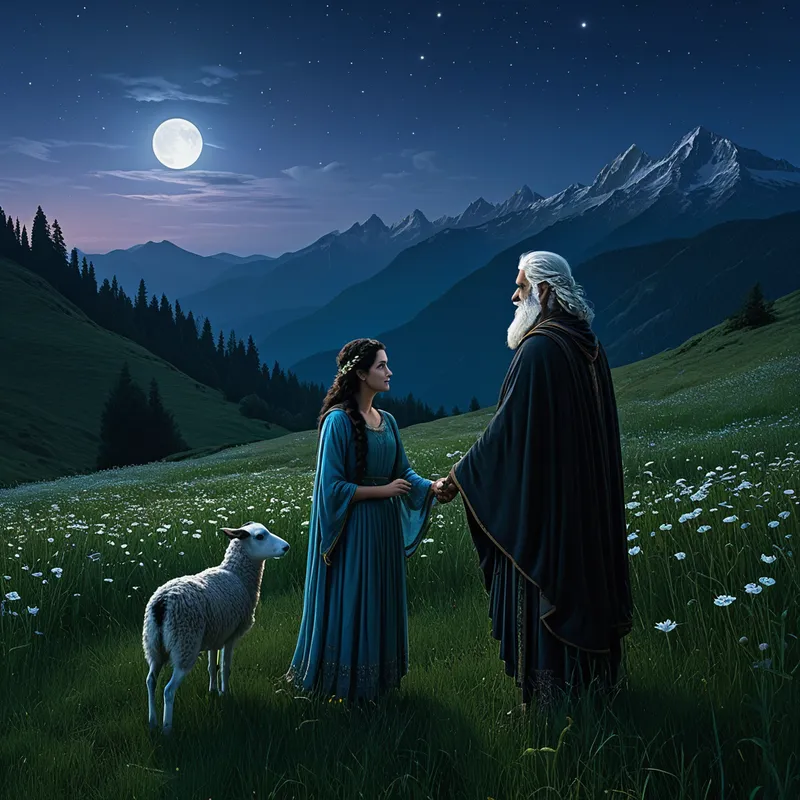
The King of the Gods, Zeus, whose will shaped mountains and rivers, looked upon this deep well of the past and saw not just history, but potential. He saw that memory alone was a tomb. To bring its treasures to life, it needed breath. It needed voice. So, he came to Mnemosyne, not as a thunderer, but as a shepherd of souls, and for nine nights, under a canopy of endless stars, the Sky courted the Memory of the world.
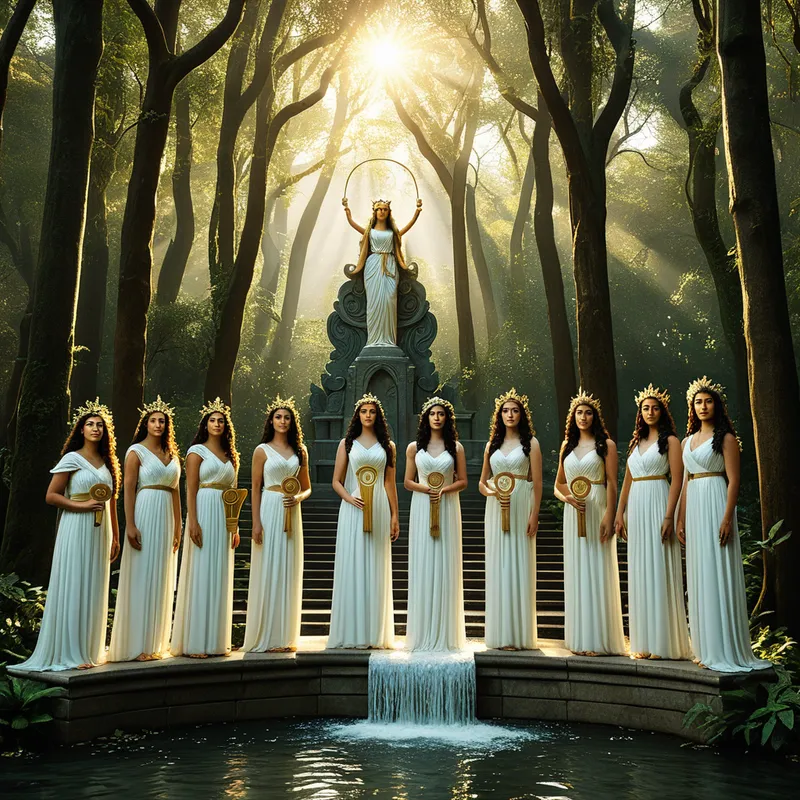
From that sacred union, a new kind of divinity was born. Not one child, but nine. They did not arrive with the clamor of battle, but emerged like the first notes of a melody from the silence. They were the Muses, Mnemosyne’s daughters. Each was a distinct facet of the creative spirit that memory could spark.
First came Calliope, her brow fair, holding a stylus and tablet, ready to inscribe the grand tales of heroes and gods. Then Clio, with her scroll, keeper of chronicles. Erato followed, tender with her lyre, and Euterpe with her flute, whose music could make stones weep. Melpomene bore the solemn mask, while Thalia held the laughing one. Terpsichore moved with immortal grace, Urania gazed at the heavens with her globe and compass, and Polyhymnia, veiled and contemplative, stood in silent meditation.
They made their home on Mount Helicon or near the Hippocrene, the spring struck by the hoof of Pegasus. Where they walked, the dry ground sprouted laurel, and the very air hummed with possibility. They were the breath that animated the clay of memory. To them, the poets, the astronomers, the playwrights, and the dancers would pray, not for raw facts, but for the spark—the divine madness that transforms remembered feeling into a song that can outlast empires.
Cultural Origins & Context
The myth of Mnemosyne and her daughters is woven into the very fabric of ancient Greek cultural identity. It is primarily preserved in the foundational texts of Hesiod’s Theogony and in the opening hymns of epic poets like Homer, who famously begins the Iliad by invoking the Muse. This was not mere poetic convention; it was a theological and psychological statement. The myth served a critical societal function: it explained the origin and sanctity of human creativity and knowledge.
In a pre-literate and oral culture, memory was the primary vessel of history, law, and identity. Mnemosyne, as a Titan, represented this foundational, pre-Olympian power—the raw data of existence. The Muses, fathered by the Olympian Zeus, represent the civilized, structured, and beautiful expression of that data. The myth thus narrates the transition from chaotic potential to cultured creation, legitimizing the arts and sciences as divine gifts essential to a functioning civilization. Bards (rhapsodes) were not mere entertainers; they were priests of the Muses, channels through which collective memory was shaped into narratives that defined a people.
Symbolic Architecture
At its core, this myth is a profound map of the creative psyche. Mnemosyne symbolizes the collective unconscious—the vast, impersonal reservoir of human experience, archetypes, and latent memories. She is the storehouse of all that has ever been felt or known.
Creativity is not born from a void, but from the fertile soil of all that we have forgotten we remember.
Zeus represents the focused, lightning-strike of conscious will and ordering principle. Their union is the essential alchemy: the moment when conscious intention (the ego, or the seeking mind) delves into the deep unconscious and calls forth its contents. The nine Muses are the personified results of this union—the specific, intelligible forms that raw psychic energy takes when it is brought into the light of awareness. They are not the memories themselves, but the inspiration to transform memory into art, science, and understanding. They represent the differentiation of a unified creative impulse into the specialized domains of human cultural endeavor.
The Dreamer's Resonance
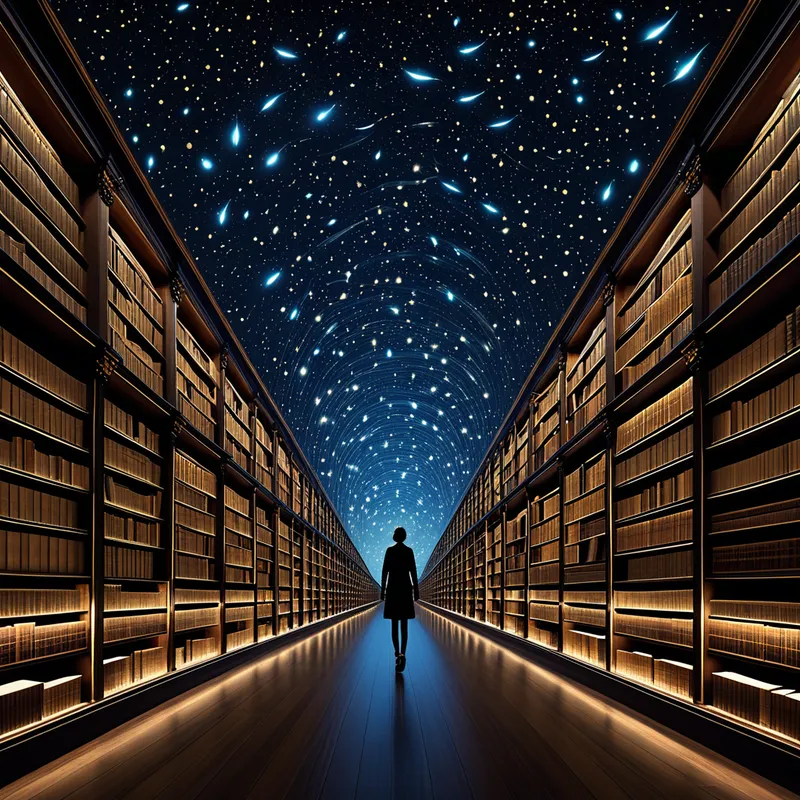
When this mythic pattern stirs in the modern dreamer, it often signals a profound engagement with the wellsprings of personal and ancestral creativity. One might dream of discovering a hidden room full of forgotten books or artifacts, of hearing a beautiful but indistinct song from a hidden source, or of meeting a group of enigmatic guides who each offer a different tool or symbol.
Somnatically, this can feel like a pressure in the chest or a buzzing in the head—a sense of something "wanting to be born." Psychologically, it is the process of the unconscious becoming active and seeking expression. The dreamer may be on the cusp of a creative breakthrough, a new career path, or a deep intellectual pursuit. The "Muses" in the dream represent the various potential forms this new psychic content could take. The conflict or awe in the dream mirrors the ego's negotiation with these powerful, autonomous forces from within. It is the psyche’s way of rehearsing the act of inspiration, of learning to listen to the daughters of one’s own inner Mnemosyne.
Alchemical Translation
The journey of individuation, the process of becoming psychologically whole, is mirrored perfectly in this myth. We all begin with our personal Mnemosyne—a mass of unprocessed memories, inherited patterns, and unconscious complexes. This is our latent potential, often felt as a burden or a vague longing.
The alchemical work begins with the "Zeus" aspect of the psyche: the conscious, disciplined ego that must actively choose to engage with this depth. This is the hard work of introspection, therapy, or dedicated practice. The nine-night union is the sustained, often difficult, period of inner work where consciousness dialogues with the unconscious.
The goal is not to possess the Muses, but to be a worthy vessel for their visitation.
The resulting "birth" is not one single solution, but a differentiation—the emergence of multiple new capacities, insights, and creative energies (the Muses) that enrich the personality. One does not become a Muse; one becomes a person whose life is inspired by them. The integrated individual is like Mount Helicon: a grounded, earthly presence from which the sacred springs of diverse creativity flow. They have learned to honor Memory not as a static archive, but as the living mother of all that they are yet to bring, beautifully and skillfully, into the world.
Associated Symbols
Explore related symbols from the CaleaDream lexicon: