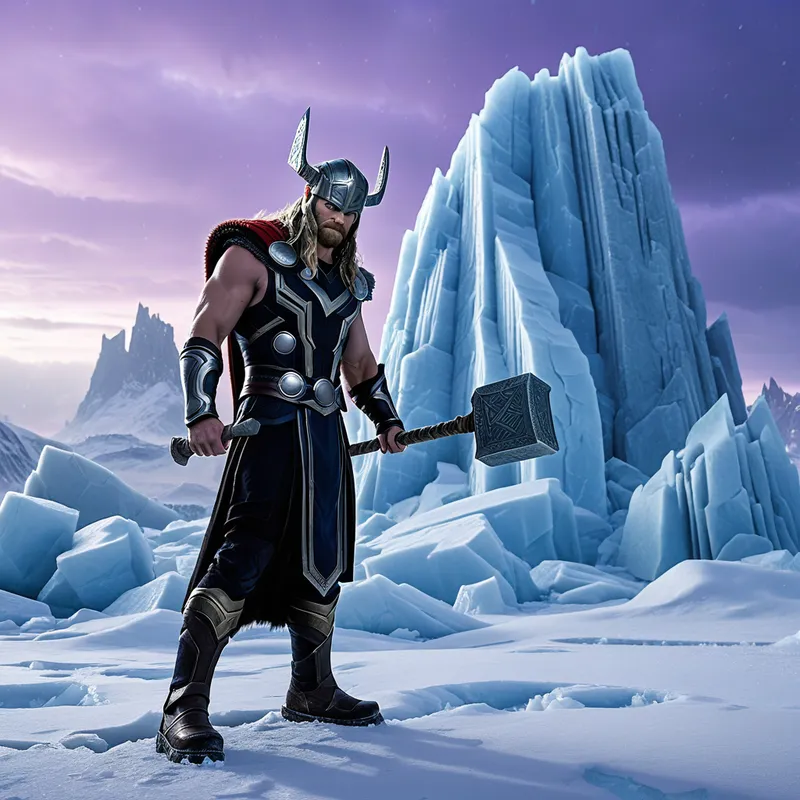
Mjölnir's Strap Myth Meaning & Symbolism
The tale of Thor losing his hammer and the cunning journey to reclaim it, a myth of lost power, strategic transformation, and the necessity of disguise for victory.
The Tale of Mjölnir's Strap
Hear now, a tale not of glory first won, but of power lost and cunningly reclaimed. It begins not in the golden light of Asgard, but in the deep, dreaming sleep of the Thunderer.
Thor slept, and his sleep was the sleep of mountains. Beside him, never parted, lay Mjölnir, its short handle wrapped in the iron grip of his hand. But in that unguarded moment, a shadow moved. It was Þrymr, lord of the frost giants, whose greed was as vast as the wastes he ruled. With a thief’s silent breath, he stole the hammer from the god’s side and bore it away to Jötunheimr, burying it eight leagues deep beneath the grinding ice.
Thor awoke to a hollow dread, a lightness in his hand where terrible weight should be. His roar of rage shook the halls of Asgard, but the hammer did not answer. His power, the very definition of his being, was gone. The gods gathered in the shadow of Yggdrasil, their faces grey with fear. Without Mjölnir, Asgard stood defenseless against the rising tide of giants.
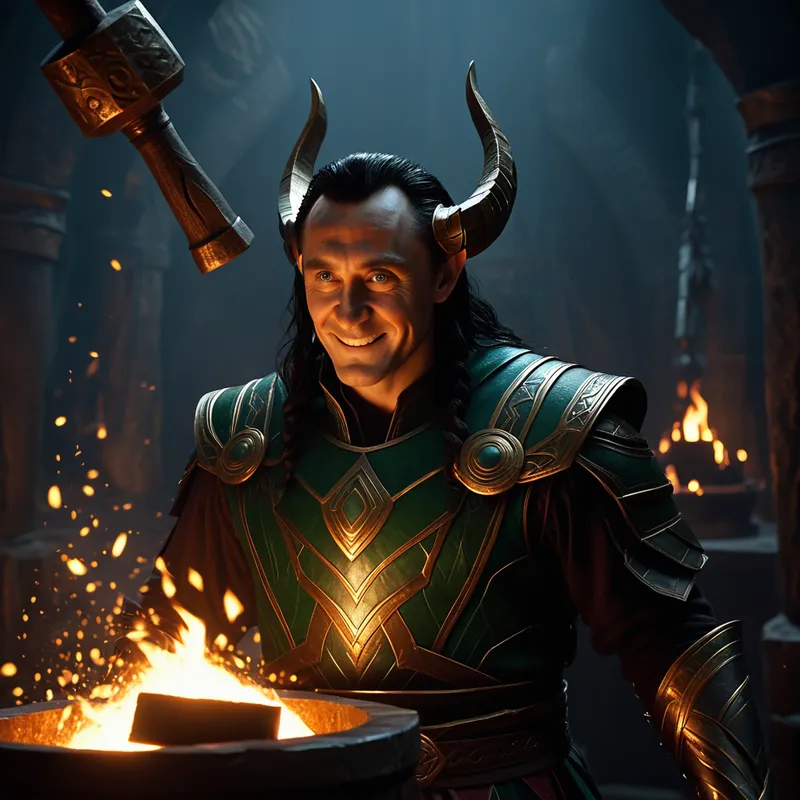
Then spoke Loki, his voice a silver thread in the gloom. "I will find it," he said, and borrowing the feather-cloak of Freyja, he flew on whispered winds to the land of frost. He found Þrymr in his high hall, gloating upon his throne. "I have hidden Thor’s might," the giant boasted. "And I will return it for one price only: the hand of Freyja as my bride."
The message brought despair. Freyja refused with such fury her necklace, Brisingamen, shattered. But Heimdallr, the watchful one, saw a path where others saw a wall. "Let Thor go," he said, his eyes like distant stars. "Let him go as the bride."
So began the great disguise. They dressed the thunder god in Freyja’s finest gown, hid his fierce eyes behind a veil, and placed the necklace upon his broad chest. Loki, as the bridesmaid, accompanied him. The journey to Jötunheimr was a torment. Thor, who crossed rivers by striding, now rode in a chariot. At the wedding feast, the "bride" devoured an entire ox, eight salmon, and three casks of mead, while Loki explained away the appetite as love-longing.
When Þrymr, his heart swelling, leaned in to steal a kiss beneath the veil, he reeled back from the fire in the bride’s eyes. Again, Loki soothed: "Freyja has not slept for eight nights, so eager was she for this union." Convinced, the fool giant ordered the bridal gift brought forth to hallow the marriage. His servants staggered under the weight of Mjölnir, laid upon the bride’s lap.
The moment the worn leather strap touched his hand, the disguise fell away like a shed skin. Thor’s laughter was the crack of the world’s end. His fingers closed, and the hall knew thunder. The feast ended not in a wedding, but in the old, red language of the hammer, as Thor reclaimed his might and left the giants broken in the ice.
Cultural Origins & Context
This myth, known as Þrymskviða (The Lay of Thrym), survives in the Poetic Edda. It was a story for the long winter nights, a poem recited in smoky halls where the cold outside was a tangible enemy. Its function was multifaceted. On one level, it was a divine comedy, a favorite tale of the mighty Thor brought low and forced into absurdity, reassuring listeners that even the gods faced humiliation and overcame it.
On a deeper level, it was a myth of cultural anxiety. The hammer was not merely a weapon; it was a sacred object used to hallow, to consecrate, and to protect. Its loss symbolized the ultimate vulnerability—the failure of the protective order. The story’s resolution through cunning (Loki) and a willingness to endure transgression (Thor’s cross-dressing) rather than pure force, reflects a pragmatic Norse worldview. Victory sometimes requires strategy and a temporary suspension of pride. The skalds who told this tale were not just entertainers but custodians of psychological and societal logic, teaching that power must sometimes be recovered through indirect, even embarrassing, means.
Symbolic Architecture
The myth is a masterclass in the symbolism of integrated power. Mjölnir is the archetypal symbol of directed, creative force—the will made manifest. Its loss represents a profound psychological crisis: the dissociation from one’s own core strength and purpose.
The strap is the covenant between will and action; when it is severed, power becomes a dead weight, buried in the unconscious.
Thor, the hero archetype of raw strength, is rendered impotent. His journey to Jötunheimr disguised as Freyja, the lover archetype, is a profound alchemical marriage. To reclaim his masculine, assertive power (the hammer), he must temporarily embody its opposite: receptivity, disguise, and allure. This is not a permanent change but a necessary integration. The giant Þrymr represents the inflated, greedy ego that seeks to possess power (the hammer) without understanding its nature, burying it in the frozen ground of literalism and possession. Loki, the trickster and shape-shifter, is the psychic function of adaptability and cunning intelligence, the only force that can navigate the shadowlands to locate what is lost.
The Dreamer's Resonance
When this myth pattern stirs in the modern dreamer, it speaks of a season of lost agency. You may dream of a crucial tool breaking, a car without brakes, or a voice that cannot scream. This is the somatic echo of Thor’s empty hand. The dreamer is experiencing a theft of their own "hammer"—their confidence, their voice, their capacity to affect their world.
The subsequent dreams often involve humiliating disguises or impossible tasks—showing up to work in pajamas, arguing without sound. This is the psyche’s staging of the necessary "bridal journey." It signals that the old, direct method of reclaiming power ("storming the fortress") has failed. The dream-ego is being forced into a state of creative adaptation. The frustration and shame felt in the dream are the price of the ticket. The moment of resolution, if the process is allowed, is the dream of finally grasping the lost object, often with a surge of immense relief and awakened energy. It is the strap restored.
Alchemical Translation
The individuation process modeled here is the recovery of the empowered Self after a crisis of identity. The "hammer" is the unique, authentic power of the individual. Life—through failure, betrayal, or trauma—can steal it, burying it in the frozen ground of depression, anxiety, or projection (the giants).
The alchemical work is not to become Freyja instead of Thor, but to allow Thor to wear Freyja’s clothes long enough to cross the threshold.
The modern individual must undertake their own journey to Jötunheimr—the cold, foreign landscape of the unconscious and the rejected parts of the self. This requires the "Loki" function: a flexible, observant, and amoral curiosity about one’s own shadows and defenses. It absolutely requires the "Thor" function to endure the humiliation of the disguise—to willingly adopt the role of the powerless, the attractive, the receptive, or the deceptive if that is what the situation demands for recovery.
The triumphant grasp of the hammer is the moment of reintegration. The reclaimed power is not the same; it is now informed by the journey. The god who returns is one who knows strategy as well as strength, who understands disguise as well as direct force. The strap, once taken for granted, is now known as the vital ligament connecting the Self to its might. The process teaches that true power is not just force, but the wisdom to know when and how to wield it—and the cunning to get it back when it is lost.
Associated Symbols
Explore related symbols from the CaleaDream lexicon: