MjölnirAmulet Myth Meaning & Symbolism
The story of how the trickster Loki's meddling leads to the flawed yet sacred creation of Thor's hammer, a symbol of consecrated power born from imperfection.
The Tale of MjölnirAmulet
Hear now a tale from the age when the worlds were young, when the breath of giants still frosted the roots of Yggdrasil. It begins not with a roar of thunder, but with a boast, and a trickster’s grin.
In the golden halls of Asgard, the gods sat in splendor, yet a shadow lay upon them. Loki, the shape-shifter, the bringer of fire and folly, had sheared the radiant hair of Sif, wife of mighty Thor. Her golden tresses, which were the very image of ripened wheat fields, lay shorn upon the floor. Thor’s rage was a gathering storm, his knuckles white upon the shaft of a lesser hammer. To save his own skin, Loki swore an oath: he would journey to the realms beneath and procure for Sif hair of living gold, finer than before.
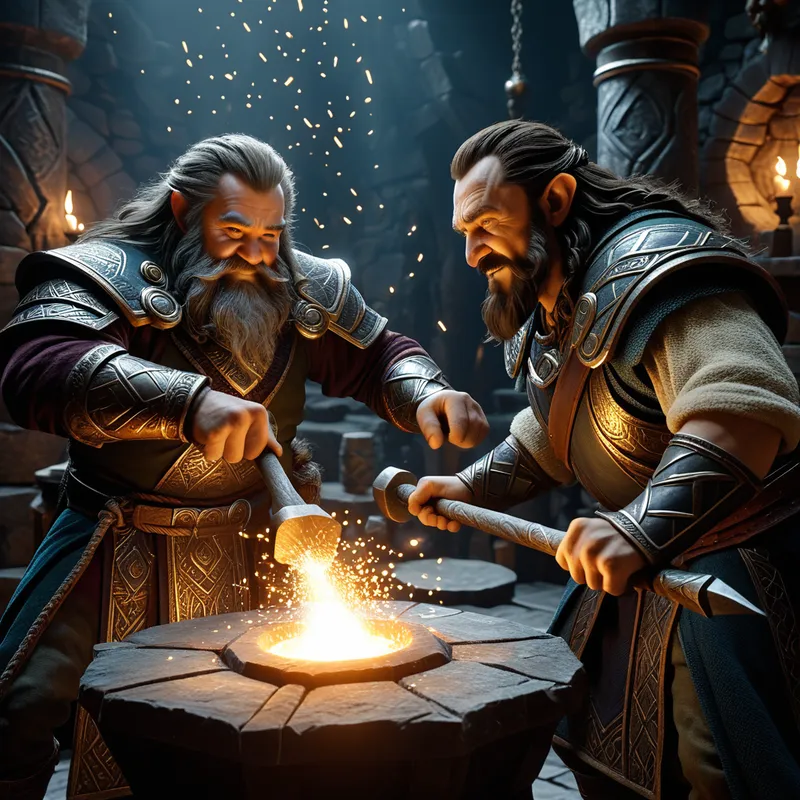
He descended to the world of the dvergr, the dwarves, in their sunless forges where the heart of the mountain beat with fire. From the sons of Ivaldi, he commissioned not only the hair, but a ship that could fold into a pocket, and a spear that never missed its mark. Pleased with his cunning, Loki then wagered his own head with the master smiths Brokkr and Eitri, boasting that their craft could never match these wonders. The dwarves, their pride stung, accepted. “We shall make three gifts,” growled Brokkr, “that will make the gods forget your trinkets. But you must not disturb our work.”
The forge of Brokkr and Eitri was a place of primordial song. Eitri laid in the hearth a pig’s skin and commanded Brokkr to work the bellows without cease, no matter what transpired. As the fire roared and the metal sang, a fly—Loki in disguise—landed on Brokkr’s hand and bit him fiercely. The dwarf did not flinch. From the fire, Eitri drew forth Gullinbursti, a living boar of gold that shone in the dark and could run across sky and sea.
Next, Eitri threw gold into the hearth. Again the bellows roared, and again the fly came, biting Brokkr’s neck until blood flowed. Still, the dwarf pumped on. From the flames came Draupnir, a ring of multiplying gold.
Then came the final and greatest work. Eitri cast into the fire a block of iron, a metal born from the blood of the earth itself. “Now, brother,” he intoned, “do not falter. For here we forge the might of the gods themselves.” Brokkr pumped, the flames turning white-hot. The fly, desperate, now landed between Brokkr’s eyes and bit his eyelid so deep that blood blinded him. For one crucial moment, Brokkr’s hand slipped to wipe the blood away. The bellows sighed.
Eitri pulled the form from the anvil. It was a hammer of immense power, its head perfectly forged, etched with runes of binding and breaking. But its handle was… stunted, too short by a grip. A flaw born from that single moment of interruption. They named it Mjölnir.
Before the gods, the gifts were presented. The sons of Ivaldi’s works were marvels. But Brokkr and Eitri unveiled theirs: the boar, the ring, and the hammer. The gods convened. Odin took the spear and the ring. Freyr took the ship and the boar. And Thor, his eyes alight, took the hammer. They judged: for its power to defend Asgard, to consecrate and to protect, the flawed hammer was the greatest gift of all.
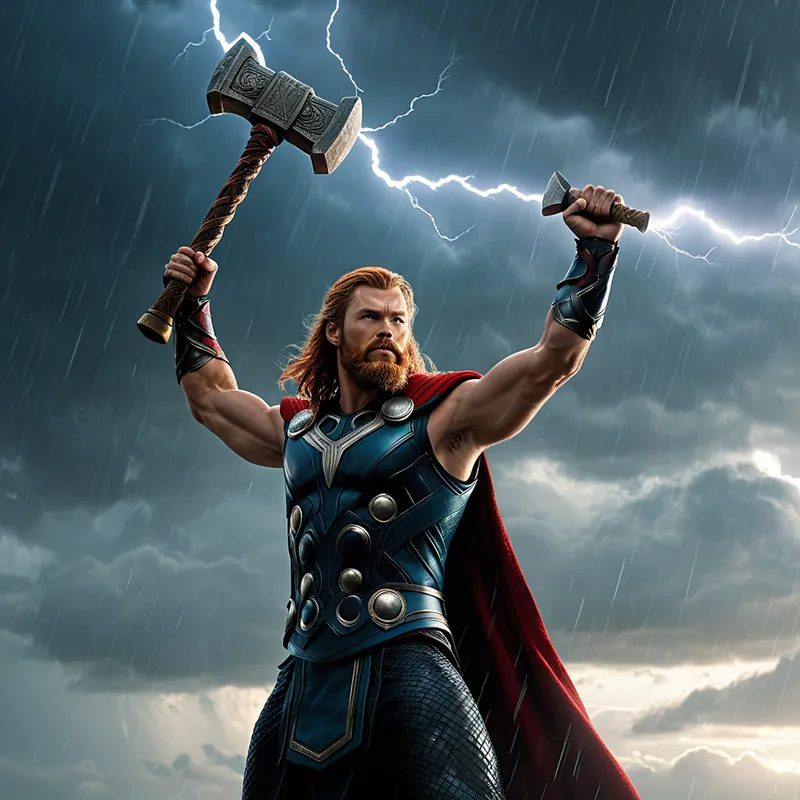
Loki, having lost his wager, fled on his magic shoes. But Thor caught him. The dwarf Brokkr, seeking his prize of Loki’s head, was tricked again—the trickster’s neck was not part of the deal. So Brokkr sewed Loki’s lips shut with a thong, a temporary silence for the eternal schemer. And Thor lifted his new hammer, its short handle firm in his grasp, and the first peal of thunder rolled out across the nine worlds, a declaration: from imperfection, sacred power is born.
Cultural Origins & Context
This myth, known as the “Treasures of the Gods” or the “Creation of MjölnirAmulet,” is preserved primarily in the Skáldskaparmál of the Prose Edda by Snorri Sturluson. It is a foundational etiological myth, explaining the origin of the gods’ most powerful artifacts. Its transmission was likely both poetic, through the complex kennings of skaldic verse, and prose, as part of the oral storytelling tradition around hearths and in halls.
Societally, it functioned on multiple levels. For a culture of master craftsmen, it underscored the sacred nature of smithing and the high stakes of a craftsman’s reputation. The narrative also reinforced core values: the importance of oath-keeping (Loki’s bargain), the dire consequences of insult (to Sif and the dwarves), and the ultimate pragmatism of the gods. The hammer, despite its flaw, was chosen for its utility in the ongoing struggle against the jötnar. This reflects a Norse worldview where function, resilience, and protective power were valued over unattainable perfection. The myth served as a divine precedent for finding profound worth and strength within inherent limitations.
Symbolic Architecture
At its heart, the myth of MjölnirAmulet is an alchemical drama of creation under duress. The hammer is not a symbol of brute force alone, but of consecrated force. Its power to hallow, to bless marriages and protect boundaries, is as crucial as its power to destroy. The flaw—the short handle—is not an accident but an integral part of its identity, born from the interference of chaos (Loki) in the process of order (the dwarves’ craft).
The sacred is not born in sterile perfection, but in the fiery crucible where intention meets interruption, where the flaw becomes the feature that defines its holy function.
Psychologically, Loki represents the shadow and the trickster archetype—the unconscious, disruptive element that inevitably infiltrates any conscious act of creation or order. Brokkr’s momentary falter is the inevitable human (or divine) lapse in focus, the intrusion of pain, distraction, or fallibility. MjölnirAmulet thus becomes a symbol of the ego’s tool for consciousness: a will or a focus forged in the unconscious, powerful and potent, yet inherently limited and requiring immense strength (Thor) to wield effectively. It is the power of conscious action, born flawed yet destined for a sacred purpose.
The Dreamer's Resonance
When this myth pattern stirs in the modern psyche, it often manifests in dreams of flawed or malfunctioning tools of great importance—a key that doesn’t turn smoothly, a pen that writes erratically yet creates masterpieces, a weapon with a crack that somehow holds. The somatic sensation is often one of immense latent power in the hands, coupled with frustration or adaptation.
To dream of forging such an object suggests the dreamer is in a potent creative or transformative phase, where an external “Loki-like” influence (a distraction, a criticism, an unexpected life event) is perceived as ruining the “perfect” outcome. The dream of receiving or being given the flawed hammer points to the acceptance phase. The psyche is presenting a new capacity or strength—perhaps a talent, a boundary, or a resolve—that feels imperfect or difficult to manage (“too short a handle”), but which is recognized as profoundly necessary for one’s defense and integrity. The emotional tone shifts from disappointment to a grim, powerful determination.
Alchemical Translation
The individuation process modeled here is the transmutation of the “flawed creation” into the “sacred implement.” We all, in our development, craft our identities, our careers, our relationships—our personal “hammers.” And inevitably, the trickster of the unconscious, or the simple reality of life’s interruptions, introduces a flaw. We are left with a sense of incompleteness: the career path that took a detour, the relationship that bears scars, the talent that isn’t “perfect.”
The alchemical work is not to re-forge the handle—the myth offers no suggestion this is possible. The work is Thor’s work: to take the flawed instrument and, through acceptance and immense personal strength, dedicate it to a sacred purpose.
Individuation is the process of consecrating your imperfections, wielding your uniquely shaped power not in spite of its limitations, but through them, to hallow the space of your own life.
First, we must acknowledge the Loki within—the chaotic, sabotaging, or simply mischievous parts of our nature that contributed to the flaw. Then, we must pump the bellows of our effort (Brokkr’s labor) despite the bites of distraction and pain. When the flawed tool is presented, we must, like the council of the gods, judge it not by an abstract ideal, but by its ultimate utility for our soul’s defense and its capacity to bless our world. MjölnirAmulet teaches that our most powerful spiritual tool is often the one we consider broken, for its very imperfection requires a deeper, more conscious, and more sacred relationship to power itself. We do not wield perfection; we wield what is truly ours, and in that act of conscious wielding, we become thunder.
Associated Symbols
Explore related symbols from the CaleaDream lexicon: