Mizuhiki Myth Meaning & Symbolism
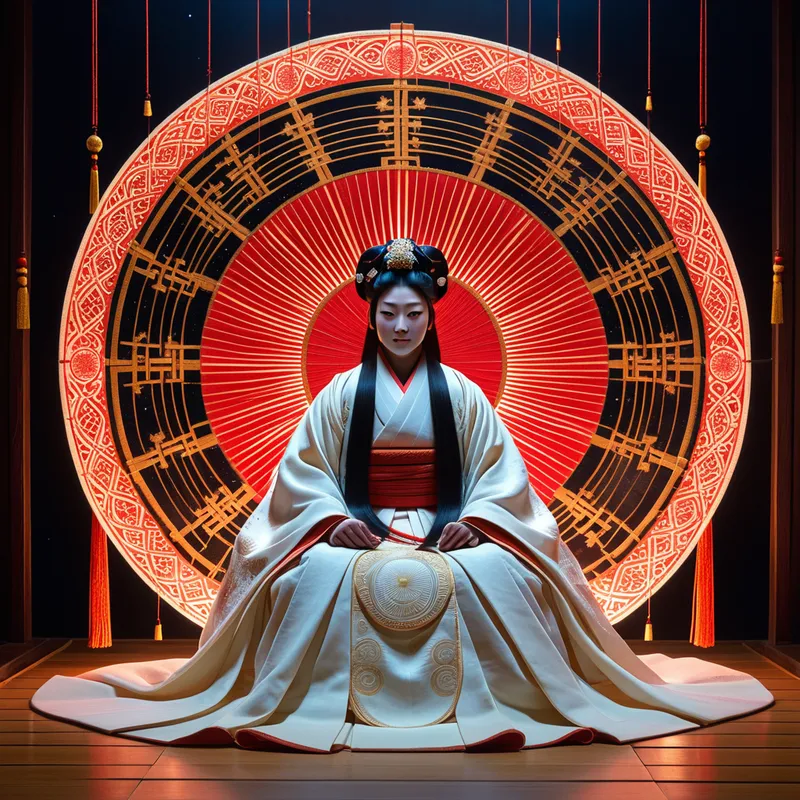
The myth of the sacred cord that binds souls, spirits, and destinies, weaving the visible and invisible worlds into a single, unbreakable fabric of existence.
The Tale of Mizuhiki
In the age when the world was still soft, when the breath of the kami still misted the mountains and the first words of humanity were whispers caught in bamboo groves, there was a silence at the heart of things. It was not an empty silence, but a pregnant one, full of potential connections that had not yet been spoken, of relationships not yet formed. The islands floated, beautiful and solitary, in the great sea.
It was then that Amaterasu-Ōmikami, the Sun Goddess, radiant in her heavenly weaving hall, looked upon the world below. She saw the people, her children, moving like lonely sparks in the dusk. They built, they loved, they grieved, but their joys and sorrows seemed to dissipate like morning fog, leaving no trace in the tapestry of eternity. Their bonds to one another, to the land, to the spirits of rock and stream, were fleeting, fraying with each setting sun. A profound sorrow touched her heart, a sorrow for the impermanence of connection.
She called to her side the kami of the deep earth and the cunning craftsman, Ōgetsuhime, and the steadfast Sukunahikona. From the loom of heaven, she drew forth strands of her own light, threads of sunbeam and dawn. Ōgetsuhime brought fibers from the heart of the ancient paper mulberry tree, pulped with the purest waters of hidden mountain springs. Sukunahikona gathered the resilience of rice straw and the supple strength of sea-grass.
Together, at the threshold where the Floating Bridge of Heaven meets the earthly air, they began to weave. Their fingers moved not with the haste of creation, but with the solemn rhythm of a sacred vow. They twisted the celestial light with the earthly fiber, the divine with the mortal, the eternal with the ephemeral. As they worked, they sang—a song without words that held the meaning of "link," "tie," "honor," and "continuance." The cord that formed was neither rope nor thread, but something else entirely: a manifest intention. It glowed with a soft inner light, its surface a perfect spiral of white and crimson, the colors of purity and vibrant life.
Amaterasu took the first length of this cord, this Mizuhiki, and descended. She found two young lovers, parted by a clan feud, their hearts aching across a river. She guided their hands to tie a simple knot in the cord, a promise. The moment the knot was secured, they did not just see their love; they felt the shape of it, a tangible truth between them. She visited a master and his anxious apprentice, and with a loop and a twist, she bound their respect and duty into a visible form. She went to a family grieving a loss, and with a complex, beautiful knot, she showed them how the departed was not severed, but their bond transformed, its pattern forever part of the family's weave.
Wherever a true connection was meant to be—between people, between a person and a kami, between a promise and its fulfillment—a length of this sacred cord would appear, not to bind, but to make visible the bond that already, invisibly, existed. The world was no longer a collection of solitary sparks. It became a vast, shimmering net of Mizuhiki, each knot a story, each strand a relationship, glowing softly in the twilight of the world, a testament that nothing of true meaning is ever truly alone.
Cultural Origins & Context
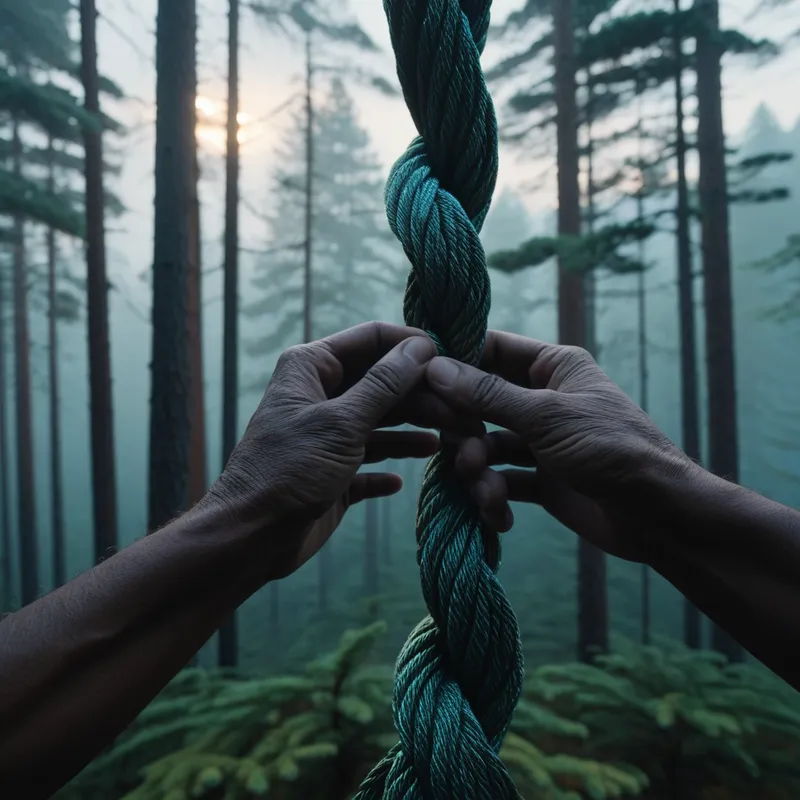
The myth of Mizuhiki is woven from the very fabric of Shinto and East Asian cosmological thought, rather than being a single, codified narrative from a text like the Kojiki or Nihon Shoki. It is an mukashibanashi (old tale) that evolved to explain and sanctify a profound material practice. Historically, the art of Mizuhiki—creating intricate cords from twisted washi paper—is believed to have entered Japan from China during the Asuka period (538-710 CE) as part of diplomatic gift-wrapping traditions.
The myth served a crucial societal function: it transformed a practical craft of tying gifts into a sacred technology of relationship. It was told by elders, priests, and craftsmen not as a distant legend, but as the hidden truth behind everyday rituals. Every time a Mizuhiki cord was tied around a gift for a wedding, a birth, a funeral, or a new business, the myth was implicitly invoked. The teller was often the person presenting the gift, and the story was embedded in the act itself, teaching that the physical object was merely a vessel; the true gift was the intentional, visible strengthening of the bond, the "knot" being tied between giver and receiver. This narrative grounded the Japanese concepts of on (social debt) and ninjō in a divine origin story, making social obligation a sacred, cosmic principle.
Symbolic Architecture
At its core, the Mizuhiki myth is a profound metaphor for the architecture of reality as perceived through a relational consciousness. The cord itself is the ultimate symbol of dependent origination made manifest.
The knot is not a confinement, but a revelation. It makes the invisible connection tangible, asking us to acknowledge the tensile strength of the ties that compose our very being.
The two-ply twist, traditionally white and red (or other symbolic pairings), represents the fundamental dualities that must be harmonized to create a strong bond: self and other, human and divine (kami and person), joy and sorrow, life and death. The twist itself is the dynamic, living process of relationship—it is not a static line but a spiraling interaction. The knots, with their myriad complex forms (butterfly knots for weddings, awabi knots for longevity), are crystallized moments of intention. They are decisions, vows, agreements, and transitions—the points where the flowing potential of relationship is given a specific, enduring form.
Psychologically, the myth posits that the individual is not a discrete entity, but a nexus—a point where multiple strands of Mizuhiki converge. Our identity is the unique pattern of knots we have tied and that have been tied to us: family bonds, friendships, traumatic breaks, sacred promises, love affairs. The hero of the myth is not a single figure, but the act of conscious tying itself. It is the Creator archetype in its most relational form, asserting that we create our souls not in isolation, but through the quality and consciousness of the bonds we weave.
The Dreamer's Resonance
When the motif of Mizuhiki appears in modern dreams, it signals a profound somatic and psychological process: the dreamer's psyche is actively mapping and negotiating its web of connections. This is rarely a peaceful audit.
To dream of tying a Mizuhiki knot with great care often coincides with life stages of new commitment—a marriage, a partnership, a deep creative collaboration. The body may feel a sense of focused tension, a somatic rehearsal of binding one's fate to another. Conversely, to dream of a fraying or snapping cord speaks directly to the anxiety of loss, betrayal, or the painful dissolution of a relationship. This can manifest somatically as a sudden jolt, a feeling of emptiness in the chest, or an ache in the hands—the physical memory of holding on.
More complex dreams involve seeing a vast, web-like network of glowing cords. This is the psyche presenting the dreamer with the awesome and often overwhelming truth of their interconnectedness. It can feel dizzying, beautiful, or claustrophobic. The dreamer might find themselves tracing a single red thread back to its source, a classic metaphor for shadow work—following a strand of anger, passion, or trauma back to its origin knot. To dream of untying a knot is particularly significant. It represents not a severing, but a careful, conscious renegotiation of a bond. It is the psychological work of forgiving, of releasing old contracts, or of transforming a relationship from one form (e.g., dependency) to another (e.g., mutual respect). The somatic sensation here is one of delicate, precise release, often followed by a deep sigh.
Alchemical Translation
The myth of Mizuhiki provides a complete alchemical model for psychic individuation, framing it not as a heroic journey into solitude, but as a sacred craft of conscious relationship. The process begins with the prima materia of our innate, often chaotic, web of unconscious attachments—the familial, cultural, and karmic strands we are born into.
Individuation is not the cutting of cords, but the conscious re-tying of every knot. We do not become free of relationships; we become responsible for their design.
The first stage, nigredo, is the recognition of the shadow in our bonds. We must examine the knots tied by others for us and by our younger selves: knots of obligation, enmeshment, or resentment. This is the "fraying cord" phase, full of confusion and conflict. The albedo stage is the clarifying work of discernment. Like Amaterasu seeing the lonely sparks, we must step back and see our relational network with clarity. Which strands are pure celestial light (our true values, loves, and callings)? Which are the coarse, earthly fibers (practical duties, societal expectations)? We learn to distinguish them.
The citrinitas stage is the active, creative work. This is where we become the kami at the loom. We take the raw materials of our inherited web and begin to re-weave. We consciously untie and re-tie knots with parents, with past selves, with old wounds. We choose which new connections to spin from our own essence and tie with intention. This is the application of the Creator archetype to the soul itself.
Finally, rubedo is achieved not in a state of perfected isolation, but in a state of perfected connection. The fully individuated Self is a magnificent, complex, and resilient knot—a musubi—where all strands are integrated. The inner and outer, the personal and the transpersonal, are woven into a single, luminous pattern. One is both a distinct point in the net and the entire pattern simultaneously, having taken full authorship of the ties that bind, and in doing so, becoming truly, authentically, and beautifully bound to the whole of existence.
Associated Symbols
Explore related symbols from the CaleaDream lexicon: