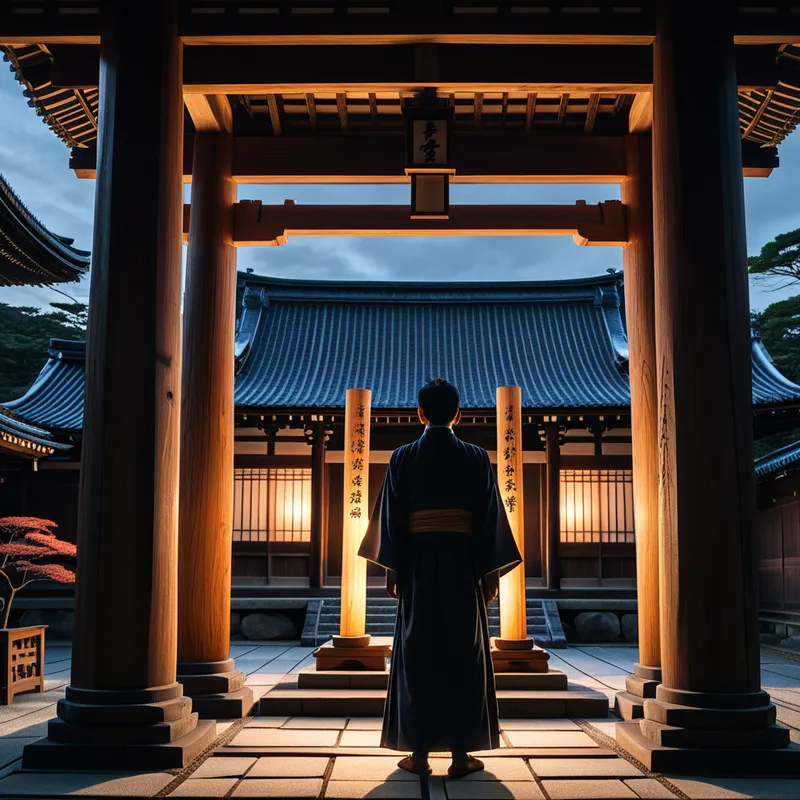
Miracle of the Mortise Myth Meaning & Symbolism
A myth of divine carpentry where a master builder, through impossible precision, joins two pillars to heal a fractured palace and world.
The Tale of Miracle of the Mortise
Listen, and hear the tale of the wood that sang, and the hand that listened.
In a time when the world was younger and the boundaries between the human and the divine were as thin as rice paper, a great calamity befell the Miyako. The heart of the realm, a magnificent palace, stood fractured. Its central pillars, twin giants of ancient, sacred cypress, had been set by lesser hands. A hair's breadth of misalignment, a whisper of imperfect intention, had left a gap between them—a chasm in the very soul of the structure. The palace groaned. The spirit of the place wept. No ordinary joinery could mend this rift, for it was not merely wood that was split, but harmony itself.
The court summoned all the master builders of the land. They came with their straight-edges and their keen eyes, they measured with threads of silk and shadows of sun, but each one departed with a bowed head. The gap remained, a silent accusation against mortal skill. Despair hung in the air like winter mist.
Then came Hidari Jingorō. He did not arrive with fanfare, but with the quiet certainty of a river finding its course. He was a man whose soul was carved from the same grain as the ancient forests. For days, he did not lift a tool. He sat in the shadow of the fractured pillars. He listened to the wind sigh through the gap. He felt the tension in the wood, the memory of the tree’s life, the trauma of its sundering. He breathed with the palace.
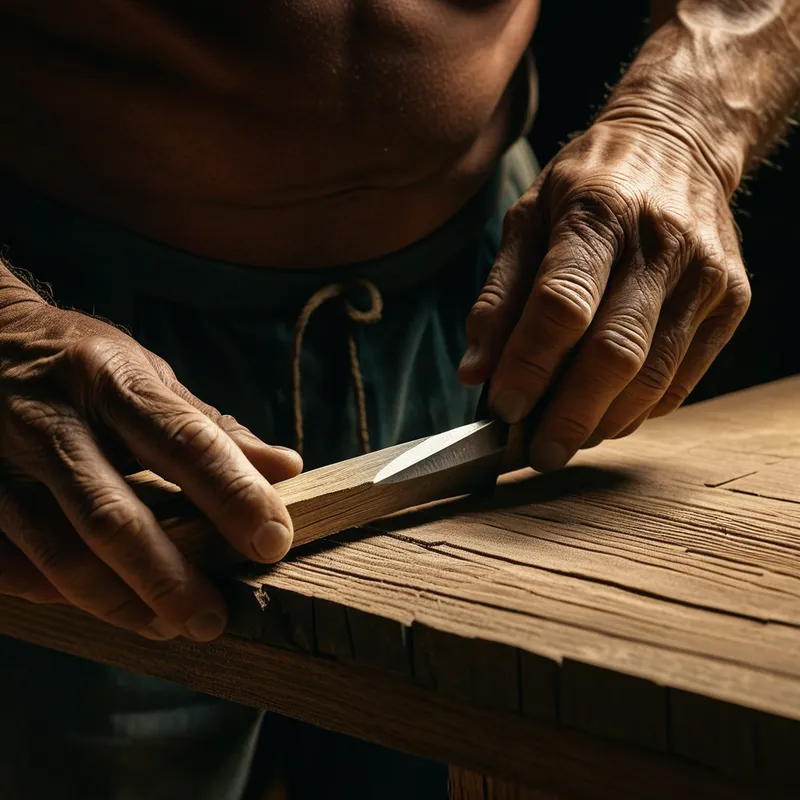
When he finally rose, it was with a clarity that silenced the courtyard. From a block of the same sacred cypress, he began to carve. Not a pillar, not a plank, but a single, perfect tenon—the male part of a joint. His chisel moved not with force, but with reverence, each curl of wood falling away like a shed doubt. He carved through the day and into the night, by the light of a single lantern, his shadow dancing with the spirit of the wood.
As dawn broke, he presented his work: a tenon of such impossible, elegant complexity that it seemed to hold a geometry known only to the kami. He approached the gap. The court held its breath. With a motion that was both a strike and a caress, he drove the tenon home.
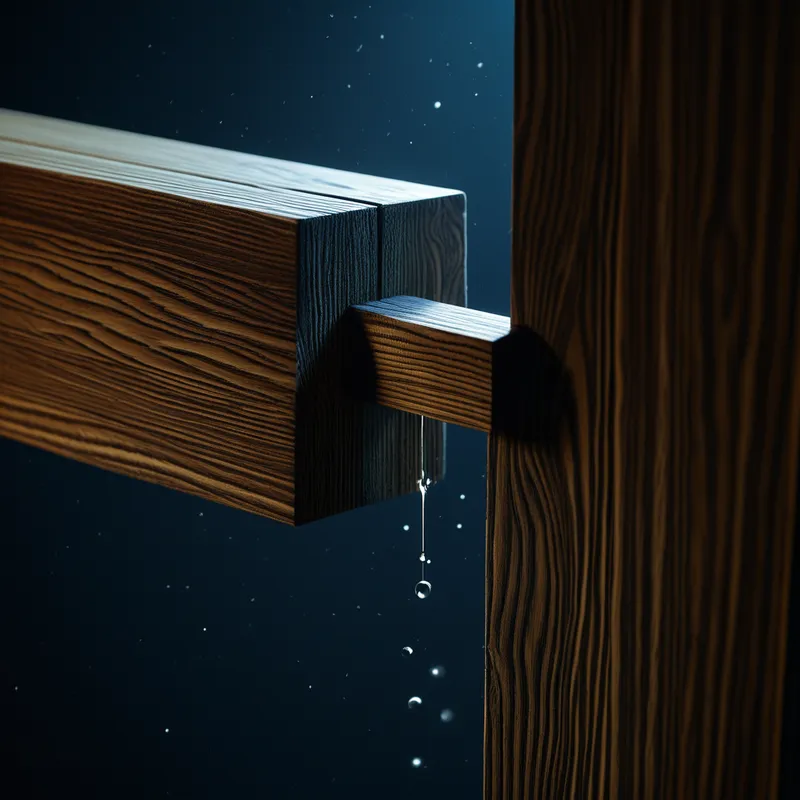
There was no sound of hammering. Instead, there was a deep, resonant hum, as if the earth itself had sighed in relief. The tenon slid into the waiting mortise of the opposing pillar not by force, but by a law of perfect affinity. The two pillars, once eternally separate, sighed and drew together. The gap vanished. The palace stood whole, not merely repaired, but made more sacred for its healing. The wood of the joint became seamless, as if it had grown that way from a single seed. This was no feat of carpentry; it was the Miracle of the Mortise—the moment where precision became prayer, and craft became creation.
Cultural Origins & Context
The Miracle of the Mortise is a foundational legend within Japanese craft spirituality, most famously associated with the folk hero Hidari Jingorō, a semi-mythical figure revered as the patron of carpenters (tōryō). It falls within a rich tradition of takumi-den (tales of master artisans) where supreme skill blurs into the miraculous. These stories were not mere entertainment; they were the sacred texts of the guilds, passed down from master to apprentice by the light of the workshop fire.
The myth served a profound societal function. In a culture built on wood, where architecture was a dialogue with nature and the divine (embodied in Shinto), the carpenter was a mediator. He transformed living trees into vessels for human and spiritual life. This tale codified the ultimate ethic of the craft: that true mastery lies not in domination of material, but in profound listening and alignment. The "miracle" was the attainable ideal—the proof that when human intention (kokoro) aligns perfectly with the nature of the material (ki) and the demands of the cosmic order, the result is a kind of magic. It legitimized the spiritual authority of the artisan class and taught that healing a fractured world begins with an act of flawless, devoted connection.
Symbolic Architecture
At its core, the myth is a supreme allegory for the act of joining. The two pillars represent any fundamental duality that requires reconciliation: spirit and matter, heaven and earth, thought and action, self and other, the conscious and the unconscious mind. The imperceptible gap is the shadow of separation that haunts all existence, the source of existential groaning.
The mortise and tenon are the archetypal symbols of receptivity and agency. The mortise is the feminine principle, the vessel, the space that waits to be filled with meaning. The tenon is the masculine principle, the form, the active truth that seeks its home.
The miracle occurs not in the carving of the tenon alone, nor in the existence of the mortise, but in the moment of perfect fit—the annihilation of the gap.
Hidari Jingorō represents the integrated consciousness, the Self in Jungian terms. His period of silent contemplation is the essential withdrawal into the unconscious, listening to the psyche's own "groaning." The carving is the conscious, disciplined effort to shape a solution—a new adaptation or understanding—based on that deep listening. The final, effortless joining is the symbolic moment of psychic integration, where a complex is resolved, a shadow is embraced, or an opposing tension within the personality is harmonized. The resulting wholeness is stronger than the original, un-fractured state, because it is a healed wholeness, imbued with the wisdom of the rift.
The Dreamer's Resonance
When this myth stirs in the modern dreamer, it often manifests as dreams of precise, impossible tasks. You may dream of trying to fit two puzzle pieces that are almost identical, or inserting a key into a lock with infinite patience. The somatic feeling is one of acute, focused tension followed by a profound release—a "click" that resonates in the body.
Psychologically, this dream pattern signals a process of active reconciliation within the psyche. The dreamer is in the "carving" phase, consciously or unconsciously working on shaping a part of themselves—a belief, a talent, a confession—into a form that can bridge an inner divide. This divide could be between a professional identity and a personal passion, a logical mind and intuitive heart, or a past trauma and present self. The dream confirms that the materials for healing are present (the two pillars of your own psyche), and the gap, however daunting, is not infinite. It is measurable. It can be addressed. The anxiety in the dream is the fear that your "tenon"—your offering, your attempt at connection—will not fit, that you will be exposed as unskilled. The miracle, when it comes in the dream or upon waking, is the realization that the fit was always potential, waiting for your devoted attention.

Alchemical Translation
The alchemical process mirrored here is one of coagulatio—the making solid, the bringing together of disparate elements into a new, enduring body. In the laboratory of the soul, we are all Hidari Jingorō, and our life is the fractured palace.
The first stage is nigredo, the blackening: the recognition of the gap, the groan of the palace. This is the depression, the conflict, the felt sense of brokenness that initiates the work. We must, like the hero, sit in this shadow and listen, without immediate action, to understand the true nature of the fracture.
The second stage is albedo, the whitening: the careful carving of the tenon. This is the conscious work of analysis, therapy, creative expression, or disciplined practice. It is the slow, often frustrating, shaping of a new attitude, skill, or understanding that is custom-made for this specific rift in our being. It requires the tools of patience, honesty, and craftsmanship.
The final transmutation is not an explosion, but an alignment. The Philosopher's Stone is not a thing found, but a relationship perfected.
The third and transcendent stage is rubedo, the reddening: the miracle of the fit. This is the moment of synthesis, often experienced as a quiet, undeniable knowing. The effort ceases; the tenon of your hard-won insight slides into the mortise of your waiting soul. The opposites are conjoined. Energy previously trapped in maintaining the tension of the gap is suddenly freed, becoming a vibrant, humming vitality—the healed palace, the individuated Self standing whole. The miracle teaches that wholeness is not a given state, but a verb: an eternal practice of precise, loving, miraculous joining.
Associated Symbols
Explore related symbols from the CaleaDream lexicon: