Mimbi Caves Creation Myth Meaning & Symbolism
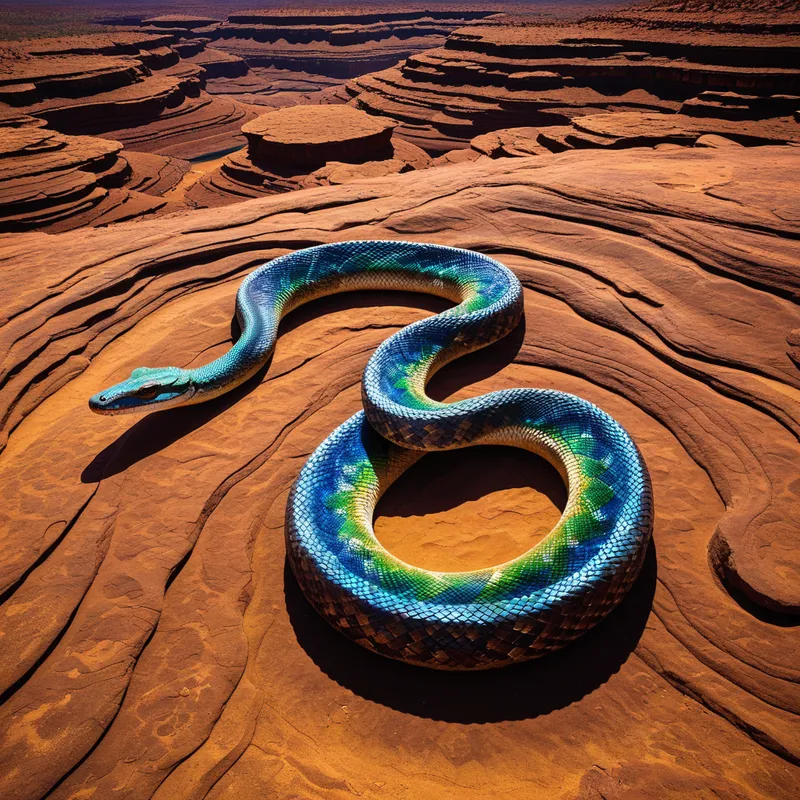
A Rainbow Serpent carves the caves from the earth, creating the first waters and shaping the landscape, establishing the sacred law of the Dreaming.
The Tale of Mimbi Caves Creation
In the time before time, when the world was a flat, dry, and featureless plain under a burning sky, the great Ancestors slept within the earth. The land was silent, waiting. Then, from the deep, dreaming heart of the country, the Rainbow Serpent stirred.
She was vast, her body holding the memory of all colors, the potential of all life. She uncoiled with a purpose that was the first law. The earth was parched, and the creatures of the Dreaming had no place to drink, no cool darkness in which to find refuge from the sun. With a mighty heave of her powerful shoulders, she began to move.
She did not walk upon the land; she journeyed through it. Her great head, crowned with wisdom older than the stars, pushed forward. Where her snout touched the hard, red earth, it cracked and yielded. She slid, she pushed, she carved. The sound was the first music: a deep, grinding groan of rock giving birth to hollow space. Dust, the color of ochre and blood, rose in great clouds, staining the sky at dawn and dusk.
She traveled in great, sinuous curves, her iridescent scales scraping the ceiling of the world into being. Where she lifted her body, she left soaring chambers. Where she pressed down, she formed deep, secret tunnels. Her journey was an act of profound longing—a longing for water, for life, for form. And as she moved, her own life-essence began to seep from her. It was not blood, but something clearer, more primordial. From her skin, from the very friction of creation, moisture began to bead and fall.
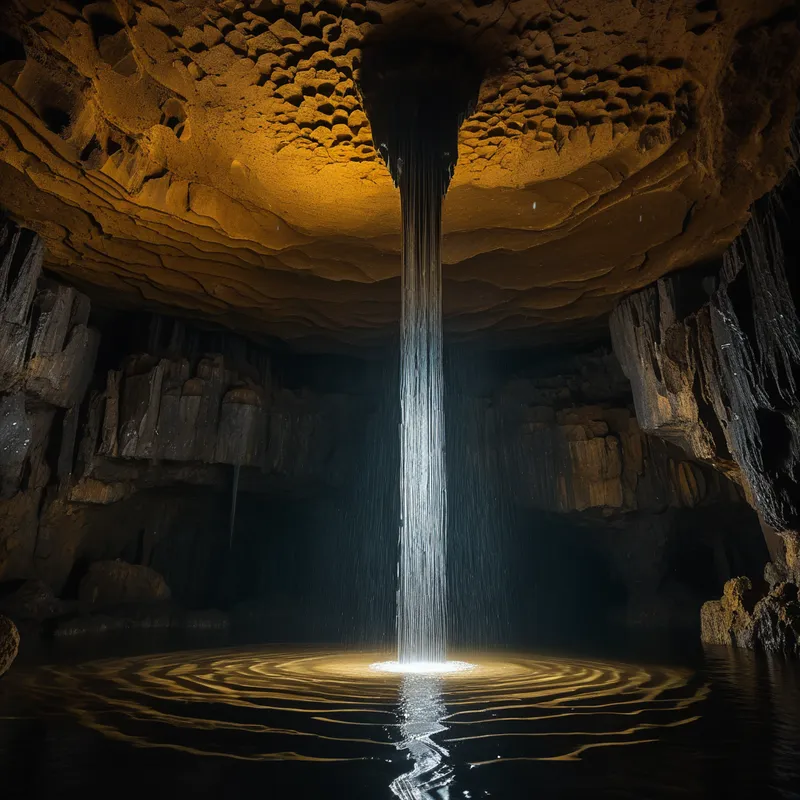
The first drops hit the newly carved stone floor with a sound like a heartbeat. Plink. Plink. Then a trickle. Then a flow. The waters of the Rainbow Serpent filled the channels she had made, welling up from below, seeping from above, creating pools of still, dark water that mirrored the newborn cavern roofs. She had not just made caves; she had made the first wells, the first springs, the first sources.
Her task complete, she rested. In some places, she left her coiled form as a range of hills. In others, her resting head became a great rock. The Mimbi Caves stood not as empty holes, but as living, breathing organs of the earth—lungs that breathed cool air, kidneys that filtered and held the sacred water. She established the law: that the deep places hold the water of life, that the journey of a great being can sculpt the world, and that every landscape is the body of a story, sleeping in the Dreaming, waiting to be sung awake.
Cultural Origins & Context
This myth originates from the Gija and related language groups of the East Kimberley region in Western Australia, for whom the Mimbi (or Mimbi Caves) area is profound Country. It is not a mere story of the past, but a living narrative that is part of the Dreaming.
The myth was and is passed down through ceremony, song, dance, and art by Elders and custodians. Its function is multifaceted: it is a geological map explaining the formation of the caves and the precious water sources within them; a legal charter establishing the sacredness of the site and the rules for its use; and a cosmological framework that connects the people directly to the creative actions of the Ancestor. To know the story is to know the land, to understand your responsibility toward it, and to locate yourself within a continuum of time that is always present.
Symbolic Architecture
At its core, the myth is a profound map of the creative act itself. The Rainbow Serpent represents the undifferentiated, potent energy of the unconscious—the primal, chaotic force that contains all possibilities within its coiled form.
The creative impulse is a serpent moving through the bedrock of the psyche: it must encounter resistance to take shape.
The featureless, dry plain symbolizes a state of psychic sterility or latent potential awaiting activation. The Serpent’s movement is the archetypal act of bringing the unconscious into manifestation. The caves are not just physical spaces but psychic structures—the carved-out hollows of the self, the inner sanctuaries and winding passages of our deepest being. The water she releases is the symbol of life, emotion, spirit, and nourishment that can only be found by journeying into those self-created depths. The act is one of self-sculpting; the psyche creates its own containers for its most vital energies.
The Dreamer's Resonance
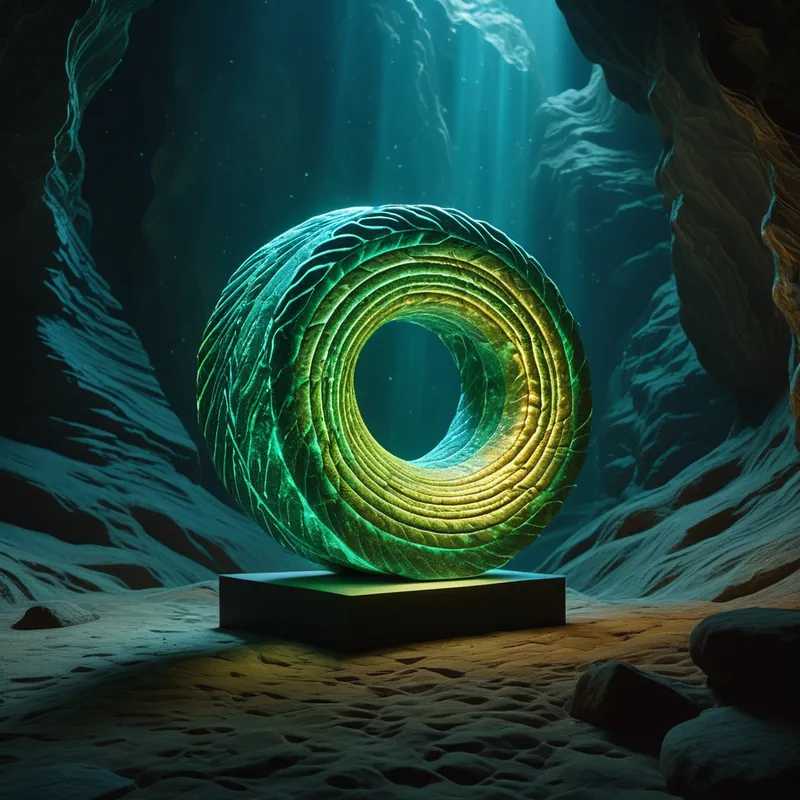
When this myth patterns a modern dream, the dreamer is often at a primal point of creation or re-creation in their life. Dreaming of carving through dense earth or rock signifies the hard, necessary work of shaping one’s identity or life path against resistance. Dreaming of discovering a hidden cave or water source within a cave points to a nascent connection with the deep, often neglected, wellsprings of the soul—the discovery of one’s own emotional or creative resources.
The somatic experience might be one of pressure, then release. Psychologically, it is the process of moving from a flat, arid state of depression or stagnation (the featureless plain) into a phase of active, if difficult, inner formation. The dream may present the dreamer as both the Serpent (the active creator) and the cave (the formed result), indicating a cycle of self-generation.
Alchemical Translation
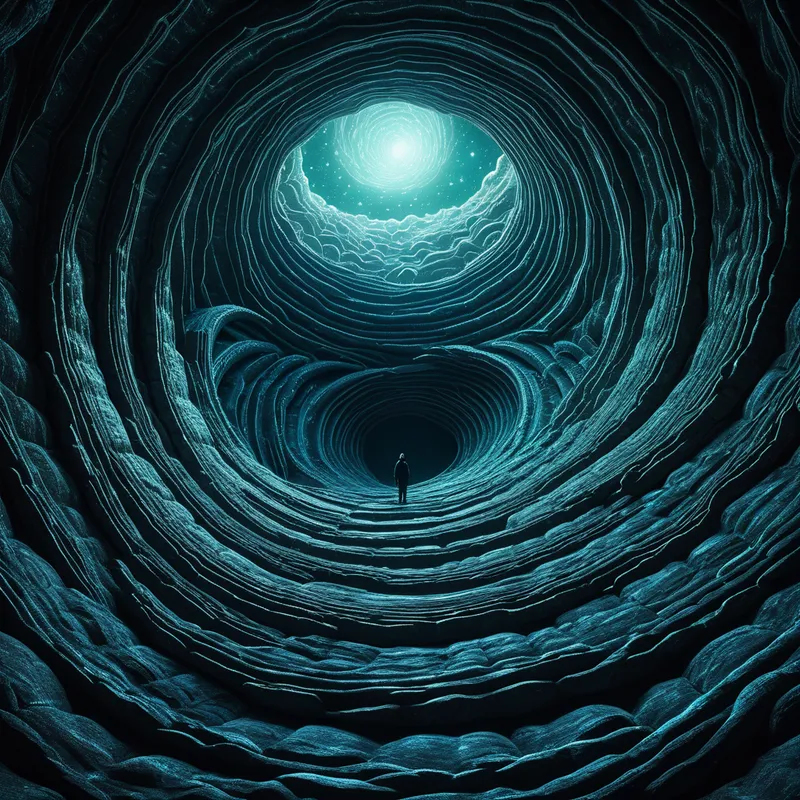
For the modern individual, the Mimbi Caves myth models the alchemical opus of individuation—the journey toward psychological wholeness. The initial state is the massa confusa, the dry, undifferentiated psyche. The Rainbow Serpent is the guiding archetypal force, the Self, that initiates the process.
Individuation is not an ascent to a peak, but a descent into the caverns one has unwittingly carried within all along.
The “carving” is the often-painful confrontation with one’s own complexes, defenses, and shadow material—the bedrock of personal history and inherited patterns. This is the nigredo, the darkening. The creation of the caves represents the structuring of the personality—the formation of a stable, complex inner space capable of holding contradiction and depth. The release of water is the albedo, the washing white; it is the emergence of feeling, meaning, and spiritual connection (the aqua permanens, the permanent water of the alchemists) as a direct result of the descent. The sacred site that remains is the integrated personality—a place within the self that is now a source of life, a touchstone to the primordial, and a testament to the transformative journey.
Associated Symbols
Explore related symbols from the CaleaDream lexicon:
- Cave — The primary symbol of the myth, representing the sacred inner space carved from the unconscious, a sanctuary of cool darkness that holds the waters of life and the echo of creation.
- Serpent — The embodiment of the Rainbow Serpent herself, symbolizing primal creative energy, cyclical time, wisdom, and the transformative force that shapes chaos into ordered, living form.
- Water — The life-giving essence released through the act of creation, symbolizing emotion, spirit, nourishment, and the sacred source that resides only in the deepest, most hard-won places.
- Earth — The raw, resistant material of the featureless plain, representing the primordial substance of the self and the world, which must be engaged and shaped to become meaningful.
- Journey — The serpent's purposeful movement, modeling the necessary passage through resistance that defines any true act of creation, whether of landscape or of soul.
- Dreaming — The ontological plane from which the myth operates, representing the eternal, creative reality that underlies the visible world and connects all beings to the Ancestral past.
- Origin — The myth is fundamentally a story of origin, not just of a physical place, but of the very principle that life and structure emerge from a dynamic interaction with the deep.
- Stone — The bedrock that is both obstacle and medium, symbolizing the enduring, foundational aspects of existence that are reshaped by creative force into vessels for life.
- Rain — The internalized, generative aspect of precipitation, as the Serpent's essence becomes the first waters within the cave, symbolizing blessing that arises from within a struggle.
- Root — The deep, anchoring connection to place and source that the myth establishes, illustrating how identity and sustenance are drawn from the hidden, subterranean layers of being.
- Creation — The central theme and action of the myth, depicting creation not as a singular spoken word, but as a physical, arduous, and embodied process of carving and filling.
- Abyssal Caves — The specific quality of the caves as profound, deep, and mysterious, representing the most inaccessible yet fertile chambers of the personal and collective unconscious.