The Somatic Echo
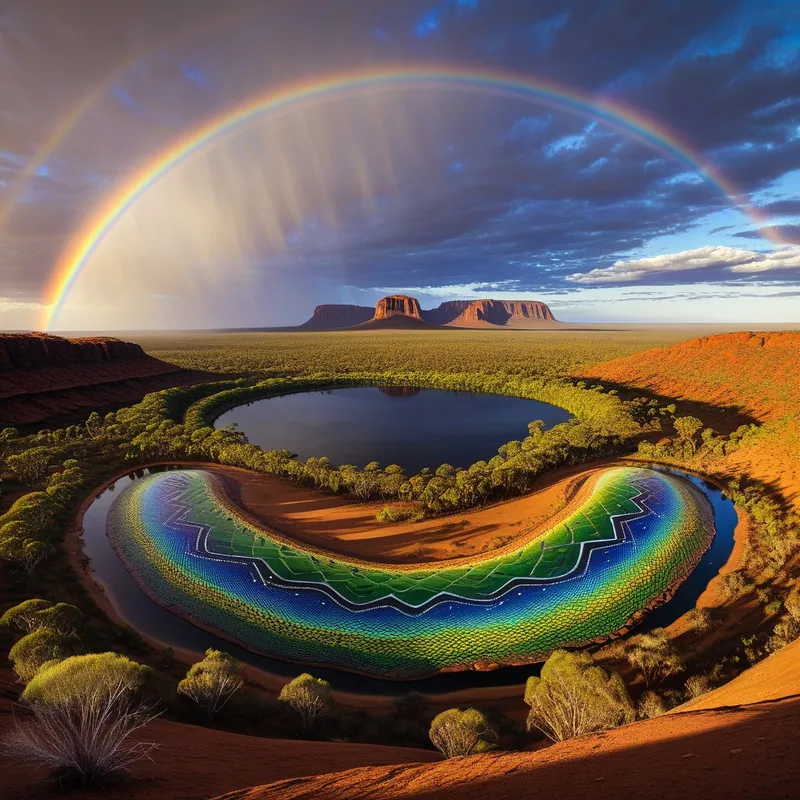
Before you see the mountain, you feel its weight in your bones. Before you cross the desert, your throat is already parched. The dream landscape announces itself not as an image, but as a condition of the body—a sudden vertigo, a profound stillness, a claustrophobic pressure in the chest, or the expansive lightness of an open horizon. This is the somatic echo: the psyche’s first, wordless communication. It is the ground-truth of your inner world, felt in the marrow before it is understood by the mind. The landscape is not a backdrop; it is the primary character, the very substance of your being in that moment. A jagged cliff face is not scenery; it is the crystallization of an impossible decision. A vast, trackless forest is not a setting; it is the living, breathing texture of your own unconscious, dense with unseen life and forgotten paths.
The Dreamer's Log (Case Vignette)
I stood at the edge of a rusted iron bridge, its far end lost in a luminous fog. Beneath me, a chasm plunged into absolute darkness. Across the abyss, carved into a cliff of black glass, was a city of impossible geometry, silent and waiting. My feet were fused to the bridge’s cold metal. To move was to fall; to stay was to petrify.
This is the alchemy of the threshold: the bridge is not an obstacle, but the solidified tension of a psyche poised between an old, known structure and a new, unintegrated potential.

The False Lead
The landscape is not a literal prophecy of future travel or a simple reflection of your daily environment. A dream of a crumbling city is not a premonition of economic collapse; it is the felt-sense of your internal structures—beliefs, identities, coping mechanisms—undergoing necessary erosion. A stormy sea is not merely about emotional turbulence; it is the raw, chaotic energy of the deep unconscious surging toward consciousness, a necessary chaos that precedes new form. To mistake the map for the territory is to remain a tourist in your own soul.
Psychological Architecture
To dream of a landscape is to stand outside your own interior, to witness the architecture of your soul as a vast and living geography. This is the core of Shadow work within this theme: you are not walking in a forest, you are confronting the Forest as a psychic entity within you—the dense, unexplored territory of repressed memories, unlived potentials, and instinctual wisdom. Individuation here is a process of cartography. You are slowly, patiently, mapping the contours of your own being. That impassable mountain is not to be conquered, but listened to. It represents a part of your consciousness that has solidified into a seemingly permanent barrier. The work is to feel its mineral composition, to understand its age and purpose, and in doing so, to discover the secret passes it contains. The barren desert is the arid landscape of a neglected inner function—perhaps feeling, or creativity—and the alchemical task is not to flee it, but to kneel in its sands and search for the hidden, subterranean aquifer.
Mythic Resonance
This universal firmware runs through our oldest stories. Consider the myth of Inanna’s Descent: the Sumerian goddess must pass through seven gates, stripping away a symbol of her power and identity at each one, to enter the barren underworld landscape of Kur. Her journey is not a lateral move, but a vertical descent into a foundational, stripped-bare psychic terrain. She does not travel to a place, but into a state—the raw, unadorned ground of being. Similarly, the Wasteland of the Grail legends is not a curse upon the land, but a direct manifestation of the wounded Fisher King’s inner state. The kingdom and the king are one. The infertility of the landscape mirrors the psychic and spiritual impotence of its ruler. Healing is not an external quest for a magical object, but an internal process of asking the right question of one’s own barrenness.
Symbolic Nodes
- Mountains & Cliffs: Aspiration, obstacles, overview, spiritual striving, or rigid perspectives.
- Valleys & Chasms: The unconscious, depression, fertile low points, hidden vulnerabilities, or transitions.
- Forests & Jungles: The unknown, complexity of the psyche, instinctual life, mystery, and potential entrapment or nourishment.
- Deserts & Wastelands: Aridity, purification, isolation, spiritual trial, and the search for the essential.
- Rivers & Oceans: The flow of life, emotion, the unconscious, time, and deep connectivity.
- Paths & Bridges: Direction, life journey, choices, and connections between states of being.
- Cities & Ruins: The constructed psyche, social selves, mental structures, and their preservation or decay.
Archetypal Resonance
The Explorer Archetype is the innate force activated by the dream landscape. Its energy is the restless pull toward the horizon, the deep curiosity about what lies beyond the known map of the self. The somatic echo of a new landscape is the Explorer’s call to adventure, felt as a quickening of the pulse. Its alchemical potential lies in its willingness to become temporarily lost, to trade the security of the known for the sovereignty of authentic discovery. The shadow of this archetype—the Aimless Wanderer or the Perpetually Alienated—appears when the exploration becomes an end in itself, a flight from integration, where the dreamer is forever crossing bridges but never arriving, forever mapping territories but never settling long enough to learn their language.
The Alchemical Process
The transmutation of the dream landscape is an act of psychic geology. The intense heat and pressure required are supplied by sustained, non-judgmental attention—the nigredo of simply staying present with the felt-sense of the barren desert or the terrifying chasm. You do not change the landscape by force of will; you subject your perception of it to the alchemical fire of curiosity. A cliff face, under this heat, may reveal itself not as a wall, but as a library of sedimentary layers, each a fossilized emotion or belief from a different epoch of your life. The pressure is the courage to stop trying to escape the landscape and instead to inhabit it fully. This is the albedo: the washing clean. As you inhabit it, you begin to discern its hidden logic, its water sources, its sheltering caves. The terrifying form begins to communicate. The rubedo—the reddening, the dawn—is the moment the landscape ceases to be an “it” and becomes a “thou.” You and the inner terrain are in relationship. Sovereignty is not lordship over this land, but a hard-won partnership with it. You are no longer lost in the forest; you are of the forest.

The Integration Protocol
Question 1: Where in my waking life do I feel the same somatic echo—the same weight, openness, or constriction—that I felt in the dream landscape?
Question 2: If this landscape were a part of me (not a place I am in, but a being I am), what is its primary need or message? What is it trying to preserve, or what new element is it trying to form?
Question 3: What small, forgotten, or overlooked detail in the landscape—a single unusual stone, a specific quality of light, a sound—holds the key to its meaning for me?
Action 1 (Somatic Re-Entry): Upon waking, before opening your eyes, return to the felt-sense of the landscape in your body. Do not visualize it; feel its weather in your skin, its terrain in your posture. Breathe into that sensation for three minutes, allowing it to be without alteration.
Action 2 (Cartographic Expression): Create a map of the landscape, but not a literal drawing. Instead, make an abstract representation using only textures and materials. Use sandpaper for deserts, moss for forests, bits of mirror for lakes, crumpled foil for mountains. Let your hands translate the terrain’s feeling into a tactile document.
Action 3 (Threshold Ritual): Identify a real-world threshold that mirrors the dream’s—a doorway, a bridge, a gate. Walk up to it and pause. On one side, name aloud the “old land” you are leaving (e.g., “the known answer”). Step across. On the other side, name the “new territory” you are entering (e.g., “the living question”). Carry a small stone from the first side and leave it on the second.
Final Validation
The terrain of your soul can be terrifying in its vastness and its desolations. To feel lost in your own interior is a profound and legitimate loneliness. This difficulty is not a sign of failure, but of depth. You are not broken because your inner world contains chasms; you are alive because it does. The sovereignty you seek is not born from flattening these landscapes into harmless parks, but from developing the courage, the curiosity, and the poetic literacy to walk them as their native inhabitant. The map is not given; it is drawn with every step of attentive feeling. You are both the cartographer and the continent.