
Milarepa and the Demons
A Tibetan Buddhist mystic confronts his inner demons through meditation, transforming personal torment into spiritual enlightenment and liberation.
The Tale of Milarepa and the Demons
The story unfolds not in a grand palace or a bustling monastery, but in the stark, wind-scoured solitude of a Himalayan cave. [Milarepa](/myths/milarepa “Myth from Tibetan Buddhist culture.”/), the great yogi and poet, had already walked the razor’s edge of human experience. From the black arts of vengeance to the purifying fires of repentance under his guru Marpa, his life was a testament to radical transformation. Now, in the deep silence of his meditation retreat, he sought the ultimate realization.
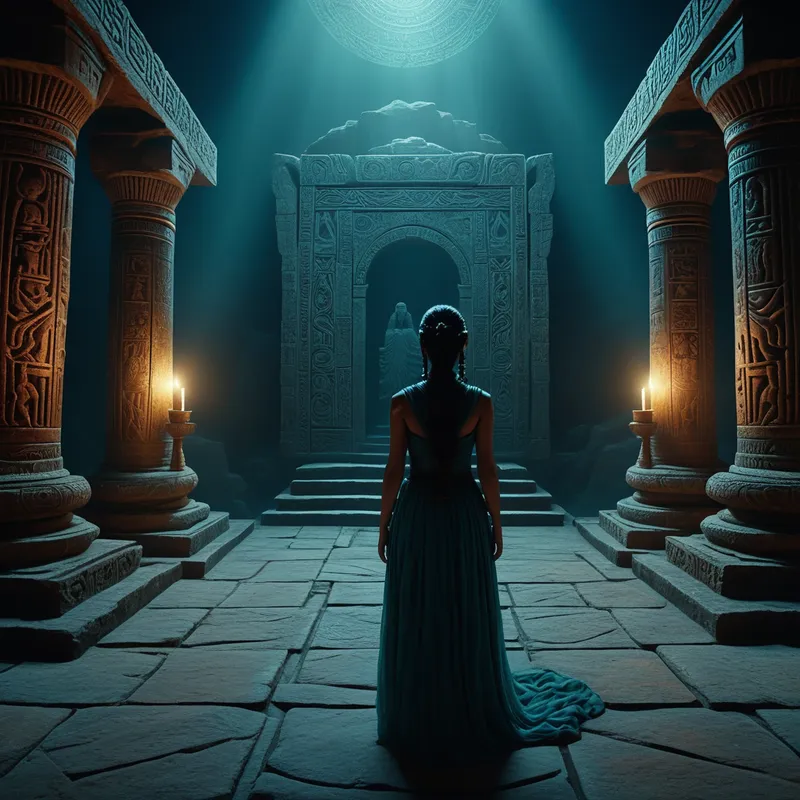
Yet, the silence did not last. As he sat in profound contemplation, [the cave](/myths/the-cave “Myth from Platonic culture.”/)’s emptiness began to stir. From the shadows of the rock and the recesses of his own mind, a host of demons manifested. They were not mere figments but terrifyingly real presences: a legion of grotesque, snarling, monstrous forms, filling the cave with their cacophony. Their eyes glowed with malice, their claws scraped the stone, and their collective rage was a palpable force aimed at breaking his concentration, his sanity, his very life.
The first instinct, even for a sage, might be to fight or to flee. But Milarepa did neither. When the demons first appeared, he did engage them with the sacred teachings. He recited mantras, he expounded on the Four Noble Truths, and he sang songs of the [Dharma](/myths/dharma “Myth from Hindu culture.”/). The demons only laughed, multiplying and growing more fierce. The teachings, when wielded as a weapon against the “other,” proved insufficient.
Then, a profound shift occurred. Milarepa ceased seeing them as external invaders to be defeated. He turned his gaze inward, to the source from which they sprang. With a courage born of absolute exhaustion and deep insight, he dropped the final barrier. He addressed the most fearsome demon, its maw dripping with venom, and spoke words that would echo through centuries: “You came here because of my [karma](/myths/karma “Myth from Hindu culture.”/). Very well, then. If you must devour me, eat. If you have business with me, do it. I will not leave.”
But he went further, into the heart of non-duality. “It seems you and I are inseparable,” he continued. “Therefore, let us make a feast of this body. Come, let us celebrate together.” And then, in an act of unimaginable psychological and spiritual alchemy, he did the unthinkable. He offered his own body as food. He leaned forward and placed his head into the demon’s gaping mouth.
In that moment of ultimate surrender, where the boundary between self and other, between saint and demon, completely dissolved, the miracle transpired. The horrific demonic horde did not consume him. Instead, they shimmered, transformed. Their monstrous forms melted away like mist in a sudden sunrise. The cacophony ceased. Where there had been a legion of terror, there was now only a serene, empty cave, illuminated by the yogi’s own inner radiance. The demons had not been destroyed; they had been liberated into their true nature—empty, luminous, and free. They became, in essence, protectors of the Dharma, their chaotic energy transmuted into enlightened power.
Cultural Origins & Context
This episode is rooted in the rich soil of Tibetan Buddhism, specifically within the Kagyu lineage, which treasures the direct, experiential realization passed from master to disciple. Milarepa (c. 1052–1135 CE) is its most iconic figure, a living emblem of the possibility of enlightenment in a single lifetime, even after grave misdeeds. His biography is not mere hagiography; it is a spiritual map.
The demon confrontation is a core episode from The Hundred Thousand Songs of Milarepa, a collection of his poetic teachings. In the Tibetan Buddhist worldview, demons (dön) are not merely external, supernatural entities. They are intrinsically linked to the mind. They represent the personification of inner obscurations: latent karmic traces, neurotic emotions, and deep-seated fears. [The wilderness](/myths/the-wilderness “Myth from Biblical culture.”/) cave is the traditional abode of yogis precisely because it strips away all worldly distraction, forcing a direct encounter with these raw, unprocessed contents of the [psyche](/myths/psyche “Myth from Greek culture.”/). The culture understands that true spirituality is not an escape from darkness but a transformative journey through it.
Symbolic Architecture
The cave, the demons, and the offering are not random [plot](/symbols/plot “Symbol: A plot symbolizes the unfolding of a story, representing personal narratives and life direction.”/) points but a precise symbolic [architecture](/symbols/architecture “Symbol: Architecture in dreams often signifies structure, stability, and the framing of personal identity or life’s journey.”/) depicting the stages of awakening.
The cave is the kunzhi, the fundamental ground of being—empty, yet capable of manifesting all appearances. It is the alchemical vessel of transformation.
The demons are the solidified, personified forms of the ego’s most cherished and feared constructs: pride, rage, shame, and the terror of annihilation. They are the psyche’s shadow, made visible.
Milarepa’s initial teachings represent the attempt to use spiritual concepts as a defense mechanism. Their failure is a critical lesson: wisdom used dualistically is just another form of aggression.
The pivotal [moment](/symbols/moment “Symbol: The symbol of a ‘moment’ embodies the significance of transient experiences that encapsulate emotional depth or pivotal transformations in life.”/) is one of radical, non-dual [acceptance](/symbols/acceptance “Symbol: The experience of being welcomed, approved, or integrated into a group or situation, often involving validation of one’s identity or actions.”/).
The offering of his body is the ultimate dissolution of the illusion of a separate self. It is the sage’s final surrender, not to the demons, but to the true nature of reality that includes them. By inviting them in, he acknowledges they are already in. This collapses the projection.
The Dreamer’s Resonance
For the modern seeker, Milarepa’s cave is the silent space of our own awareness when we dare to be still. The demons are the unwelcome guests of our inner world: the cascading anxieties that haunt the night, the old wounds that throb with fresh pain, the corrosive self-criticism, the repressed rage that shapeshifts into depression or somatic illness. We spend lifetimes building fortresses against them, negotiating with them, or numbing ourselves to their presence.
Milarepa’s myth offers a terrifying yet liberating alternative: to turn and face them. Not with the sword of suppression, nor with the shield of positive affirmation, but with the open, curious, and ultimately compassionate gaze of the witness. It suggests that our deepest torments, when fully embraced and investigated, hold the very keys to our liberation. The energy bound in our shame, if allowed to be fully felt without identification, can reveal a profound tenderness. The fire of our rage, if met with space instead of resistance, can transmute into the fierce clarity of protective wisdom. The demon, when invited to the feast, often reveals itself to be a lost part of the soul, begging for reintegration.

Alchemical Translation
Psychologically, this is a masterclass in shadow integration, as articulated by depth psychology. The demons are archetypal representations of the personal and [collective unconscious](/myths/collective-unconscious “Myth from Jungian culture.”/). The standard ego response is repression or [projection](/myths/projection “Myth from Alchemical culture.”/), which only empowers [the shadow](/myths/the-shadow “Myth from Jungian culture.”/) and leads to neurosis or acted-out violence. Milarepa demonstrates the advanced stage of the process: confrontation, dialogue, and assimilation.
The act of placing his head in the demon’s mouth is the symbolic equivalent of the ego surrendering its hegemony, allowing the contents of the unconscious to “consume” the limited self-concept. This is not annihilation of personality but death of the ego-illusion, making way for the emergence of the more authentic, holistic Self.
The transformation of the demons into Dharma protectors signifies that integrated psychic energy no longer acts autonomously as a symptom or complex. Instead, it is harnessed in service of consciousness and growth. A healed wound becomes a source of empathy; a reconciled rage becomes a force for righteous action.
This is the alchemy of enlightenment: the base metal of primal fear is transmuted into the gold of fearless compassion. The path is not one of moving from darkness to light, but of realizing that the light is inherent within the very substance of the darkness, once it is seen with eyes of wisdom.
Associated Symbols
Explore related symbols from the CaleaDream lexicon:
- Cave — [The womb](/myths/the-womb “Myth from Various culture.”/) of transformation and [the vessel](/myths/the-vessel “Myth from Alchemical culture.”/) of solitude, where one retreats from [the world](/myths/the-world “Myth from Tarot culture.”/) to confront the raw, unadorned truth of the inner self.
- Demon — The personified embodiment of inner conflict, repressed emotion, and karmic obstruction, representing all that the conscious self fears and rejects.
- Mountain — The arduous path of spiritual ascent, representing discipline, perseverance, and the lofty, purified state of consciousness achieved through effort.
- Shadow — The totality of the unconscious psyche, containing denied weaknesses, latent potentials, and the disowned parts of [the self](/myths/the-self “Myth from Jungian culture.”/) awaiting integration.
- Transformation Cocoon — The enclosed, often dark and challenging period of inner metamorphosis, where old forms dissolve so a new, more authentic being can emerge.
- Fire — The purifying and transformative element that burns away impurity and ignorance, symbolizing both the destructive force of karma and the illuminating power of wisdom.
- Mirror — The nature of mind itself, empty and clear, capable of reflecting all appearances without being stained by them, revealing the illusory nature of demons.
- Journey — The epic, inward odyssey from ignorance to enlightenment, marked by trials, revelations, and the gradual shedding of illusion.
- Soul — The essential, indestructible core of being that undergoes the trials of transformation, seeking liberation from suffering and the realization of its true nature.
- Light — The innate radiance of pure awareness, which is not created but revealed when the obscurations of fear and fixation are dispelled.