Midas Touch Myth Meaning & Symbolism
A king's wish to turn all he touches to gold becomes a curse of isolation, teaching a brutal lesson about the true nature of wealth and desire.
The Tale of Midas Touch
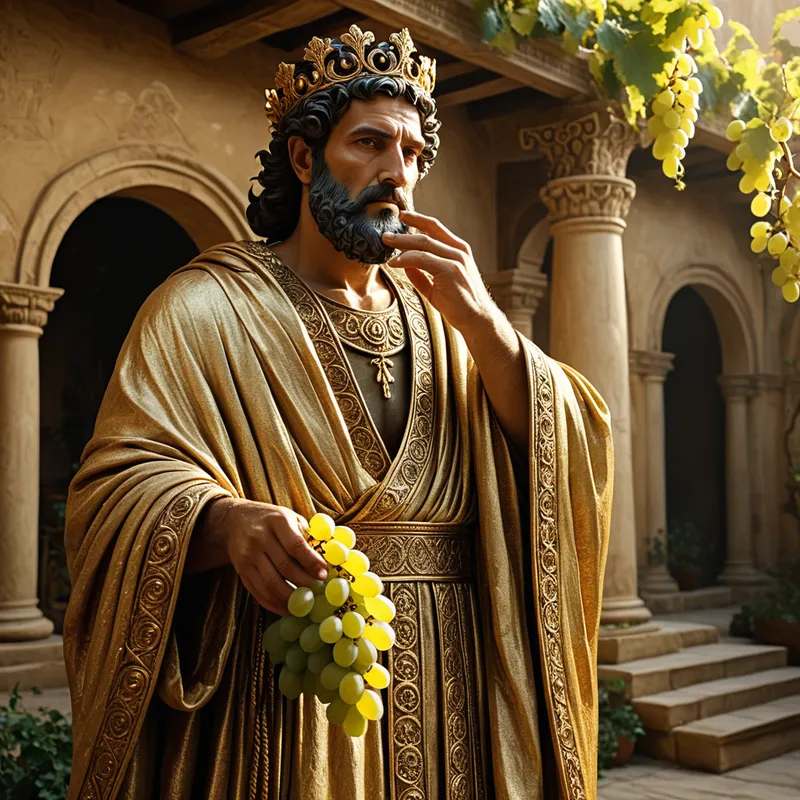
Hear now the tale of Midas, king of Phrygia, a man whose name became a byword for fortune and folly. His story begins not in a throne room, but in a wild, vine-choked grove. The great god Dionysus was passing through his lands, and his most beloved companion, the wise and drunken Silenus, had strayed. Midas found the old satyr, treated him with ten days of royal hospitality, and returned him safely to his divine master.
In his gratitude, Dionysus, his eyes swirling with the purple depths of the grape, offered Midas any boon his heart desired. The king did not pause. He did not ask for wisdom, or long life, or peace for his kingdom. His desire was a single, glittering point. "Grant," he said, his voice trembling with avarice, "that everything I touch be turned to gold."
The god, perhaps with a sigh lost in the scent of ivy and wine, granted the wish.
At first, it was a miracle. Midas rushed from the grove, his fingers dancing. A low-hanging oak branch became a rigid, dazzling sculpture. A stone from the path transformed into a heavy nugget. He returned to his palace, turning doorposts and tables, chairs and urns, all into immutable, priceless gold. He laughed, a sound that echoed coldly in his golden halls. His wealth was infinite, instant, absolute.
Then came the hunger. He called for a feast. But as he lifted a crust of bread to his lips, it hardened into a metallic lump. He reached for a ruby-red apple; it became a golden weight in his palm. He raised a cup of wine to quench his thirst, and the liquid solidified into a golden seal. The dread began as a cold trickle in his stomach.
The terror crowned itself when his young daughter, hearing his cries of distress, ran to embrace him. As her arms wrapped around his neck in comfort, she stiffened. Her warm, living form grew cold and still, her loving face frozen into a serene, golden mask. The king’s greatest treasure had become his most horrifying monument. His gift was a prison. His golden touch was the touch of death.

Cultural Origins & Context
The myth of Midas is not a tale of Olympian grandeur, but a moral fable that circulated in the ancient world, most famously recorded by the Roman poet Ovid in his Metamorphoses. Its roots are in Anatolia, in the historical kingdom of Phrygia, which was proverbial in Greece for its wealth. The story functioned as a cautionary narrative, told and retold to examine the perils of unchecked desire and the hollow nature of material wealth divorced from life.
It belongs to a class of myths where mortal wishes are granted literally by capricious gods, leading to catastrophic unintended consequences. It served a societal function, warning against the sin of hubris in the face of divine power and teaching that the gods' gifts often contain their own antithesis. It asks a fundamental question of an increasingly mercantile ancient world: what is true value?
Symbolic Architecture
The myth’s power lies in its stark, alchemical symbolism. Gold, the ultimate symbol of inert, perfected value, is placed in direct opposition to the messy, transient, but vital processes of life: eating, drinking, loving. Midas’s wish is for a world without decay, without need, without process—a sterile eternity.
The wish for the golden touch is the ego’s fantasy of absolute control, where the fluid complexity of life is frozen into a single, manageable substance.
Midas represents the part of the psyche that seeks to convert all experience into a currency it understands—status, security, possession. His daughter symbolizes what is most vulnerable, spontaneous, and truly valuable in life: relationship, love, the future itself. In turning her to gold, the myth shows that the ultimate cost of this psychic transaction is the petrification of the heart. The river where he washes away his curse is not just a geographical feature but the solutio, the return to the primal waters of feeling and connection, without which the soul starves.

The Dreamer's Resonance
When this myth stirs in the modern dreamer, it often manifests as dreams of terrifying transformation or sterile abundance. You may dream of your hands leaving a metallic sheen on everything you handle, or of a home filled with beautiful, cold objects you cannot use. You may dream of trying to eat food that turns to dust or metal in your mouth.
These are somatic signals of a psychological process where a once-cherished ambition or defensive strategy has become a curse. The "Midas complex" in dreams points to a area of life where the drive for success, security, or perfection has begun to isolate you, cutting you off from nourishment—both literal and emotional. The dream is the psyche’s dramatic enactment of the warning: your pursuit is killing what you love. The weeping in the dream is the neglected feeling-function, the orphaned soul, crying out from its golden tomb.

Alchemical Translation
The path of Midas is a brutal but precise map for psychic transmutation. The first stage is the wish: the conscious, ego-driven desire for a power that simplifies the world (the nigredo of misguided ambition). The second is the realization: the horrific discovery that this power creates isolation and starvation (the albedo, the bleaching shock of truth). The climax is the confrontation with the golden child: facing the ultimate consequence—the sacrifice of one’s own vitality and future (the profound despair of the citrinitas).
Redemption is not found in reversing the wish, but in bathing in the humble river of repentance, in admitting one’s poverty of spirit.
The final stage, the plea to Pan or Dionysus to take the gift back, represents the rubedo—the surrender of the ego’s prized possession for the sake of life itself. The washing in the Pactolus is the act of humility that allows the gold—now externalized in the river’s sands—to become part of the living world again, not its enemy. For the modern individual, the alchemy lies in identifying what your "golden touch" is—the talent, obsession, or defense mechanism that creates wealth but also isolation—and learning to kneel at the riverbank, to let the waters of feeling, vulnerability, and connection wash it from your hands, so you may once again break bread and embrace your world.
Associated Symbols
Explore related symbols from the CaleaDream lexicon: