Midas Myth Meaning & Symbolism
A king's wish for a golden touch becomes a curse, teaching that true wealth lies not in what we grasp, but in what we are willing to release.
The Tale of Midas
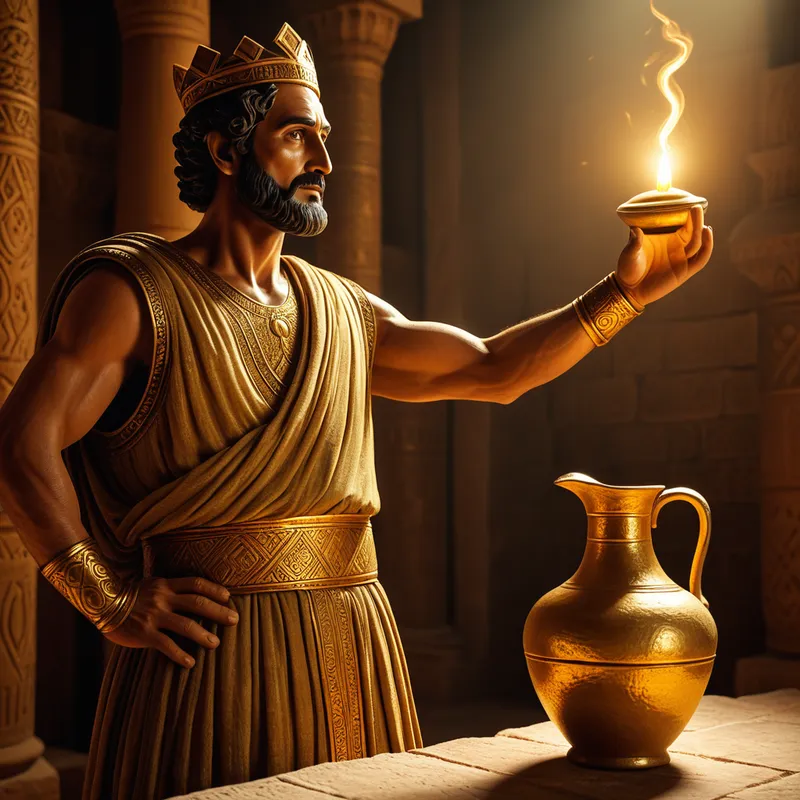
In the ancient, sun-baked highlands of Phrygia, there ruled a king named Midas. His wealth was already the envy of nations, his storerooms groaned with treasure, yet a hollow wind whistled through the chambers of his heart. He desired not just wealth, but the very act of wealth-making, a power to make his touch divine.
His chance came not from ambition, but from an act of rustic kindness. The old, wine-soaked satyr Silenus, tutor to the god Dionysus, had stumbled lost into the king’s rose gardens. Midas, recognizing the sacred guest, hosted him for ten days and nights of revelry before returning him safely to his divine charge. In gratitude, Dionysus, his eyes swirling with the depth of the vine, offered Midas a single wish.
The king did not hesitate. “Grant that all I touch be turned to gold!”
A shadow, fleeting as a cloud over the sun, passed over the god’s face. “So be it,” Dionysus said, his voice a blend of pity and the inevitable.
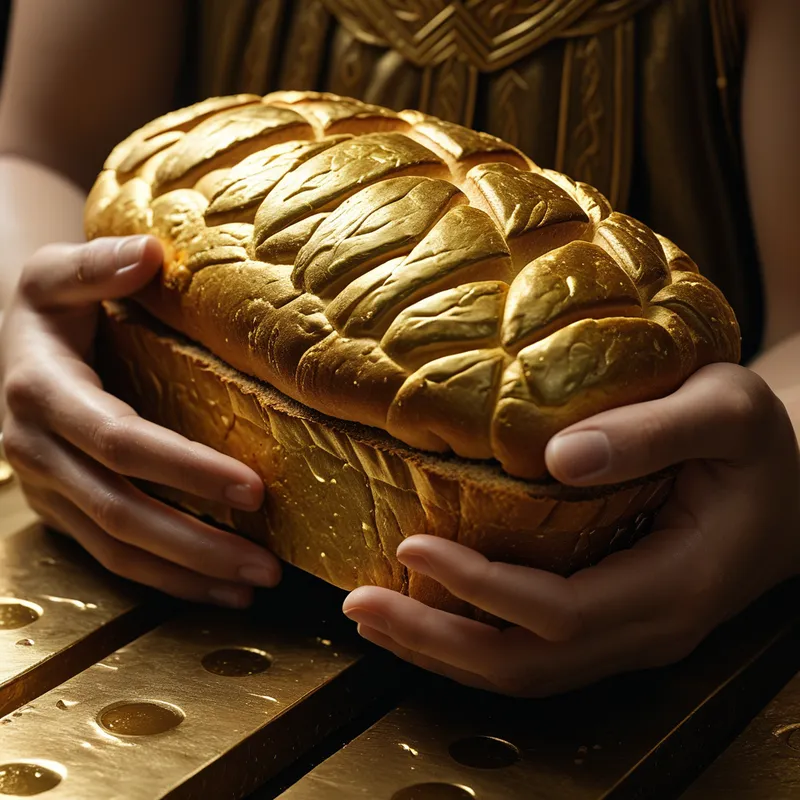
At first, it was a rapturous dream. Midas raced through his palace, a laughing alchemist. He brushed a stone column—it sang into burnished gold. He plucked an apple from a branch—it became a weighty, perfect jewel in his palm. He laughed, the sound echoing in his now-golden hall. But hunger called him to his feast. As his fingers closed around a loaf of bread, it hardened into a useless, metallic sculpture. He raised a cup of wine to his lips, and the liquid became a sheet of gold, cold and unyielding against his mouth.
Panic, cold and sharper than any blade, pierced his joy. Then came the true horror. His young daughter, hearing his cries of distress, ran to embrace him. As her small arms wrapped around his neck, her loving warmth stiffened, her joyful gasp silenced. Before his eyes, his beloved child was transformed into a beautiful, lifeless statue of gold.
The king’s wail shook the golden palace. He had been given the touch of the sun, and it had frozen his world. The gift was a prison, the fulfillment a famine. Clutching his golden daughter, he stumbled back to Dionysus, his pride turned to ashes, his golden hands now instruments of utter despair.
Cultural Origins & Context
The myth of Midas is a cornerstone of Greek mythology, primarily preserved through the works of the Roman poet Ovid in his Metamorphoses, and earlier references by historians like Herodotus. It belongs to a rich tradition of cautionary tales about mortal interactions with the divine, where a wish granted is often a lesson delivered.
The story was not merely entertainment; it served a vital societal function. In a culture navigating the rise of coinage and material wealth, the myth acted as a psychic counterweight. It was told to temper ambition, to question the true source of value, and to illustrate the foundational Greek principle of sophrosyne—moderation. Midas, the historical figure vaguely remembered as a wealthy Phrygian king, became the archetypal vessel for this warning. The tale was passed down by bards and poets as a dramatic, visceral reminder that the gods’ gifts are double-edged, and that human desire, unchecked by wisdom, leads to isolation and spiritual death.
Symbolic Architecture
At its core, the myth of Midas is a profound allegory for the psychology of inflation and the nature of true value. The golden touch is not merely a magical power; it is the ultimate symbol of a consciousness that seeks to transmute the living, fluid, and relational world into a static, fixed, and “owned” state.
The Midas touch is the ego’s wish to make the world in its own image—permanent, controllable, and superficially brilliant. It is the tragedy of success that annihilates context.
Gold represents absolute, abstract value. When Midas applies it to the world, he destroys the specific, functional value of things: bread is for eating, wine for drinking, a daughter for loving. He exchanges the use of the world for its appearance. Psychologically, this mirrors any obsession—with status, with an idea, with a goal—that so possesses an individual that it sterilizes their lived experience. The relational field turns to cold metal. The myth brilliantly maps the arc from desire (the wish) to euphoric inflation (turning objects to gold) to catastrophic realization (the inability to eat, the loss of the daughter) and finally, to the potential for humility (the plea for release).

The Dreamer's Resonance
When the pattern of Midas appears in modern dreams, it signals a profound somatic and psychological process: a confrontation with an “inflated” or “sterilizing” complex. The dreamer may not touch gold, but they might dream of turning loved ones into mannequins, of conversations becoming written scripts, or of their own hands emitting a light that makes everything rigid and distant.
This is the psyche’s alarm. It indicates a part of the personality that is, with the best or worst of intentions, trying to control, perfect, or monetize aspects of life that must remain fluid and vulnerable. The somatic feeling is often one of coldness, paralysis, or choking—the body experiencing the “golden” transformation as a loss of vitality. The dream is an invitation to feel the hunger behind the greed, the loneliness behind the control, and to recognize what precious, living connections are in danger of being sacrificed on the altar of a fixed idea or compulsive desire.

Alchemical Translation
The path of Midas models a brutal but essential alchemical sequence for individuation: *the *Nigredo of fulfillment. His journey begins with the *Albedo—the wish for pure, perfect transformation. He achieves it instantly, skipping the necessary *Nigredo of struggle and integration. The result is a false, deadly purity. His golden world is the Albedo turned toxic, a spiritual whiteout.
The cure is not in reversing the wish, but in descending through its consequences. The path to the true gold of the Self (the Philosopher's Stone) leads through the river of mud.
His salvation comes only when he touches the daughter—the symbol of his own soul, his capacity for love and relatedness—and turns it to gold. This is the catalytic shock that forces the Nigredo upon him. His desperate journey to wash away the curse in the river Pactolus is the alchemical *Ablutio. He must immerse himself in the flowing, humble, earthy waters (the unconscious, the feeling function) to cleanse the sterile, solar consciousness of his ego’s wish.
For the modern individual, the myth instructs that our most glittering talents, ambitions, or defenses can become curses if they are not rooted in and tempered by the muddy, flowing waters of human connection, vulnerability, and sacrifice. The true alchemical gold is not what we can possess, but what we are willing to lose—the rigid, golden identity—to regain a living, breathing, imperfect, and nourishing world. The wisdom of Midas, earned through utter despair, is that release is the only true redemption.
Associated Symbols
Explore related symbols from the CaleaDream lexicon:
- Business
- Cash
- Material
- Rich
- Got
- Cheap
- Touch
- Million
- Vein of Gold
- Ambitious Businessperson
- Citrine Gemstone
- Pyrite Glimmer
- Gold Nugget
- Moonlit Gold
- Leprechaun Gold
- Goblin Gold
- Gilded Age Mansion
- Incan Gold Nugget
- Warhol's Campbell's Soup Can
- The Bourgeoisie
- Monopoly
- Revenue
- Commodity
- Excess
- Caramel
- Civet