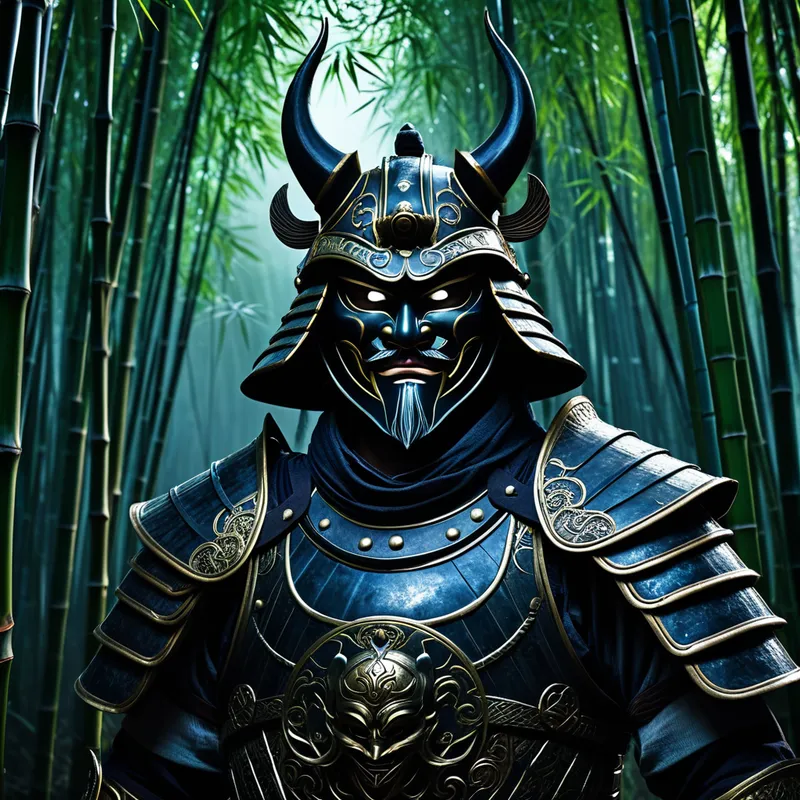
Mempo Myth Meaning & Symbolism
A warrior's enchanted mask, forged in grief and rage, becomes a vessel for his shadow, demanding a confrontation with the self behind the armor.
The Tale of Mempo
Listen, and let the wind through the pines carry you back. To an age of clashing steel and whispered honor, when a man’s soul was as much his weapon as his katana. This is the tale of Mempo.
He was born not of legend, but of grief. A lordless samurai, a ronin, whose world was ash. His lord had fallen to treachery, his family to the sword, his heart to a cold, silent fury that no battle could quench. He wandered the provinces, a specter of vengeance, his skill unmatched but his purpose a hollow echo. The world saw only a shell of polished armor and deadly grace. They did not see the man crumbling within.
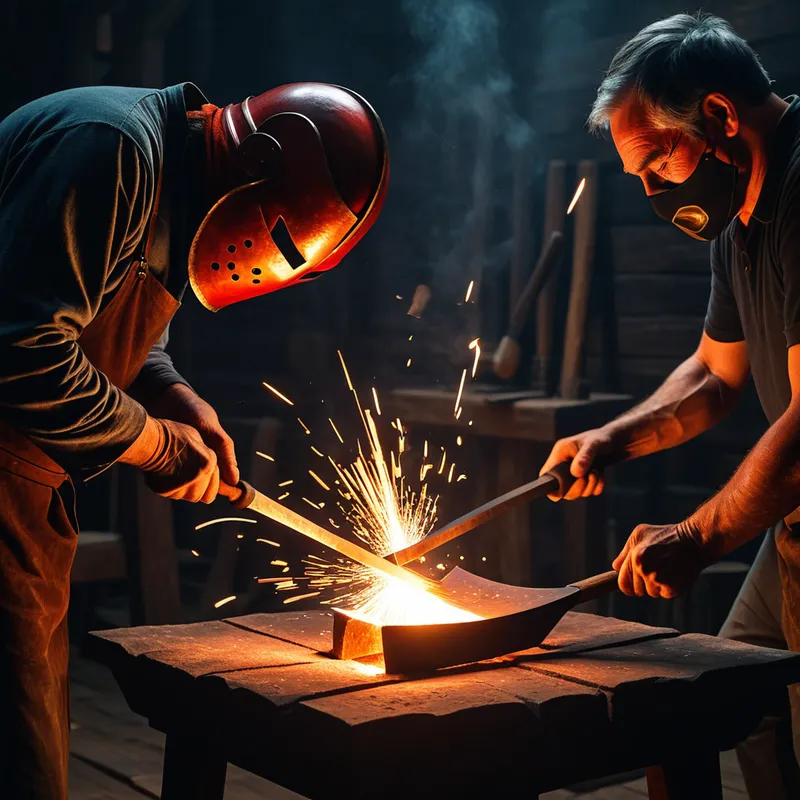
One night, beneath a blood-red moon, he came to a remote forge nestled in mountain mists. The smith was old, his eyes like chips of flint, said to have learned his art from Yama-no-Kami. The ronin had no coin, only his story, told in the silence between words and the scars on his spirit. The smith listened to the silence. “I will forge you a new face,” the smith said, his voice like grinding stone. “But the metal will drink not water, but your oath. The fire will be fed not by bellows, but by your intent.”
For seven days and seven nights, the ronin labored beside the ancient smith. He pumped the bellows until his arms burned, each breath fanning the coals with his own simmering rage. He chanted the names of the fallen, pouring his loyalty, his love, and his bottomless hatred into the crucible. When the molten iron was poured, it did not shine silver, but a dark, smoky grey, like a storm cloud given form.
The smith hammered the mask. With each strike, the ronin felt a corresponding blow within his chest—not of pain, but of release. His stoic grief was hammered into the furrowed brow. His silent scream was shaped into the mask’s open, menacing mouth. His unshed tears became the polished, sightless curves beneath the helmet’s rim. When it was done, cooled in a sacred spring, the mask was a masterpiece of terror. It was no longer mere armor for the cheeks and chin; it was a face. His face, but externalized, solidified. The face of his shadow.
He donned it. And the world changed. In battle, he was no longer a man, but a force of nature. The mask did not hide him; it revealed him. It channeled his fury into preternatural focus, his grief into unbreakable resolve. He became a legend, a demon in iron, feared by all. Yet, with each victory, the mask grew heavier. In quiet moments, he would feel its weight as a second skull, its grimace a permanent echo of his own frozen anguish. He had given his pain a form, and the form now held him.
The climax came not on a battlefield, but at a crossroads. Facing the last of his lord’s betrayers, he raised his sword. The traitor, broken and defeated, looked past the blade, past the terrible mask, and into the space where eyes should be. “Who are you?” the traitor whispered, not in fear, but in a strange, exhausted pity. “What is left behind the demon?”
In that moment, Mempo—for that was the only name he had now—stilled. The question echoed in the hollow between the mask and his skin. He saw that his vengeance, once a sacred duty, had become a cage crafted by his own hands. The mask had served him, but it had also consumed him. With a cry that was part agony, part liberation, he tore the mempo from his helmet. He cast the iron visage onto the stone at the traitor’s feet. It did not clatter; it rang like a bell, a single, pure note that hung in the air.
He did not strike the final blow. He walked away, his true face exposed to the wind and the light for the first time in years, raw, unknown, and finally, free. The legend says the mask remained, half-sunk in the earth at that crossroads, a silent testament to the warrior who outgrew his own wrath.
Cultural Origins & Context
The tale of Mempo is not found in a single, canonical text like the Kojiki, but lives in the oral traditions of the samurai class and the folk imagination of the Edo period. It is a kōdan—a dramatic oral story—often told by traveling storytellers to audiences captivated by bushidō drama. Its power lies in its psychological realism, set against the historical backdrop of the samurai’s complex relationship with armor.
The mempo was a very real piece of battlefield equipment, designed to protect the face and intimidate the enemy. Crafted by skilled katchū-shi (armorers), they often featured fearsome expressions—demons, snarling beasts, or stern gods. This myth takes that practical object and imbues it with profound spiritual significance. It speaks to the samurai ideal of bushidō, where the warrior was expected to subjugate his personal emotions (ninjō) to his duty (giri). The myth asks: what happens to the emotions that are suppressed? They do not vanish. They are forged, like iron, into a new shape—a protective yet imprisoning second self.
The story was a societal safety valve. It allowed a culture that prized stoic self-control to explore, in a safely metaphorical space, the dangers of total emotional suppression. It was a cautionary tale for the warrior, and a deeply human story for the commoner, reminding all that even the most fearsome exterior guards a vulnerable interior.
Symbolic Architecture
At its heart, the myth of Mempo is a masterful allegory for the birth and integration of the Shadow. The protagonist’s unbearable grief and rage—emotions incompatible with his conscious identity as a disciplined ronin—are not processed but projected. They are literally projected onto the anvil and given form by the smith, who here represents the archetypal Mentor or the unconscious itself, facilitating a necessary but dangerous act of creation.
The mask is the solidified psyche. What we cannot bear to feel within, we wear without.
The mask, therefore, is not a disguise. It is a truth-teller. It is the autonomous complex of his trauma, made manifest. It grants him power—the power of his unfettered shadow—but at the terrible cost of alienation from his own core self. He becomes a legend, but ceases to be a man. The mask’s increasing weight symbolizes the psychic burden of living from a place of armored, unintegrated trauma.
The crossroads confrontation is the pivotal moment of recognition. The enemy’s question, “Who are you?”, is the call of the Self, the archetype of wholeness. It forces the ego to confront the fact that it has become identified with its defensive armor. Casting off the mask is the ultimate act of courage in the myth—greater than any battlefield feat. It represents the dissolution of a provisional identity, the willingness to face the world and oneself in a state of vulnerable, unmasked reality.
The Dreamer's Resonance
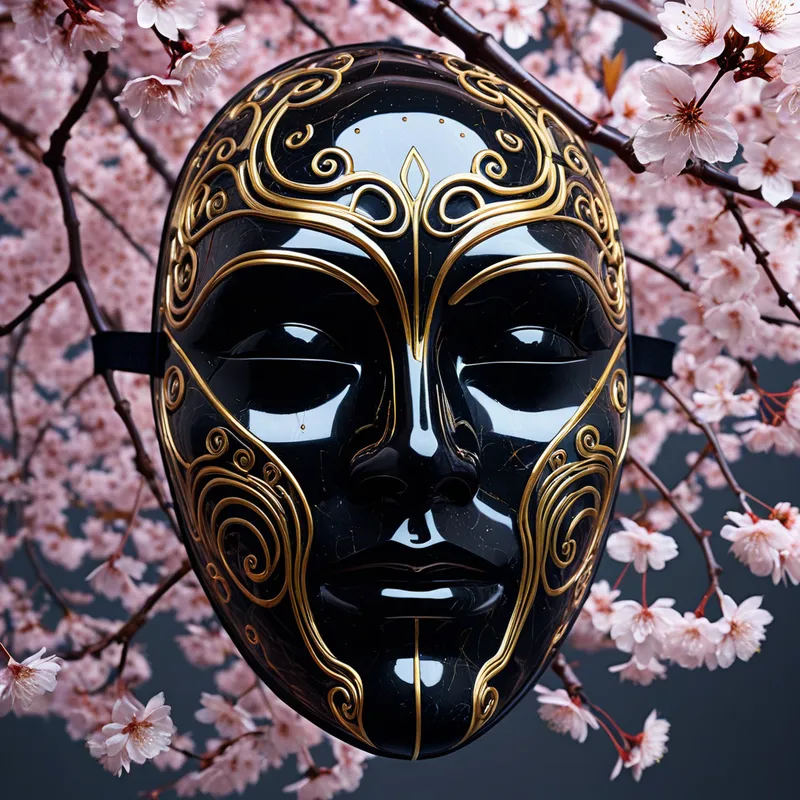
When this myth stirs in the modern dreamer, it rarely appears as a samurai tale. Instead, it manifests as dreams of masks, helmets, or heavy facial coverings that cannot be removed. One might dream of being in a crucial meeting but wearing a rigid, expressionless mask, unable to speak their truth. Or of looking in a mirror to see a face that is not their own—a face of cold professionalism, performative happiness, or stoic toughness.
Somatically, this can feel like a tightening in the jaw, a stiffness in the facial muscles, or a literal sensation of pressure on the head and cheeks. Psychologically, it signals a state of over-identification with a persona—the social mask we wear—that has hardened and become autonomous. The dream is highlighting a disconnect: the energy, the emotion, the authentic response (the grief, the rage, the passion) is being actively restrained and shaped into a defensive, but ultimately limiting, form. The dream is the psyche’s attempt to make the mask visible, to show the dreamer the armor they have forgotten they are wearing.

Alchemical Translation
The alchemical journey of Mempo maps perfectly onto the process of Individuation. It begins in Nigredo, the blackening: the ronin’s world is in ashes, his spirit in despair. This is the necessary descent, the confrontation with the prima materia of suffering.
The forging of the mask is the stage of Albedo, the whitening, but in a distorted form. Here, the unconscious content (shadow emotions) is extracted and given a distinct, separate form. It is made conscious, but not integrated; it is objectified as an “other.” This creates a powerful but unstable duality: the man and his mask.
Individuation does not mean becoming perfect, but becoming complete, which includes reclaiming the power we lent to our defenses.
The climax at the crossroads is the Rubedo, the reddening or realization. The question “Who are you?” forces the coniunctio oppositorum—the conjunction of opposites. The conscious ego (the warrior) must recognize its shadow (the mask) not as a tool or a demon, but as a part of itself that was split off in a moment of trauma. Casting the mask aside is not destroying the shadow; it is breaking the identification with it. The rage and grief are not gone; they are now available to the man as raw emotional energy, no longer frozen into a single, terrifying shape.
For the modern individual, the alchemy is internal. We are all the smith and the warrior. We forge our masks from the ores of past hurts and societal expectations. The work of individuation is to feel the weight of that mask, to hear the question from our own inner “other,” and to find the courage to remove it—not to be without a face, but to finally feel the air on our own skin, and begin the work of living from the vulnerable, authentic self that was there all along, waiting behind the iron.
Associated Symbols
Explore related symbols from the CaleaDream lexicon: