
Mayari Myth Meaning & Symbolism
The story of the moon goddess Mayari, born from cosmic creation, who loses an eye in a battle for order and becomes the gentle, one-eyed ruler of the night.
The Tale of Mayari
In the time before time, when the world was a formless sea beneath a starless sky, the great Bathala willed creation into being. From the void, he brought forth the first light, the first land, and the first beings of power. Among these were his children, born not of flesh, but of his divine essence and the primal elements. There was Apolaki, whose spirit was forged in the heart of a newborn star, radiant and fierce. And there was Mayari, whose soul was drawn from the cool, silver light that first kissed the calm sea, beautiful and profound.
For eons, they lived in harmony under their father’s watch. But when Bathala ascended to the highest heaven, leaving the governance of the world to his children, a shadow fell upon their unity. Apolaki, in his blazing certainty, claimed sole rulership. "The day is the time of work and war," he declared, his voice like the crack of dawn. "It requires a single, strong hand. I shall rule alone."
Mayari emerged from the twilight, her presence a calming silence. "Brother," she said, her voice the sound of rustling night leaves, "our father left the world to us both. The night is as vast as the day. Its mysteries require a different sight, a gentler strength. We must rule together, as equals."
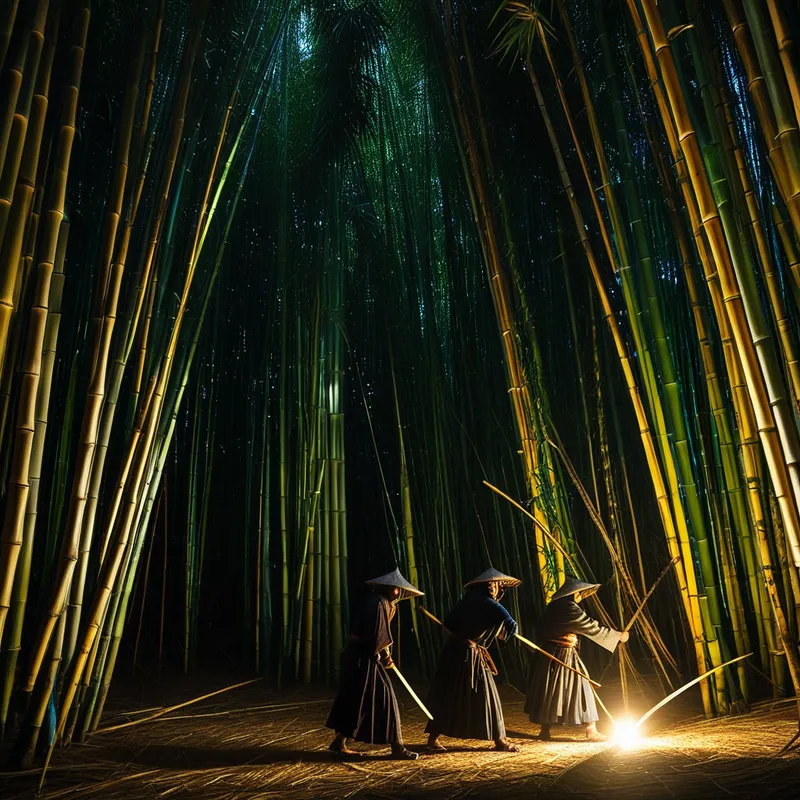
Words turned to embers, and embers to a blaze of divine pride. No compromise could be found in the space between the sun’s glare and the moon’s glow. They agreed to the oldest way: a duel. Not to the death, for they were immortal, but to submission. The battleground was the very fabric of the young world. They chose weapons of bamboo, strong yet humble.
The battle was a cataclysm of light. Apolaki struck with the force of noon, each blow meant to overwhelm. Mayari moved with the grace of an eclipse, parrying and weaving, her strength rooted in resilience, not in force. For three days and three nights, the clash echoed, shaking the mountains and churning the seas. The world trembled on the edge of chaos, fearing a return to the primordial dark.
In a final, furious exchange, Apolaki’s club swung true. Mayari raised her own to block, but the impact was devastating. The sacred bamboo shattered. A searing pain, more profound than any physical wound, lanced through Mayari. She fell back, a hand clasped to her face. When she lowered it, the world had halved. One of her luminous eyes was gone, its light extinguished.
A silence, deeper than the void before creation, fell. Apolaki stood frozen, his rage extinguished by the terrible sight. The brilliant light from his sister’s wounded face was dimmed. In that moment, he saw not a rival, but a consequence of his own blinding pride. The cost of his victory was a beauty maimed, a light lost to the world forever.
Shame, cold and heavy, washed over him. He threw down his club. "Sister," he whispered, the fire gone from his voice. "I am defeated not by your hand, but by my own. Forgive me."
Mayari, though in immense pain, saw his genuine remorse. With her remaining eye, she saw the balance that had been broken and the one that could yet be forged. "There is no victory here, brother," she said, her voice strained but clear. "Only loss. But from loss, a new order can rise."
And so, they forged their pact. Apolaki, humbled, would rule the day with his undiminished light. Mayari, in her sacrifice, would rule the night. Her remaining eye, now softer and more compassionate, would become the moon, guiding travelers, comforting lovers, and watching over the world in the time of dreams. Her lost eye, some say, became the stars—countless fragments of her light scattered across the eternal dark to remind all of the price of harmony. Thus, order was born from conflict, and balance was purchased with a sacred wound.
Cultural Origins & Context
The myth of Mayari originates from the Kapampangan and Tagalog peoples of the Philippine archipelago, a cornerstone of the complex pre-colonial animist and polytheistic belief system. These stories were not written in codices but lived in the oral tradition, passed down through generations by the community’s storytellers, the babaylan (shaman-priestesses) and the elders. Recited during communal gatherings, under the very moonlight Mayari provided, the myth served multiple vital functions. It was a cosmological map, explaining the origin of the celestial bodies and the cycle of day and night. It was a social charter, modeling the resolution of conflict through compromise rather than annihilation, a crucial lesson for clan-based societies. Most importantly, it was a spiritual guide, personifying the natural world. Mayari was not a distant symbol but a living deity—the gentle light on the rice paddies, the protector against nocturnal dangers, the witness to secret vows. Her myth rooted the people’s daily and seasonal rhythms in a sacred, familial drama played out across the heavens.
Symbolic Architecture
At its heart, the myth of Mayari is a profound allegory for the necessity of sacrifice in the creation of a functioning whole. The cosmic battle between Apolaki and Mayari represents the clash of complementary but opposing principles: the masculine and the feminine, action and reflection, assertion and receptivity, the conscious ego and the unconscious soul.
The true light is not that which blinds with its singular brilliance, but that which reveals the contours of wholeness by embracing its own shadow.
Mayari’s lost eye is the central, devastating symbol. It is the price of order. She does not merely concede; she is physically altered, her wholeness shattered to prevent the world from being shattered. This transforms her from a goddess of perfect, symmetrical beauty into a deity of profound, compassionate depth. Her single eye sees differently—not less, but more intimately. It sees the need for mercy in justice, for rest in labor, for mystery in clarity. The bamboo weapons signify that even divine conflicts use the materials of the earthly realm, grounding the cosmic struggle in the reality of the natural world. The resulting balance—fierce sun, gentle moon—establishes a cosmic circle, a diurnal rhythm that allows for both growth and regeneration.

The Dreamer's Resonance
When the pattern of Mayari’s myth stirs in the modern dream, it often signals a profound internal conflict between two powerful aspects of the self. The dreamer may be caught in a struggle between ambition (Apolaki) and compassion (Mayari), between the drive to dominate their world and the need to nurture their inner life. The somatic experience can be one of tension, of feeling pulled in two directions until something feels like it must "give."
Dreams may present this as a literal fight, a competition where the dreamer is both participants, or through the potent image of losing an eye, a tooth, or another symbol of personal power or perception. This is not a nightmare of pure loss, but a sacrificial dream. The psyche is staging the difficult but necessary process of relinquishing a part of one’s egoic certainty, one’s demand for total control or perfect wholeness, to achieve a higher, more functional integration. The emotional tone upon waking is often one of poignant grief mixed with a strange, quiet relief—the feeling after a necessary, painful decision has finally been made.

Alchemical Translation
The journey of Mayari is a masterful blueprint for the alchemical process of individuation. It begins with the nigredo, the blackening: the chaotic, fratricidal conflict that threatens to undo creation (the psychic disintegration of old, rigid structures). The battle itself is the separatio, the violent dividing of previously united but unconscious opposites.
The critical alchemical moment is the wounding—the loss of the eye. This is the mortificatio, the symbolic death. It represents the ego’s necessary sacrifice, the humbling of one’s totalitarian claim to consciousness. One must lose a certain kind of sight—the sight that sees only one’s own rightness—to gain another.
To become sovereign of one’s inner night, one must first be wounded by the blinding light of one’s own pride.
From this sacrifice arises the conjunctio, the sacred marriage. Apolaki and Mayari do not become one; they become harmonious counterparts. This is the integration of opposites within the psyche. The ego (Apolaki) retains its necessary function of conscious action and daylight discernment, but it is now tempered by and in service to a relationship with the soul (Mayari)—the ruler of the interior, intuitive, and cyclical realms. The final state is not perfection, but balanced imperfection. The individual rules their own inner cosmos, capable of both decisive action and compassionate reflection, their consciousness illuminated by a single, focused eye and their unconscious adorned with the starlight of latent potentials born from their sacrifice.
Associated Symbols
Explore related symbols from the CaleaDream lexicon:
- Moon — The primary symbol of Mayari herself, representing cyclical time, reflective consciousness, the feminine principle, and the gentle light that guides through darkness.
- Sun — Represents Apolaki, the principle of masculine energy, conscious action, clarity, and the life-giving but potentially scorching force of the ego.
- Sacrifice — The core action of the myth; the voluntary or forced giving up of something of great value (wholeness, an eye) to achieve a greater equilibrium or prevent greater loss.
- Light — The divine substance of both deities, split into the blinding light of day and the reflective, softer light of night, symbolizing different modes of consciousness and awareness.
- Balance — The ultimate outcome of the myth, the hard-won state of cosmic and psychological order where opposing forces are reconciled in a dynamic, complementary relationship.
- Goddess — Mayari as a specific archetypal expression of divine femininity, embodying sovereignty, nurturing protection, and wisdom born of sacrifice.
- Shadow — Represented by the night Mayari rules, it is not evil but the necessary counterpart to light, the realm of the unconscious, mystery, and that which is hidden from the sun’s direct gaze.
- Eye — The central symbol of perception, identity, and cost; the loss of one eye signifies a shift from totalizing vision to depth perception, from seeing everything to seeing into things.
- Battle — The necessary, often painful, conflict between opposing inner forces that must occur before a higher synthesis can be achieved.
- Sky — The cosmic canvas upon which this divine drama is played out, representing the totality of the psyche and the realm of archetypal forces.