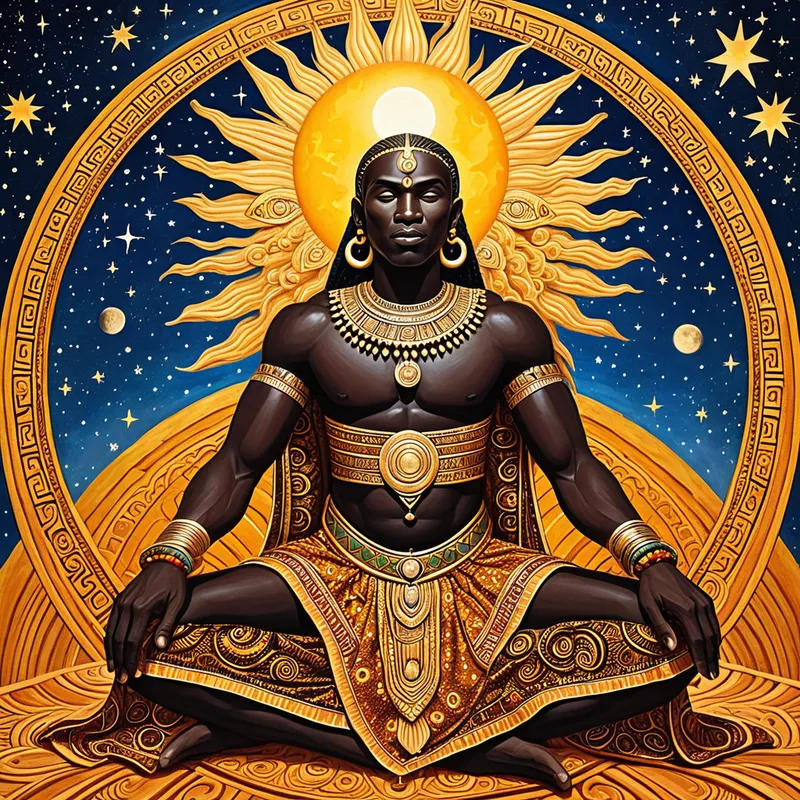
Mawu-Lisa the Dual Creator Myth Meaning & Symbolism
A West African myth of Mawu-Lisa, the primordial dual deity of moon and sun, whose harmonious dance births the cosmos and models the integration of opposites.
The Tale of Mawu-Lisa the Dual Creator
In the time before time, there was only the great, silent womb of Nunyame. No light pierced it, no sound echoed within it. It was a deep, dreaming potential, a breath held for eternity. And within that breath, two spirits slumbered, coiled together as one: Mawu and Lisa.
Their awakening was not a start, but a recognition. Mawu opened her eyes, and her gaze was the soft, silver light of the first moon, cool and gentle, illuminating the contours of possibility. Lisa stirred, and his presence was the first warmth, a golden promise of fire and life. They beheld each other, not as separate, but as the two essential breaths of a single being. In their gaze, the first thought was born: the world.
Mawu, with hands as gentle as nightfall, began to shape the substance of Nunyame. She drew forth the cool, dark waters and the fertile, receptive earth. She breathed life into the roots of great trees and the silent depths of caves. Her voice was the whisper of rain and the sigh of the wind through leaves. She crafted the rhythms of rest, of gestation, of the inward turn.
Then Lisa, with hands bright as noon, took what Mawu had shaped and gave it form and force. His touch hardened the mountains, set the rivers flowing with purpose, and pulled the great trees upward toward the sky. He lit the fire in the heart of the earth and placed the blazing sun in the vault of heaven. His voice was the crack of thunder and the roar of the lion, defining boundaries and imparting motion.
Together, in an eternal, harmonious dance, they populated the world. Mawu would conceive a creature in the quiet of her lunar mind—a fish, a bird, a human soul. Lisa would then give it its spark, its song, its place in the great chain of being. He gave the leopard its speed, the eagle its sight, and humanity the fire of intellect and the strength of will. Mawu gave them the gift of dreams, of compassion, and the deep, knowing connection to the earth that birthed them.
Their greatest creation was order itself. Mawu established the law, the moral fabric that would hold society together—truth, kindness, the sacred bonds of family. Lisa enforced it, ensuring justice and balance. They did not rule from a distant heaven but were immanent in their creation. The moon in the sky is Mawu’s watchful eye; the sun is Lisa’s vitalizing presence. The world was not made by conflict, but by a sublime, collaborative conversation between night and day, softness and strength, wisdom and action—a universe born from sacred marriage.
Cultural Origins & Context
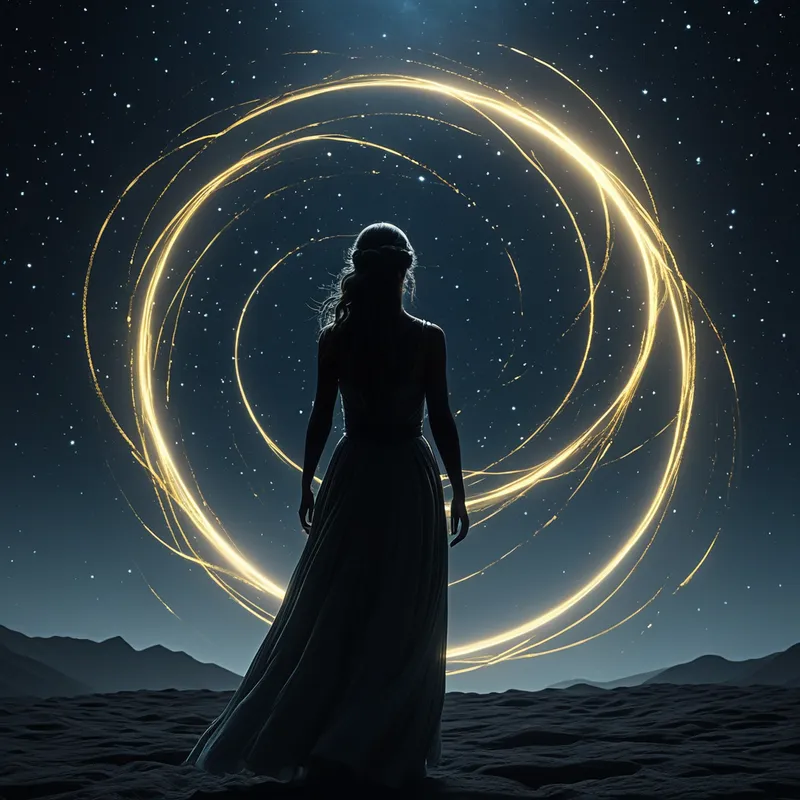
The myth of Mawu-Lisa originates primarily among the Fon people of Dahomey (modern-day Benin and Togo) and is also found in related Gbe-speaking cultures. This is not a myth confined to ancient scrolls; it is a living cosmology passed down through generations by oral historians, priests, and elders. It was traditionally recited during important rituals, festivals, and rites of passage, embedding its principles into the very structure of society.
Its societal function was profound. Mawu-Lisa provided a divine model for kingship (the king embodying Lisa’s authority, the queen mother embodying Mawu’s wisdom), for marriage (as a partnership of complementary forces), and for the community’s relationship with the natural world. The myth explained the fundamental order of the cosmos—why we have day and night, seasons, and moral law. It was a narrative anchor, teaching that balance, not domination, is the foundational principle of a healthy world, community, and individual.
Symbolic Architecture
At its core, Mawu-Lisa represents the archetypal unity of opposites, a primordial syzygy that precedes and generates all differentiation. This is not a hierarchy but a dynamic equilibrium.
Creation is not an act of a solitary will, but the child born from the intimate dialogue between receptivity and action, the container and the contained.
Psychologically, Mawu symbolizes the anima principle—the unconscious, the womb of ideas, intuition, compassion, and the capacity to hold and nurture. Lisa symbolizes the animus principle—consciousness, the will to form, logic, assertion, and the energy to bring potential into manifestation. The myth posits that wholeness exists not in one or the other, but in their conscious partnership. The world egg of Nunyame is the psyche itself, containing both in undifferentiated form. Creation is the act of psychological differentiation, where these innate capacities are recognized and set into their creative dance.
The Dreamer's Resonance
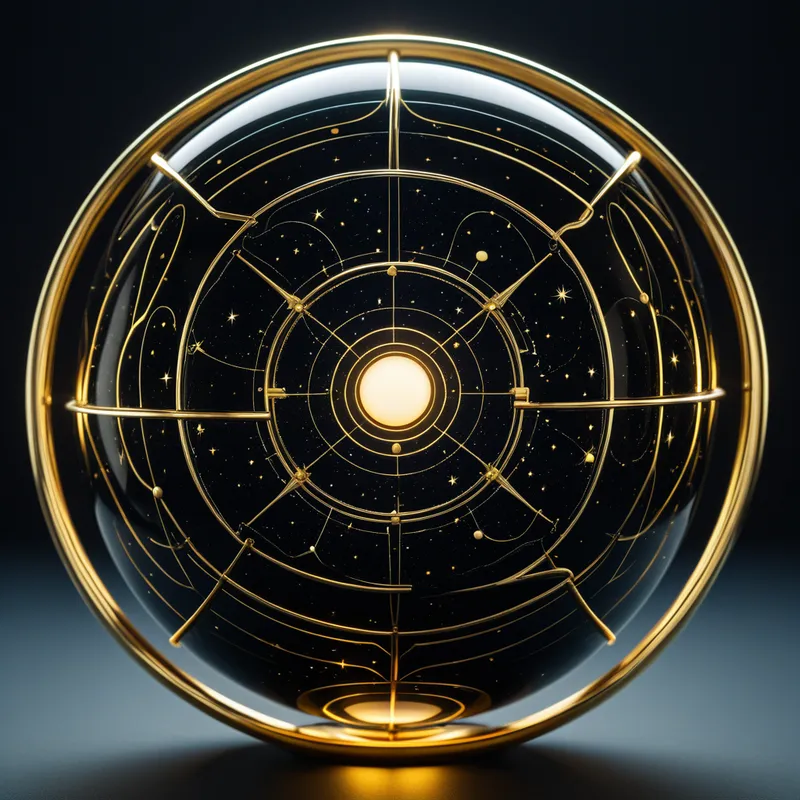
When this myth stirs in the modern unconscious, it often manifests in dreams of profound duality seeking reconciliation. One may dream of being two people at once, or of a house divided into a bright, busy wing and a cool, silent wing. There may be dreams of a marriage between a moon and a sun, or of trying to balance scales that hold radically different substances.
Somatically, this can feel like a tension between expansion and contraction, between the urge to act and the need to rest. Psychologically, it signals a critical stage where one’s over-identification with a single mode of being—perhaps the relentless, solar "Lisa" drive of productivity, or the withdrawn, lunar "Mawu" state of introspection—is causing imbalance. The dream is the psyche’s attempt to reintroduce the missing half, initiating a process of inner marriage. It is a call to honor the neglected aspect of the self, to allow the intuitive to inform the active, and for action to give shape to intuition.
Alchemical Translation
The individuation process, the journey toward psychic wholeness, is perfectly modeled by the Mawu-Lisa myth. For the modern individual, often fragmented by cultural demands to be solely logical or solely emotional, solely strong or solely soft, the path is one of sacred reintegration.
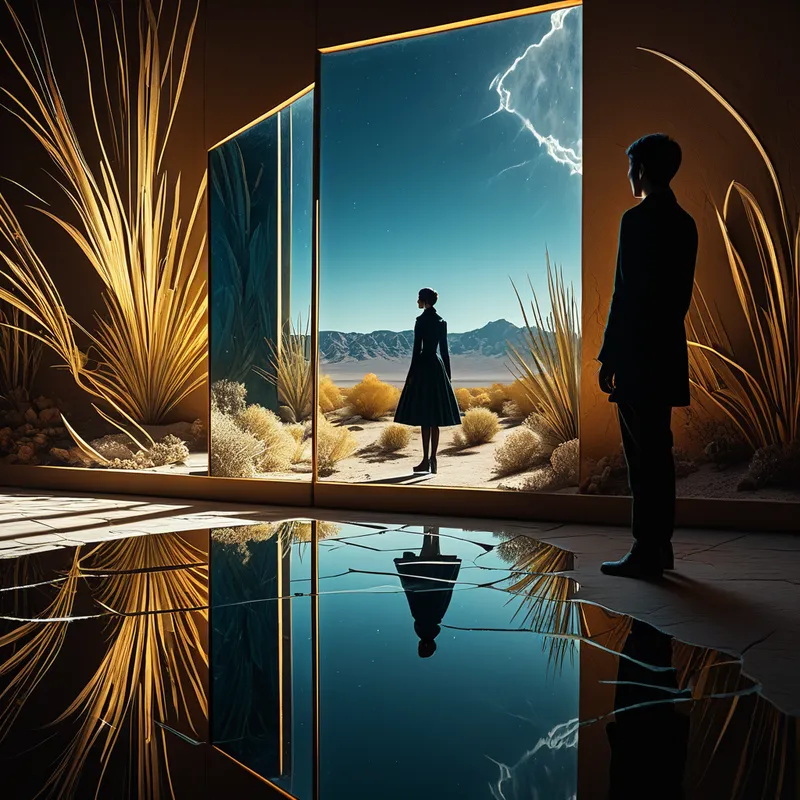
The alchemical gold is not found in purity, but in the perfected alloy of one’s inherent opposites.
The first stage is Nunyame: the fog of undifferentiation, where one’s capacities are confused and latent. The "work" begins with recognizing the distinct voices within—the Mawu voice that says "be still and know," and the Lisa voice that says "arise and do." The conflict many feel is the mistaken belief that these voices are enemies. The alchemical translation teaches they are co-creators.
The coniunctio, or sacred marriage, occurs when we consciously facilitate their dialogue. This might mean allowing a period of Mawu-like gestation (introspection, dreaming, receiving) for a new idea before unleashing Lisa-like execution (planning, building, launching). It means applying Lisa’s discipline to Mawu’s compassionate impulses to make them effective in the world, and using Mawu’s wisdom to temper Lisa’s potentially destructive force. The triumph is not the victory of one over the other, but the establishment of a sustainable, creative rhythm between them. The individual becomes a living embodiment of the dual creator: a vessel through which the universe continues its act of balanced creation.
Associated Symbols
Explore related symbols from the CaleaDream lexicon:
- Moon — Represents the Mawu principle: intuition, the unconscious, cyclical time, receptivity, dreams, and the gentle, formative power of night.
- Sun — Represents the Lisa principle: consciousness, vitality, linear time, action, clarity, and the active, defining power of day.
- Duality — The core theme of complementary opposites existing in a state of dynamic, creative tension rather than conflict.
- Creator — The archetypal force of genesis, embodied here not as a singular entity but as a collaborative partnership fundamental to all making.
- Balance — The ultimate goal and operating principle of the cosmos as established by Mawu-Lisa, signifying harmony between opposing forces.
- Circle — Symbolizes the cosmic egg of Nunyame, the wholeness of the dual deity, and the cyclical, eternal nature of their creative dance.
- Marriage — The sacred union of complementary principles, representing the internal and external partnerships that generate life and order.
- Earth — The primary creation of Mawu-Lisa, representing the manifested world born from the marriage of lunar and solar energies.
- Order — The divine law and structure imparted by the creators, establishing the framework for a harmonious cosmos and society.
- Dance — The eternal, rhythmic interaction between Mawu and Lisa, modeling the continuous, dynamic process of co-creation.