
Marjanah and Ali Baba
A clever slave girl outwits thieves to protect her master Ali Baba, revealing themes of loyalty and resourcefulness in Arabian folklore.
The Tale of Marjanah and Ali Baba
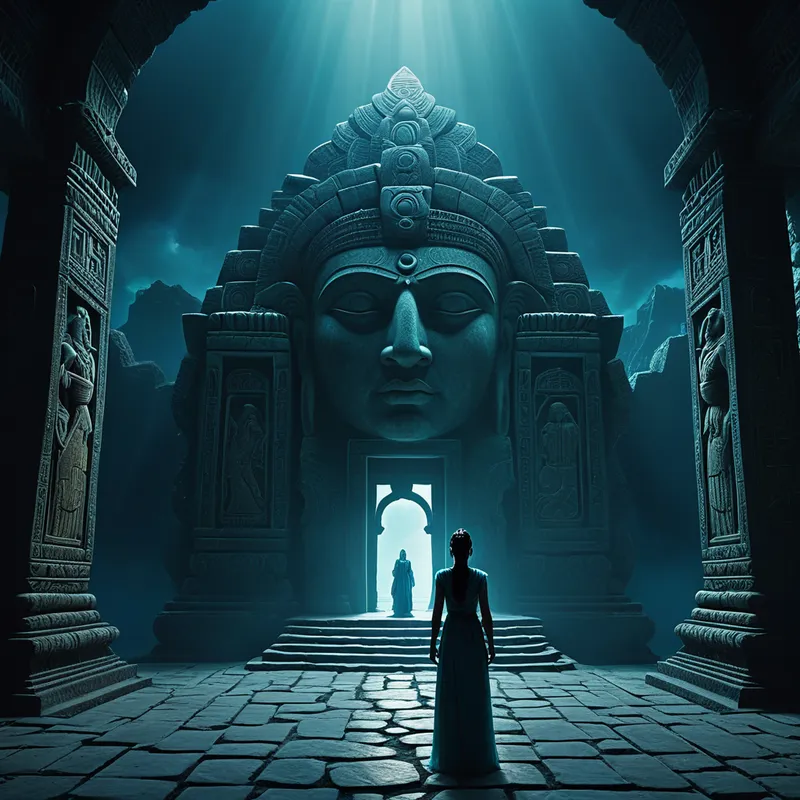
The story begins not with a hero, but with a man of modest means, Ali Baba, whose fate is changed by an act of witness. While gathering wood in a remote forest, he hides himself as a band of forty thieves approaches a sheer rock face. He hears their captain cry, “Open, Sesame!” and watches, breath held, as a hidden door in the stone swings wide. After the thieves depart, Ali Baba, driven by a mix of fear and wonder, speaks the same words. The cave opens to him, revealing a cavernous chamber piled high with silks, coins, and jewels—a hoard of ill-gotten gains accumulated over generations. He takes only what his donkeys can carry, a sensible portion, and returns home to a newfound, secret wealth.
But the thieves discover their loss. Through cunning of their own, they trace Ali Baba to his home. The captain, disguised as an oil merchant, arrives with his thirty-nine men hidden in large jars, carried by mules. He requests shelter for the night, intending to murder Ali Baba and his household once darkness falls. Here, the true protagonist of the tale emerges: Marjanah, Ali Baba’s intelligent and perceptive slave girl. Tasked with preparing a bath and supper for the guest, she finds the household lamp oil depleted. She decides to draw some from the merchant’s jars.
As she approaches the first jar, a whisper from within asks, “Is it time?” Marjanah, without a moment’s hesitation, replies in a disguised voice, “Not yet, but soon.” She repeats this encounter at each jar, discovering the deadly plot. With preternatural calm, she fetches a great cauldron of oil, heats it to boiling, and pours a lethal measure into each jar, silencing the thieves where they hide. When the captain later signals his men by throwing stones from his window, only the grim silence of hot oil answers him. He flees, but his vengeance is not spent.
The captain returns, insinuating himself into the confidence of Ali Baba’s household, even earning the trust of Ali Baba’s son. Yet Marjanah, ever vigilant, recognizes the stranger from the market. To confirm her suspicion and protect her master, she devises a test. As a dancer performing at a dinner, she unveils a dagger from her belt and, in the climax of her performance, plunges it into the heart of the disguised captain, ending the threat forever. In reward for her loyalty and cleverness, Ali Baba grants Marjanah her freedom, and his son, having witnessed her extraordinary qualities, takes her as his wife. The secret of the cave and its treasure passes to them, guarded now not by violence, but by wisdom.
Cultural Origins & Context
The tale of Ali Baba and Marjanah is one of the most beloved narratives from the One Thousand and One Nights (often known in the West as the Arabian Nights). Unlike some core stories traced to Persian or Indian origins, “Ali Baba and the Forty Thieves” is considered a “orphan tale,” likely a later addition from a Syrian storyteller’s repertoire, incorporated into the manuscript tradition in the 18th century. Its setting, however, is deeply grounded in the social and economic realities of the medieval Islamic world. The story unfolds in a mercantile landscape where wealth is tangible—coin, spice, silk, oil—and its sudden acquisition is both a blessing and a profound danger.
Marjanah’s role is particularly significant. As an enslaved person, her legal and social status was dhimmi or property, yet the narrative subverts this position entirely. Her intellect and agency become the linchpin of the household’s survival, reflecting a folk wisdom that recognizes capability and virtue beyond station. Her eventual manumission and marriage into the family represent a social mobility rare in reality but cherished in folklore, rewarding inner merit over inherited rank. The tale thus operates within a framework of divine justice and cleverness (‘aql), where the loyal and resourceful individual, even from the margins, can restore order and secure prosperity.
Symbolic Architecture
At its heart, this is a myth of consciousness confronting the unconscious. The Cave is the ultimate symbol of the hidden psyche, a chthonic vault containing both the glittering wealth of potential and the lurking danger of repressed contents—the thieves. The password “Open, Sesame!” is a verbal Key, a spell of invocation that makes the permeable boundary between the everyday world and the numinous realm explicit. Ali Baba’s initial foray is that of the naïve ego, stumbling upon riches it does not fully understand and cannot yet integrate.
The thieves represent the autonomous complexes—the bundled energies of greed, violence, and shadow—that guard this inner wealth. To take the treasure without integrating its guardians is to invite a deadly backlash.
Marjanah embodies the integrating function of consciousness. She does not enter the cave; she protects the home—the seat of identity and relationship—from the cave’s vengeful emanations. Her tools are domestic: oil, a cauldron, a dagger used in dance. She transforms the substance meant for light (lamp oil) into an instrument of purgative fire, and the art of performance into a vehicle of decisive action. Her cleverness is a form of psychological hygiene, identifying and neutralizing the invasive, destructive elements before they can erupt into the living space of the self.

The Dreamer's Resonance
For the individual psyche, this tale maps the perilous journey of engaging with one’s own depth. The call to “open sesame” is the call to explore one’s hidden capacities, traumas, and inherited psychic wealth. Like Ali Baba, one may initially be a passive witness, then a frightened appropriator. The treasure, however, always demands a price: the confrontation with the “forty thieves.” These can manifest as recurring negative thought patterns, self-sabotaging behaviors, or eruptive emotions that seek to reclaim the nascent consciousness that has “stolen” their energy.
Marjanah represents the vigilant, discerning intelligence within us that must manage this process. She is the part of the self that notices when something feels “off” (the whisper from the jar), that devises strategies to contain and transform threat (the boiling oil), and that has the courage to deliver the final, integrating blow when deception is unmasked. Her movement from slavery to partnership signifies the dreamer’s need to elevate this discerning intelligence from a servile, automatic function to a co-regent of the psyche, married to the forward-moving spirit (Ali Baba’s son).

Alchemical Translation
The myth is a precise allegory for the alchemical opus. The Cave is the vas hermeticum, the sealed vessel where the great work occurs. The mixed treasure is the prima materia, the chaotic, valuable base substance. The thieves are the volatile, corrosive spirits that must be fixed and subdued.
Marjanah’s boiling oil is the ablutio and separatio—the washing and separation of the pure from the impure through the application of controlled fire. Her dance with the dagger is the coniunctio oppositorum, the sacred marriage where the penetrating spirit (dagger) unites with the rhythmic, embodied soul (dance) to slay the last vestige of deceit, leaving only the purified gold of an integrated self.
The final reward is not merely material wealth, but the elixir vitae: freedom, legitimate belonging, and the stewardship of the secret itself. The treasure is no longer a hoard to be feared, but a legacy to be wisely managed, having passed through the fire of ordeal.
Associated Symbols
Explore related symbols from the CaleaDream lexicon:
- Cave — The hidden chamber of the unconscious, containing both immense psychic wealth and the autonomous, guarding complexes that must be integrated.
- Key — The secret word or insight that unlocks access to hidden dimensions of the self or the world, representing the power of correct knowledge.
- Fire — The transformative agent of purification and destruction; the boiling oil that neutralizes latent threats and prepares the way for a new order.
- Dance — The ritualized, embodied expression of truth, which here becomes the vehicle for a fatal and necessary act of integration, merging art with decisive action.
- Oil — A substance of illumination and anointing, here alchemically reversed into an instrument of cleansing violence, showing the dual nature of vital substances.
- Door — The permeable threshold between the known world and the realm of mystery, which opens only to those who speak the precise, resonant formula.
- Shadow — The collective of thieves representing the repressed, dangerous, and autonomous aspects of the psyche that guard the treasure of wholeness.
- Treasure — The accumulated, often dormant potential of the psyche—talents, insights, and ancestral wisdom—that requires ordeal to claim and integrate.
- Dagger — The penetrating instrument of discernment and decisive action, which cuts through deception and severs the lingering ties to a destructive complex.
- Master/Slave — The initial internal hierarchy of the psyche, where conscious agency is subservient to habit, transformed into a partnership of mutual respect and shared sovereignty.