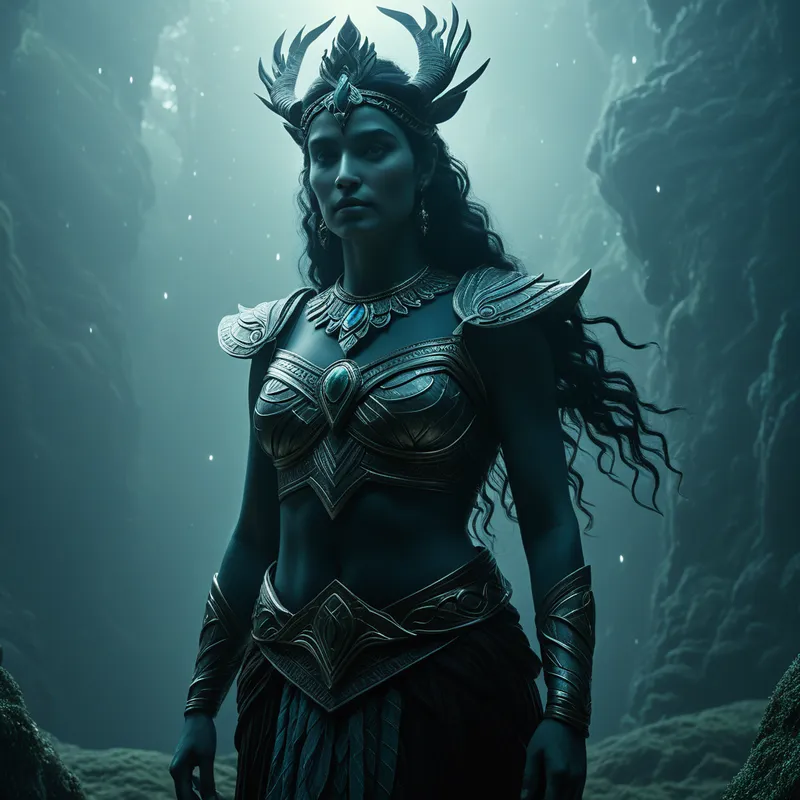
Maria Sinukuan
A powerful Filipino mountain goddess who embodies both nurturing abundance and fierce protection, reflecting the dual nature of nature itself.
The Tale of Maria Sinukuan
In the heart of Luzon, the great island of the Philippines, rises a mountain of mist and myth: Mount Arayat. Its slopes are cloaked in dense, whispering forests, and its peak often vanishes into the clouds, a realm apart from the world of men. This is the sacred domain of Maria Sinukuan, the lady of the mountain. Her story is not one of distant Olympus, but of intimate, earthy presence.
She is the spirit of the mountain made manifest, a being of profound contradiction. To the respectful and the humble, she is Inang Bundok—Mother Mountain. Her forests offer boundless bounty: fruits that never seem to spoil, game that is plentiful and tender, rivers running clear and cool. A weary hunter, lost and hungry, might stumble upon a grove of trees heavy with lanzones, their skins golden and sweet, placed there just for him. A farmer praying for rain might find the springs at her feet flowing more generously. She is the ultimate caregiver, her abundance a direct reflection of her nurturing heart, a promise that nature, when honored, provides.
But let a soul grow greedy, or let a hand take more than is needed, and her face changes. The same forests that offered sanctuary become a labyrinth of thorns and shadows. The benevolent mother reveals herself as the fierce guardian. Tales whisper of those who tried to steal her magical fruits or hunt her sacred white boar. They found the paths they knew vanishing, the friendly trees turning hostile. Bounties transformed into curses; sweet fruits turned to stone in the mouth, or the very game they carried doubled in weight, becoming an unbearable burden that pinned them to the mountain’s side. Her wrath is not a lightning bolt from the sky, but a chilling transformation of the landscape itself. She does not destroy the intruder from without; she allows the mountain’s spirit to turn their own greed against them, a psychological wilderness reflecting their internal trespass.
Cultural Origins & Context
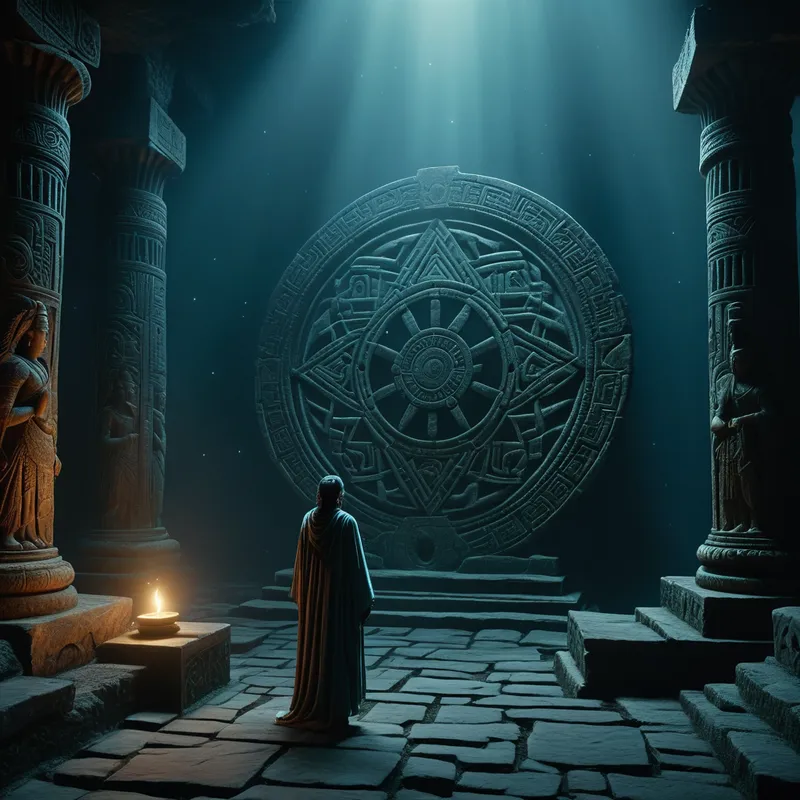
Maria Sinukuan is a powerful syncretic figure, a bridge between worlds. Her roots dig deep into the pre-colonial animist soil of the Kapampangan and other Luzon peoples, for whom every mountain, river, and tree housed an anito, a spirit. The mountain itself was a living deity, Arayat. With the arrival of Spanish colonization and Catholicism, a profound cultural alchemy occurred. The indigenous mountain spirit was grafted onto the familiar framework of a saint or a divine feminine figure—hence the name “Maria,” a layer of Christian veneration over the ancient, pagan heart. “Sinukuan” derives from suku, meaning “to end” or “to surrender,” hinting at her role as the final authority, the one to whom the land and its fate ultimately yield.
This fusion created a uniquely Filipino resilience. The goddess could not be erased; she was simply translated, her worship continuing under a permissible guise. She embodies the Filipino concept of loob—the inner self, the interior landscape that connects person, community, and environment. To have magandang loob (beautiful interior) towards Maria Sinukuan is to approach with respect and right relationship. To have masamang loob (bad interior) is to invite her transformative justice. She is not a myth of the past, but a living articulation of the sacred contract between a people and their land, surviving conquest by wearing a mask the conquerors could recognize.
Symbolic Architecture
Maria Sinukuan’s myth constructs a profound psychological and ecological model. She represents the complete, un-split psyche of nature—and by extension, the human psyche that mirrors it. There is no separation between her kindness and her severity; they are two breaths of the same being.
She is the archetypal Great Mother in her full spectrum: the womb that gives life and the tomb that reclaims it. Her mountain is both sanctuary and prison, depending on the attitude of the one who enters.
Her duality refuses the simplistic split into “good goddess” and “angry goddess.” Instead, she presents a unified field of consciousness where care and boundary are inseparable. To receive her nurture, one must implicitly accept her law. This makes her a deity of profound integrity. Her protection is not passive; it is active, intelligent, and conditional upon reciprocity. She teaches that true abundance is not a free-for-all, but a sacred exchange based on respect and limit.
The Dreamer's Resonance
To encounter Maria Sinukuan in the imaginal realm—whether in dream, vision, or deep reflection—is to confront the nature of one’s own desires and boundaries. She appears when the question of “enough” arises. Are we taking with gratitude or with greed? Are we relating to the resources of our own soul—our creativity, our energy, our love—with respect, or are we exploiting them?
She symbolizes the internal caregiver who must sometimes become fierce to protect the sanctity of the inner world. An individual who cannot say “no,” who gives until they are depleted, may dream of a barren, wrathful mountain. This is Maria Sinukuan reflecting back the exhaustion of a psyche that has failed to protect its own bounty. Conversely, connecting with her nurturing aspect can feel like discovering an inner wellspring of resilience and unconditional support, a core self that provides and sustains. She models a wholeness where self-care and self-protection are not selfish, but sacred duties.

Alchemical Translation
The alchemy of Maria Sinukuan is the transformation of raw appetite into sacred relationship. Her myth performs the opus of turning the leaden weight of greed into the golden awareness of enough. The transgressor who is pinned by the weight of their stolen bounty undergoes a brutal but initiatory ordeal. The mountain itself becomes the alchemical vessel, the vas, in which the psyche is broken down and reconstituted.
The process is one of solve et coagula: the old, grasping identity is dissolved in the acid of her wrath, only to be reconstituted in humility and understanding. One does not conquer the mountain; one is reconfigured by it.
Psychologically, this is the journey from entitlement to gratitude, from exploitation to stewardship. It is the recognition that the Mother is not a servant, but a sovereign. The ultimate goal is not to avoid her fierce face, but to integrate its lesson, to internalize her law so completely that one lives in harmony with it, thus forever residing in her grace. She offers not salvation from nature’s laws, but initiation into them.
Associated Symbols
Explore related symbols from the CaleaDream lexicon:
- Mountain — The immutable, enduring body of the goddess, representing both spiritual ascent and the formidable, grounding reality of nature’s law.
- Mother — The primal source of nurture and provision, whose love is inseparable from the necessity of setting life-giving boundaries.
- Forest — The lush, mysterious embodiment of her abundance and the labyrinthine trials she presents to those who lose their way in greed or disrespect.
- Goddess — The divine feminine principle in its complete, unsplit form, encompassing creation, sustenance, and the righteous reclamation of all things.
- Duality Mask — The single face that presents two aspects, revealing that nurture and wrath are not separate identities but different expressions of the same profound integrity.
- Abundance — The limitless, generative flow that springs from a sacred source, contingent upon the receiver’s capacity for reverence and right relationship.
- Stone — The transformed fruit of greed, symbolizing the petrification that occurs when living bounty is met with a hardened, entitled heart.
- Boundary — The invisible but potent law of the mountain, the essential structure that makes genuine care and sustainable abundance possible.
- Greed — The shadow of hunger, the force that seeks to possess and hoard the generative flow, thereby triggering its transformative cessation.
- Sacrifice — Not an act of loss, but the essential offering of respect and limit that maintains the sacred exchange between the human and the divine.
- Rebirth — The psychological renewal possible after the ordeal of the mountain, where one is remade with a new understanding of enough and a healed relationship to source.
- Amulet of Protection — The internalized lesson of her law, a psychic talisman born of respect that allows one to move safely within realms of great power and bounty.