Mara Myth Meaning & Symbolism
The story of the Buddha's final trial beneath the Bodhi tree, where the demon Mara assaults him with desire, doubt, and fear before his awakening.
The Tale of Mara
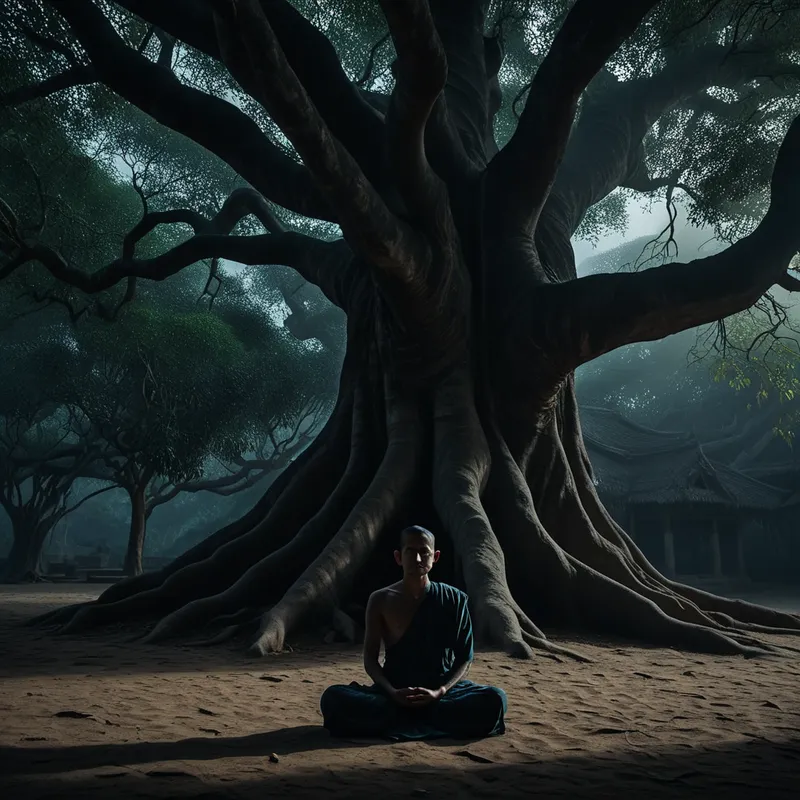
The air beneath the Bodhi tree was thick, not with humidity, but with potential. Siddhartha Gautama sat upon the immovable earth, a vow etched into his bones: he would not rise until he had pierced the final veil. The world held its breath. The gods watched from the high heavens, and the demons stirred in the depths.
He was known as Mara, the Lord of the Realm of Desire, the Great Tempter, the one who binds beings to the wheel of suffering. He felt a tremor in his domain—a vibration of imminent freedom. A man was about to slip the noose. This could not stand.
First, he sent his daughters, the epitome of sensual allure. They danced from the shadows, forms shifting from exquisite beauty to tender vulnerability, their voices a symphony of promised pleasure and comforting attachment. “Take your rest,” they seemed to whisper, “the path is too harsh. Embrace the world you know.” Siddhartha’s gaze remained inward, unmoved. The illusions dissolved like mist in a steady wind.
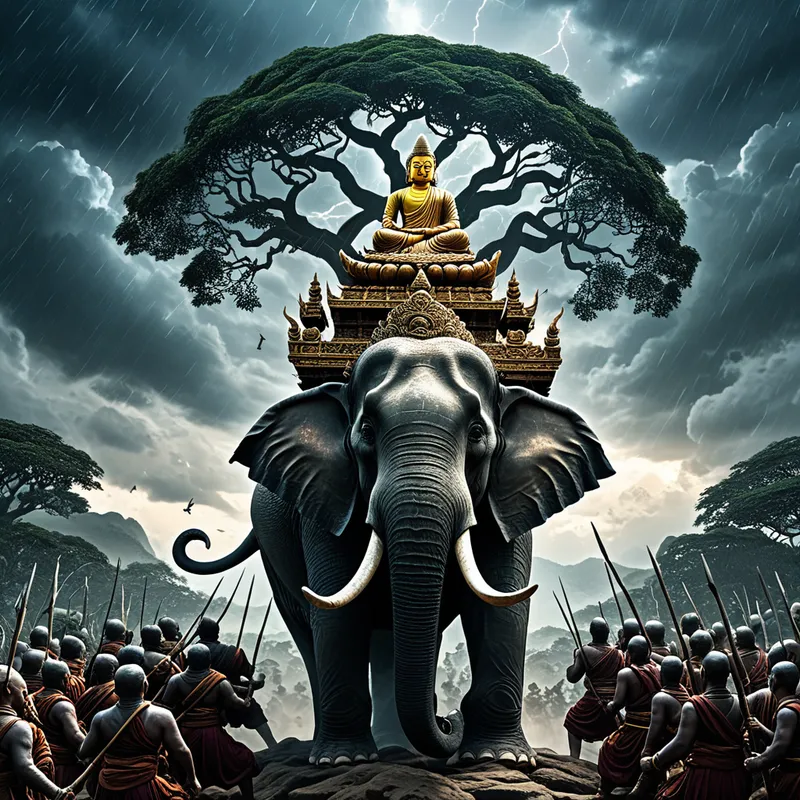
Enraged, Mara summoned his true might. The sky darkened with his legion. This was no earthly army, but a host of nightmares given form: snarling beasts with eyes of fire, warriors clad in black armor screaming silent warcries, hulking monsters of pure dread. The air crackled with the energy of a thousand violent intentions. Mara himself, mounted upon his colossal war elephant Girimekhala, led the charge. “Yield this seat!” Mara thundered, his voice the sound of crumbling empires. “It belongs to me!”
Siddhartha opened his eyes. The cataclysm approached, a tsunami of fear and aggression. He did not flinch. Slowly, he reached down and touched the earth with the fingertips of his right hand. “This earth,” he said, his voice quiet yet piercing the tumult, “is my witness. Through countless lifetimes of generosity and virtue, I have earned this seat.”
The moment his fingers met the soil, the earth itself roared in affirmation. The goddess Sthavara emerged, her form vast and maternal, and with a torrent of water that washed from her hair—the accumulated waters of the Buddha’s boundless merit—she swept Mara’s phantom army away. The demons fled, shrieking, into the void from which they came. Mara, defeated, vanished.
In the profound silence that followed, with the tempter’s shadow dispelled, Siddhartha turned his perception to the true nature of existence. As the morning star rose in the pre-dawn sky, he saw with utter clarity. He was awake. He was the Buddha.
Cultural Origins & Context
The myth of Mara is not a peripheral folktale but a central, defining drama within the early Buddhist textual tradition, primarily found in the Sutta Pitaka. It functions as the climactic prelude to the enlightenment event itself. Narrated by the Buddha after his awakening, the story was passed down orally by the monastic community (Sangha) for centuries before being committed to writing.
Its societal function was multifaceted. For monks and nuns, it served as a powerful pedagogical allegory for the internal obstacles on the meditative path. For lay followers, it externalized the immense difficulty and heroic nature of the Buddha’s achievement, legitimizing his authority as one who had truly conquered all foes. The myth provided a shared symbolic language for the very real experiences of temptation, doubt, and fear that any practitioner would encounter, framing them not as personal failures, but as the expected assaults of Namuci, the implacable force of delusion.
Symbolic Architecture
Mara is not a discrete external devil, but the personification of the entire psychic system that constitutes the unawakened mind. He is the architect of the prison, and his weapons are the very materials from which the prison is built.
His three daughters—often named Tanha (Craving), Arati (Aversion/Dissatisfaction), and Raga (Lust/Passion)—represent the fundamental emotional pulls that generate Samsara. The monstrous army symbolizes the eruption of raw, undifferentiated psychological afflictions: fear, aggression, pride, and despair. Mara’s final challenge—claiming the seat of enlightenment—is the ultimate deception of the ego, which believes ownership, achievement, and even spiritual attainment are its personal possessions.
The true battle is not against a demon, but for the sovereignty of attention. Mara wins when consciousness identifies with the storm. The Buddha wins when consciousness becomes the sky that holds it.
The gesture of the Bhumisparsha Mudra is the pivotal symbolic act. It represents grounding in reality, in truth (Dharma), and in the accumulated weight of one’s own authentic experience and virtuous action. It is the shift from being a subject battered by phenomena to becoming an unwavering witness rooted in the real.
The Dreamer's Resonance
When the pattern of Mara manifests in modern dreams, it rarely appears as a mythological demon king. Instead, the dreamer undergoes a somatic and psychological process of confronting the “inner obstruction.”
One may dream of being paralyzed on the eve of a crucial life event, besieged by a cacophony of critical voices (Mara’s army) that sound suspiciously like one’s own inner critic, parents, or societal expectations. Another may experience seductive dreams of abandoning a difficult but meaningful path for a life of comfortable numbness (the daughters’ allure). The setting is often a liminal space—a dark room, an empty road at night, the moment before a presentation or performance—mirroring the Bodhi tree as the threshold between ignorance and awakening.
The somatic experience is key: a tightening in the chest (fear), a flush of heat or agitation (anger), a heavy lethargy (doubt). The dream is the psyche’s theater, staging the confrontation between the emerging, more authentic self and the entrenched, defensive complex that seeks to maintain the status quo. The dream-Mara is the shadow not of evil, but of inertia and identification.
Alchemical Translation
The myth models the complete process of psychic transmutation, or individuation, for the modern individual. The journey to the “seat of enlightenment” is the journey to the integrated Self.
First, one must sit down in the place of seeking (the Bodhi tree). This is the commitment to self-inquiry, to therapy, to a creative practice, or any discipline that promises deeper truth. Immediately, the “Mara-system” activates. The alchemy of the daughters is the recognition that our deepest attachments and aversions are not enemies to be destroyed, but energies to be understood and transmuted. Craving, when seen clearly, reveals the structure of desire. Aversion points directly to what we fear to lose.
The onslaught of the army is the inevitable crisis. As the old identity destabilizes, the psyche unleashes a flood of anxiety, old wounds, and self-sabotaging behaviors. This is not a sign of failure, but of the process working. The ego, feeling annihilated, marshals every defense.
The transformative moment is not victory in battle, but the change of posture from combatant to witness. The hand touching the earth is the ego surrendering its claim to the throne, allowing the deeper, transpersonal Self to bear witness.
The earth-touching gesture is the alchemical key. It is the act of grounding in the body, in felt sensation, in the concrete reality of the present moment—“This, here, now.” It is invoking one’s own lived experience and inherent worth as the ultimate authority. When one stops arguing with the projections and simply acknowledges, “This is what is arising,” the projections lose their power to define reality. The army was always composed of shadow and suggestion; it disperses when the light of non-identified awareness is turned upon it.
The enlightenment that follows is the internal re-alignment. It is not the acquisition of something new, but the realization of what was always present once the obstructing patterns—the very substance of Mara—are seen through. The individual becomes, in a psychological sense, self-governed. The tempter remains in the world, but can no longer claim the seat of consciousness. One is free to engage with life, not as a prisoner of reaction, but from the unshakable ground of being.
Associated Symbols
Explore related symbols from the CaleaDream lexicon: