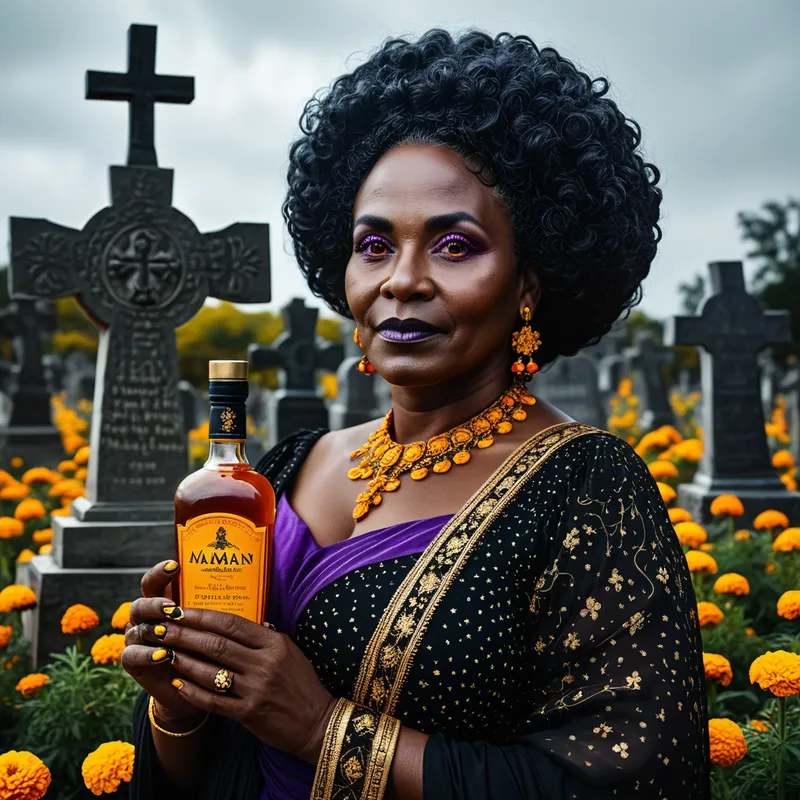
Maman Brigitte Myth Meaning & Symbolism
The story of the fiery Vodou lwa who married death to become the protector of graves, the mother of spirits, and the arbiter of sacred justice.
The Tale of Maman Brigitte
Listen. There is a story whispered where the iron crosses stand sentinel and the scent of rum hangs thick in the humid air. It is not a story for the faint of heart, for it begins not in life, but in the great crossing-over.
Before time was counted as we count it, there was a woman of fire and iron. She walked the green hills of a land far across the salt-water, a spirit of such fierce vitality that the very earth trembled with her laughter. But destiny is a serpent that bites its own tail. A great shadow fell—sickness, or violence, or the slow sigh of time—and her vibrant flesh became still. Her journey was not ended, but transformed. She crossed the black water of the Ginen, not as a supplicant, but as a queen in exile.
She arrived at the shores of the spirit world, a place of mist and memory. The guardians there, accustomed to receiving broken, weeping souls, drew back. For she did not weep. She surveyed the realm of the dead with the keen eye of a farmer surveying fallow land. She saw the disorder, the grief untended, the spirits lost and wandering without honor. A righteous fury, hot as Scotch bonnet pepper, ignited within her.
She went to Baron Samedi, the master of the crossroads, the lord of the cemetery. He was lounging against a tomb, smoking a cigar, his top hat tipped at a jaunty angle. "You are in my yard," he drawled, his voice like dry earth shifting.
"I am not in your yard," she replied, her voice clear as shattered glass. "I am surveying my inheritance. This place is a mess. The dead are thirsty. The graves are cold."
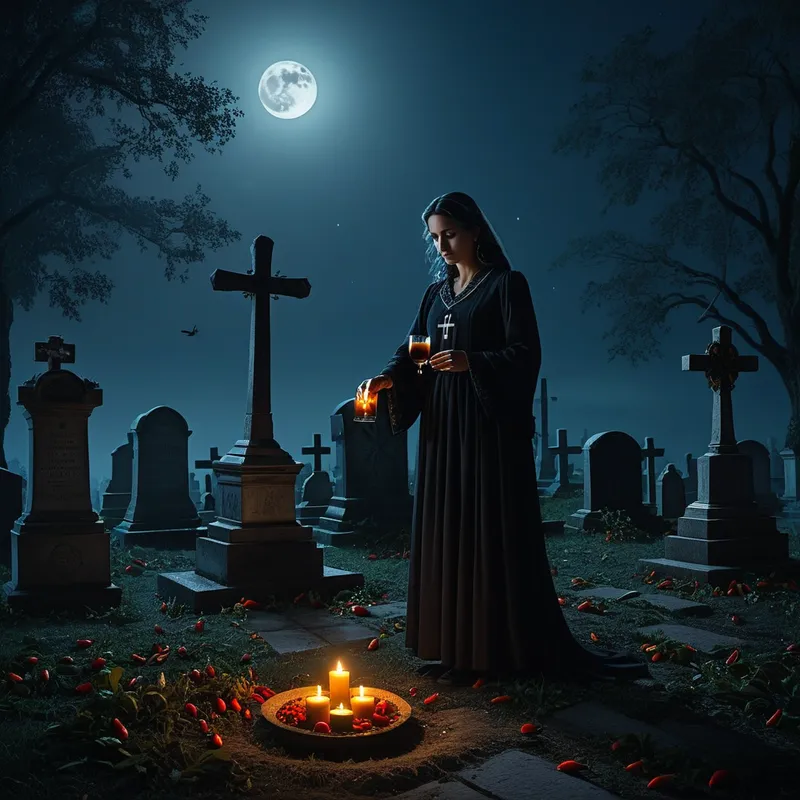
The Baron laughed, a sound like stones rattling in a gourd. No one spoke to him so. Intrigued, he offered her the traditional greeting for the newly arrived: a sip of rum. She took the bottle, not to sip, but to pour a generous libation onto the nearest grave. Then, from the folds of her skirt, she produced a handful of tiny, fiery peppers and crushed them into the rum. She drank deeply, her eyes never leaving his. Fire met fire. Chaos met order. Death met a love so fierce it would not be severed by the grave.
In that moment, the cemetery was no longer just a field of endings. It became a court. She became Maman Brigitte, the first wife of the Baron, the mother of the Gédé. She took the black cross for her own, decorating it not with mourning, but with vibrant purple and silver, with offerings of rum and hot peppers. She established the law: the dead must be called by name. They must be given their libations. Their stories must be told, or she would hear of it. Her justice was swift—a sudden fever, a stinging rebuke in a dream—for those who neglected their ancestors. But for the faithful, for the broken-hearted who came to her with honest tears, she was a comfort. She would sit with them in the dirt, share their rum, and teach them that true mourning is not forgetting, but a sacred, ongoing conversation across the veil.
Cultural Origins & Context
Maman Brigitte is a powerful testament to the resilience and creativity of the African Diaspora, specifically within the Vodou tradition of Haiti. Her origins are syncretic, a spiritual alchemy born from profound trauma and cultural survival. Scholars see in her the fierce warrior queens and mother goddesses of the Dahomey and Kongo regions, reborn in the New World. Her name and certain attributes—a connection to justice, sacred wells, and fiery spirit—show a deliberate alignment with the Celtic Saint Brigid of Kildare, a strategy of cultural camouflage and synthesis employed by enslaved Africans under oppressive Catholic colonial rule.
Her myth was not written in books but inscribed in ritual, song, and the collective memory of the community. It was passed down by Houngans and Mambos, and lived by every individual who ever poured a libation at a family grave. Societally, Maman Brigitte served a critical function. In a world where enslaved and later oppressed people were systematically stripped of their history, family ties, and legal personhood, she became the divine guarantor of identity and legacy. She enforced the sacred duty of remembrance, creating an unbreakable chain of belonging that no plantation or colonial power could sever. She provided a framework to process immense, collective grief, transforming it from a paralyzing force into a source of spiritual power and connection.
Symbolic Architecture
Maman Brigitte is the archetypal guardian of the threshold between the living and the dead. She symbolizes the transformative power of confronting the ultimate reality of death and loss, not with passive acceptance, but with active, fiery engagement.
She represents the principle that to truly care for the living, one must first learn to honor the dead. Her motherhood is not of the cradle, but of the crypt—a fierce, protective love that extends beyond the biological into the realm of eternal spirit.
Her symbols are profound in their duality. The pepper represents the searing pain of grief and the "spice" or vitality that must be returned to memory to keep it alive. The rum is both an intoxicant that loosens the tongue for truth-telling and a libation that nourishes the ancestors. The tignon signifies dignity, resilience, and hidden wisdom. Most powerfully, the cemetery under her care is not a place of finality, but a fertile field. It is the crossroads where tears water the roots of the family tree, ensuring its growth into the future.
Psychologically, she embodies the capacity to hold profound contradiction: life-in-death, love-in-loss, justice-in-chaos. She is the part of the psyche that can look directly at what is broken, buried, or shameful in one's personal or ancestral history, and through the act of sacred witnessing, begin to heal it.
The Dreamer's Resonance
When the pattern of Maman Brigitte stirs in the modern dreamer, it often signals a profound somatic and psychological process: the necessary confrontation with ancestral or personal grief that has been buried, but not laid to rest. This is not the acute sadness of a recent loss, but the chronic, haunting presence of unmourned history.
Dreams may feature neglected gravesites that the dreamer is compelled to clean, encounters with formidable yet compassionate female figures in liminal spaces (crossroads, shorelines, doorways), or rituals involving spicy food, dark liquids, or the giving of gifts to unseen presences. Somatically, the dreamer may awaken with a feeling of pressure in the chest (the buried grief) or a fiery sensation in the throat (the truth demanding to be spoken).
The psychological process is one of re-membering—literally, putting the members (the parts of the self, the fragments of story) back together. Maman Brigitte in dreams acts as the psychopomp for these dismembered parts, guiding the dreamer to acknowledge the wounds, name the losses, and perform the internal libation. This often feels less like catharsis and more like a solemn, daunting responsibility. The dreamer is being called to become the priest/priestess of their own lineage, to tend the graves of their inner history so that new life can grow.

Alchemical Translation
The myth of Maman Brigitte models a complete alchemy of the soul, a roadmap for the individuation process through the crucible of loss. The core struggle is the human resistance to facing mortality, failure, and inherited pain. Her triumph is the transmutation of that leaden weight into spiritual gold.
The process begins with the descent—the involuntary crossing into the "cemetery" of one's psyche, where repressed memories, family secrets, and old sorrows lie buried. The modern individual, like Maman Brigitte, must choose not to be a victim of this landscape but its sovereign. This is the confrontation: sitting in the dirt of one's own shadow, engaging directly with the Baron Samedi aspects of one's nature (the cynicism, the fear, the obscenity of pain).
The alchemical fire is not avoidance, but the pepper-infused rum of conscious, felt experience. One must drink the bitter truth of what was and what was lost.
The transmutation occurs through the establishment of inner law and ritual. Maman Brigitte's decree—"call them by name"—becomes the psychological imperative to articulate the pain, to journal the family story, to speak the unspeakable in therapy or art. This sacred naming converts chaotic grief into structured legacy. The final stage is integration. The cemetery is no longer a haunted place to avoid, but a tended garden within the self. The ancestor-spirits—the patterns, traits, and stories of one's lineage—are no longer ghosts that haunt, but allies that inform. The individual achieves a profound wholeness, having married the life force to the reality of death, and in doing so, becomes a true caregiver—to themselves, their history, and the future they will seed.
Associated Symbols
Explore related symbols from the CaleaDream lexicon:
- Cross — The black iron cross of the cemetery, transformed under Maman Brigitte's care into a sacred crossroads and a symbol of the intersection between life and death, the vertical axis of spirit meeting the horizontal plane of the earthly world.
- Grave — Represents the place of burial and memory, which in this myth is not an end but a site of potent fertility, dialogue, and the source of ancestral power.
- Spirit — The essential force of the ancestors and the lwa, whom Maman Brigitte protects and mediates, emphasizing the ongoing, active presence of the non-corporeal world.
- Ritual — The libations, prayers, and offerings (like pepper-infused rum) that are the sacred language of communion with Maman Brigitte and the dead, turning grief into structured, meaningful practice.
- Mother — She embodies a fierce, protective, and demanding motherhood that extends beyond biological kinship to encompass all the spiritual children and ancestors under her care.
- Justice — Maman Brigitte's core function as the divine arbiter who ensures the dead are remembered and the living fulfill their sacred duties, representing a moral order based on reciprocity.
- Fire — Symbolizes her fierce, unyielding vitality, the searing truth she demands, and the transformative energy of the hot peppers she is associated with, which burn away neglect.
- Death — The fundamental realm she rules alongside Baron Samedi, reframed not as mere extinction but as a transition into another state of being and a source of authority.
- Ancestor — The collective dead whom she champions and nurtures, representing the foundational link of identity, wisdom, and strength that flows from the past.
- Healing — The profound mending she facilitates, which comes not from forgetting trauma and loss, but from confronting it with honor and integrating it into the fabric of the self and community.