Mama Quilla
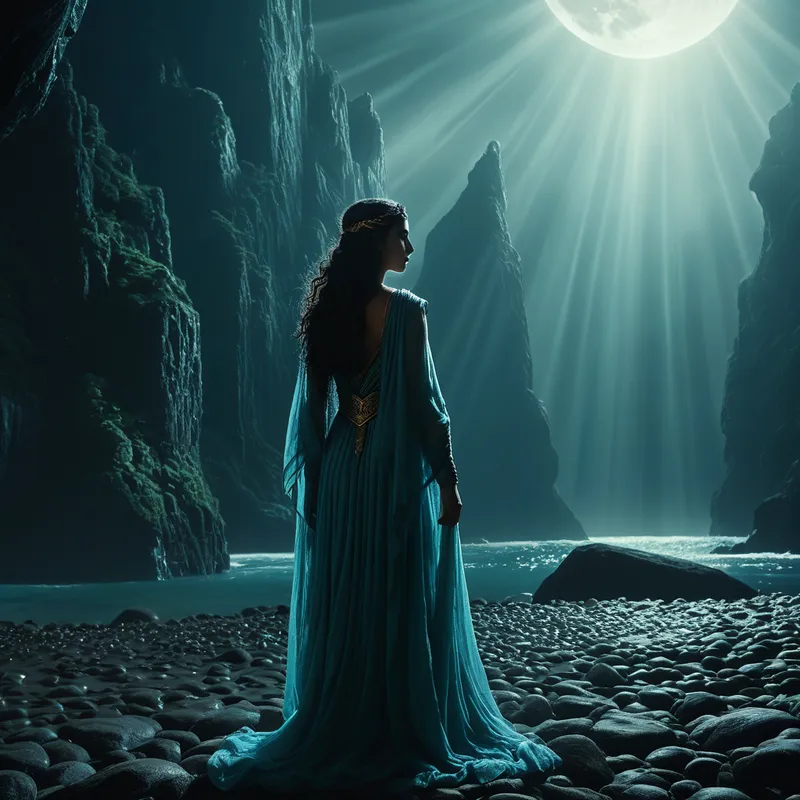
The Incan moon goddess who governed time, protected women, and wept silver tears during eclipses, embodying both nurturing and destructive lunar forces.
The Tale of Mama Quilla
In the beginning, when the world was still cloaked in primal shadow, the great creator Viracocha brought forth the celestial family to bring order to the cosmos. From the void, he summoned Inti, the resplendent Sun, to rule the day with warmth and life-giving power. And as a necessary counterpart, a gentle balance to that brilliant fire, he drew forth Mama Quilla, the Moon, to govern the night. She was his sister, and in time, his wife, a union that cemented the fundamental rhythm of the universe: day and night, sun and moon, masculine and feminine, locked in an eternal, sacred dance.
Mama Quilla was not a distant, cold light. She was a luminous, silver presence, a mother to the stars, whom the Incas saw as her celestial court. Her face, a soft glow in the velvet dark, was a familiar comfort. She watched over the women of the empire—their cycles, their labors, their secret sorrows and joys. She was the guardian of marriage and childbirth, her light a protective shawl thrown over the vulnerable. In her domain, time itself was measured; the Incan calendar was a lunar one, her phases dictating the sacred Quilla and the timing of planting and harvest. She was order, rhythm, the predictable turn of fate.
Yet, this serene goddess held a profound and terrifying secret. Periodically, the harmony of her marriage to Inti would shatter. A monstrous celestial beast, often envisioned as a great jaguar or serpent of the void, would attack her. It would sink its dark jaws into her luminous body, swallowing her silver light whole. This was an eclipse. To the people below, the world would plunge into an unnatural night; the familiar order of the cosmos was violently undone. In these moments of cosmic terror, Mama Quilla wept. Her tears, falling from the darkened sky, were not of water, but of purest silver. The people, in a frenzy of protective love and fear, would rush from their homes. They would shake their spears at the sky, beat their drums into a thunderous roar, and set their dogs to howling, all to frighten the beast away and rescue their weeping mother. They believed the moisture on the leaves the next morning was the residue of her silver sorrow.
Her story is also one of poignant loss. She and Inti, in their compassion for humanity, sent their children, Manco Cápac and Mama Ocllo, to earth to found the Incan civilization and teach the arts of society. Thus, Mama Quilla, like any mother, knew the ache of separation, watching her children from the vast distance of the sky, her light a constant, mournful blessing upon their lineage.
Cultural Origins & Context
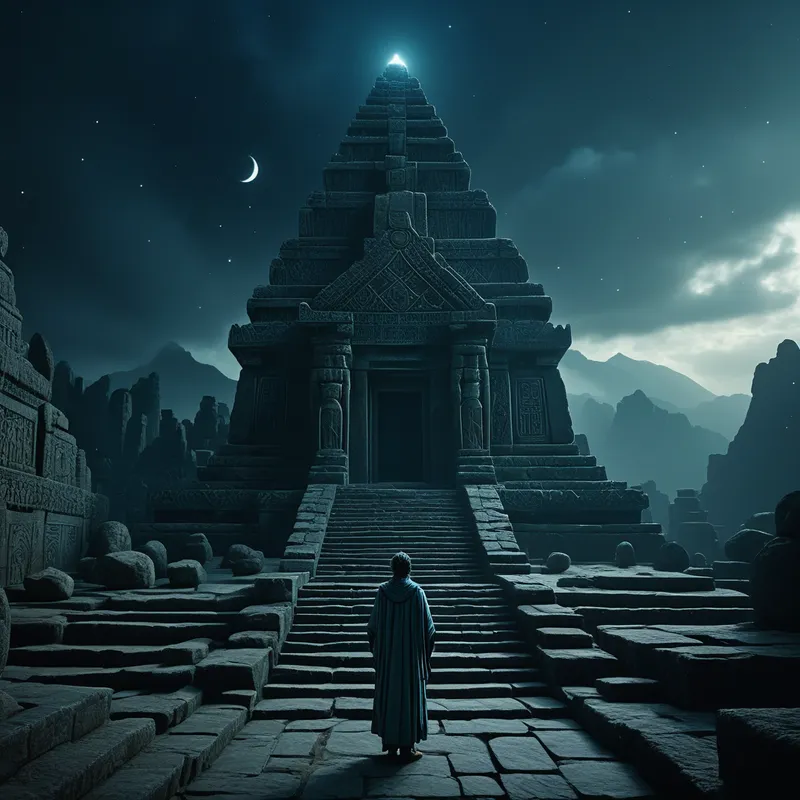
Mama Quilla’s worship was central to the fabric of the <abbr title="The empire of the Incas, known as Tawantinsuyu, meaning "The Four Regions"">Tawantinsuyu. Her primary temple, the Coricancha (the "Golden Enclosure") in Cusco, stood alongside that of Inti, often sharing a sacred space, their idols adorned with precious metals. Her statue was a bust of a woman fashioned from the finest silver, reflecting her essence. As the sister-wife of the divine ancestor Inti, she was directly tied to the legitimacy of the Sapa Inca, the emperor, who was considered Inti’s living son. Her feminine principle was indispensable to the cosmic and political order.
Her role transcended the celestial. In the earthly realm, she was the special protectress of women. Women would pray to her for ease in childbirth, for fertility, and for protection in marriage. The lunar calendar she governed dictated not only state festivals but also the intimate rhythms of women’s lives. This connection made her worship deeply personal and woven into daily existence. The fear of eclipses was not mere superstition; it was a cosmological crisis. The temporary devouring of the moon threatened the very pillars of time, fertility, and protection. The communal rituals to save her were acts of profound solidarity with the divine feminine, a desperate attempt to restore balance and stave off chaos.
Symbolic Architecture
Mama Quilla embodies the full spectrum of the lunar archetype: not merely a passive reflector of the sun’s light, but an active, sovereign power governing the invisible, the cyclical, and the interior life. She is the celestial manifestation of the Caregiver archetype, but one whose care is bound to inescapable cycles of light and darkness, presence and absence.
She represents the psyche’s dependency on rhythm. Just as the body relies on biological cycles, the soul requires the predictable waxing and waning of energy, the time for outward action and the necessary retreat into inward reflection. Her eclipse is the terrifying rupture of that rhythm, a descent into a formless night where all familiar structures of the self are swallowed.
Her silver tears are a profound alchemical image. They are the tangible product of profound suffering—the condensation of grief into a substance of value and beauty. This speaks to the transformative potential of facing the "beast" of the unconscious, the shadow that periodically consumes our conscious light. The outcome is not mere restoration, but the creation of something precious from the experience of darkness.
In psychological terms, Mama Quilla is the anima of the cosmos. She relates, she feels, she protects, and she mourns. Her weeping is not a sign of weakness, but the expression of a deep, empathetic connection to all that is vulnerable under her watch. The communal ritual to save her is the ego’s necessary engagement with the unconscious, using noise and motion (conscious effort) to integrate the threatening shadow and restore the guiding light of intuition.
The Dreamer's Resonance
To dream of Mama Quilla is to encounter the deep, rhythmic intelligence of the unconscious. A full, bright moon in a dream may signal a time of intuitive clarity, feminine wisdom, or protective guidance in one’s life. It can represent the nurturing, cyclical aspects of the self or point to significant feminine figures. A waning or darkened moon, however, might speak to a period of emotional withdrawal, a loss of intuitive connection, or a fear of the hidden, unknown parts of the psyche.
An eclipse in a dream is a powerful motif of crisis and transformation. It suggests a major life transition where old structures of identity, time, or relationship are being violently, temporarily obscured. The dreamer may feel consumed by a "beast" of anxiety, grief, or rage. Following the Mama Quilla myth, the task here is not to panic passively, but to engage. The dream may be calling for a ritualistic act—facing the fear, making noise (expression), and rallying one’s inner resources to howl back at the darkness, trusting that light will return, perhaps bearing the silver residue of hard-won insight.

Alchemical Translation
The alchemy of Mama Quilla is the Lunatio—the silvering of the soul. It is the process by which the raw, emotional experience of time, loss, and vulnerability (the weeping) is distilled into a lasting, reflective wisdom (the silver). Her primary element is not earth or fire, but time itself, measured in luminous, fluid cycles.
The celestial marriage of Inti and Mama Quilla is the conjunctio oppositorum of consciousness (the solar, discriminating light) and the unconscious (the lunar, reflective, feeling light). They are not rivals but consorts. An eclipse is not a battle, but a temporary, terrifying union—a hieros gamos in shadow—where the conscious light is completely absorbed by the unconscious. From this terrifying fusion, new silver, new soul-substance, is born.
Her worship ritual during an eclipse is a supreme act of psychological alchemy. The people do not hide; they participate. By beating drums (the heartbeat of the earth), howling (giving voice to primal fear), and shaking weapons (mobilizing will), they actively engage with the cosmic process. They assist in the transformation, helping to "birth" the moon anew from the belly of the beast. This teaches that our darkest periods are not to be endured in silent despair, but met with active, ritualized engagement. The goal is not to avoid the eclipse, but to pass through it collectively and emerge with the precious metal of a deepened communal and individual soul.
Associated Symbols
Explore related symbols from the CaleaDream lexicon:
- Moon — The celestial body of reflection, cycles, intuition, and the feminine principle, governing the rhythms of time and the hidden depths of the unconscious.
- Silver — The metal of the moon, embodying purity, reflective wisdom, emotional value, and the alchemical product of distilled experience or grief.
- Cycle — The fundamental pattern of waxing and waning, presence and absence, governing life, death, rebirth, and all natural and psychological rhythms.
- Mother — The archetypal nurturer and protectress, the source of life and cyclical time, offering comfort and demanding reverence.
- Time — The river of existence measured in celestial movements, encompassing fate, seasons, mortality, and the sacred ordering of rituals.
- Tears — The liquid expression of profound grief, sorrow, or empathy, which in the mythic realm can transform into substances of sacred value.
- Eclipse — The terrifying but temporary union of opposites, representing crisis, the swallowing of light by shadow, and the potential for transformative rebirth.
- Night — The domain of the moon, a time of rest, introspection, dreams, vulnerability, and the revelation of the starry depths.
- Drum — The ritual instrument whose beat mimics the heartbeat, used to commune with spirits, alter states of consciousness, and rally collective energy against chaos.
- Protection — The act of shielding the vulnerable, a primary function of the caregiver archetype, extending a celestial mantle over women, marriage, and the rhythms of life.
- Rhythm — The essential pulse of existence, from celestial orbits to biological cycles, providing the foundational order that makes life and meaning possible.
- Shadow — The dark, unknown counterpart to light, represented by the eclipse beast, containing both destructive terror and the potential for profound integration.