
Mama Cocha Sea Goddess
Mama Cocha was the Incan goddess of the sea, water, and fertility, revered as a life-giving mother who sustained communities through her oceanic powers.
The Tale of Mama Cocha Sea Goddess
Before the first dawn silvered the peaks of the Andes, there was the deep, murmuring dark of the primordial waters. From this unfathomable abyss, Mama Cocha, the Sea Mother, emerged. She was not born of stone or sun, but was the conscious, breathing essence of the waters themselves—the vast Pacific that cradled the western edge of the world, the lakes that were the sky’s fallen tears, and the rivers that were the land’s pulsing veins.
The people of the coast knew her breath in the salt-laden wind that filled their fishing nets. They heard her voice in the crashing surf and the gentle lap of waves upon the shore. She was the great provider. When the runa cast their lines and nets into her gray-green depths, it was Mama Cocha who decided their bounty. A calm sea meant a full belly; a tempest meant her displeasure, a withdrawal of her nurturing embrace. But her domain was not limited to the ocean’s edge. Her essence traveled as mist and cloud, carried by the breath of her brother, the wind, to be wept upon the terraced mountainsides as life-giving rain. In this way, she was the mother of all fertility—the fish in the sea, the maize in the high fields, and the children in the wombs of women.
One enduring tale whispers of a time of great drought. The sun, Inti, blazed with a relentless fury, and the earth, Pachamama, cracked and thirsted. The rivers shrank to threads of dust. The people’s prayers to the sky gods seemed to evaporate in the heat. In their desperation, they turned to the west, to the source of all moisture. They made offerings of the finest sea-shells and woven textiles, casting them into the surf. For three days and nights, they sang hymns to the deep, their voices mingling with the cry of gulls.
Mama Cocha heard their suffering, the dry rattle of a land that was also her child. She did not rage against the sun, for she understood the balance of all things. Instead, she drew a great, sighing breath, pulling the ocean’s surface into a vast, swirling inhalation. From this, she spun the very humidity of the deep into colossal banks of cloud, a floating extension of her own body. She then gave these clouds to the wind, commanding them to travel inland. The clouds, heavy with her essence, climbed the slopes of the Andes and broke open, not in a violent storm, but in a gentle, persistent rain that soaked the soil and filled the springs. The drought was broken not by conquest, but by a mother’s compassionate exhalation, a reminder that the sea’s gift was the source of all freshwater life.
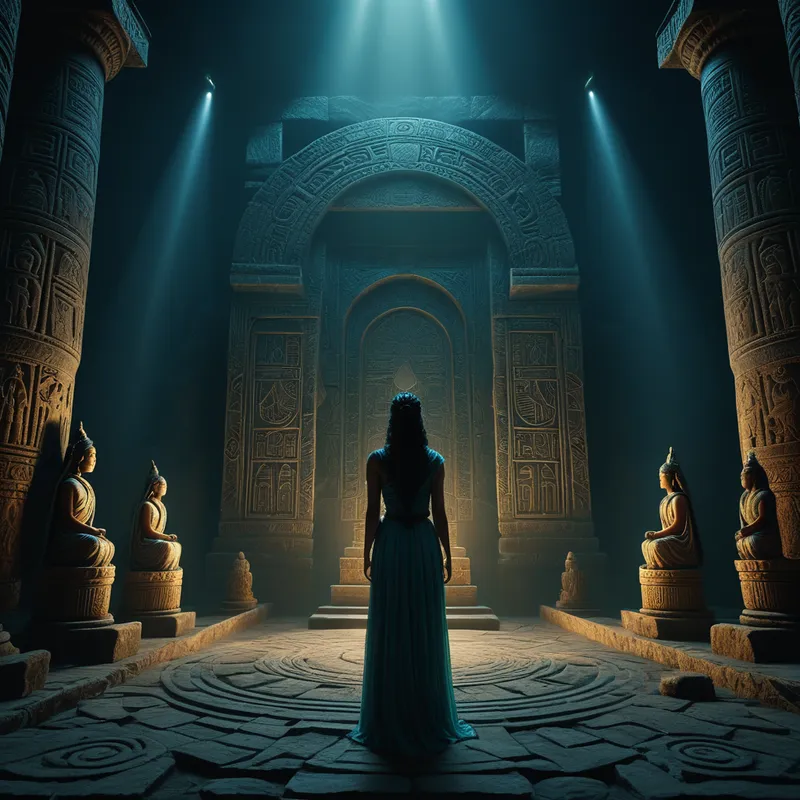
Cultural Origins & Context
Mama Cocha’s veneration was rooted in the pragmatic and spiritual realities of the Andean world. For the coastal cultures like the Chimú, later integrated into the Inca Empire, the Pacific Ocean was not a boundary but a primary source of sustenance and a terrifying, unpredictable power. The sea was a highway for trade, a larder of protein, and a capricious deity that could grant life or swallow it whole. This duality positioned Mama Cocha as a quintessential mother archetype—nurturing yet potentially severe, the source of life who also held the secrets of death in her abyssal depths.
Within the Inca pantheon, she existed in a sacred kinship network. She was often considered the wife or consort of Viracocha, the supreme creator god, making her the maternal, generative force that complemented his cosmic structuring power. As the mother of Inti (the sun god) and Mama Quilla (the moon goddess) in some traditions, she was positioned as the primal womb from which the celestial bodies themselves were born. This connected her directly to agricultural cycles, as the sun and moon governed planting and harvest times. Her worship was thus not isolated to fishermen; it was integral to the empire’s agricultural heart, linking the ocean’s fertility to that of the mountain terraces through the sacred cycle of evaporation and rain.
Symbolic Architecture
Mama Cocha represents the archetypal Mother in her most elemental, pre-personal form. She is not the mother of a single hero, but the Mother of All Potentiality—the amniotic ocean from which forms emerge. Her symbolism bridges the literal and the metaphysical: the saltwater ocean and the primordial waters of chaos (Chaos) from which order is born.
She is the psychological concept of the unconscious, not as a repository of personal trauma, but as the vast, impersonal, and creative ground of being. To encounter Mama Cocha is to confront the deep, nourishing, yet terrifying source of life itself, before it is shaped into individual identity.
Her governance over both the sea’s bounty and its storms illustrates the caregiver’s shadow: the capacity to withhold. True nourishment requires both giving and the integrity of boundaries. A mother who cannot say no ceases to be a source of structure and becomes a flood of undifferentiated engulfment. Mama Cocha’s tempests are not mere cruelty; they are the necessary moments of withdrawal that define the shoreline of the self, teaching respect, ritual, and reciprocity.
The Dreamer's Resonance
To dream of Mama Cocha is to dream of the foundational waters of the psyche. Calm, expansive seas may speak to a state of emotional abundance, creative potential, or a connection to the deep, intuitive self. A storm-tossed ocean may reflect inner turmoil, overwhelming emotions, or a fear of being consumed by the unconscious. To dream of fishing in her waters is to engage with the process of drawing conscious insight (the caught fish) from the unconscious depths.
On a cultural-psychic level, she resonates with the modern seeker’s yearning for a connection to nature that is not merely scenic, but sacred and reciprocal. In an age of ecological crisis, Mama Cocha becomes a potent symbol of the consequences of forgetting our debts to the life-giving source. Her myth demands an ethic of gratitude and offering, challenging the extractive mindset. Psychologically, she calls for an acknowledgment of our absolute dependence on forces greater than our ego—the “oceanic feeling” of connection to the source of life, with all the humility and awe it entails.

Alchemical Translation
The alchemical process mirrored in Mama Cocha’s myth is the stage of solutio—dissolution into the primal water. This is not a destruction, but a return to the source for regeneration. The drought in the myth represents a state of psychic rigidity, desiccation, and isolation (the inflated ego of the sun). The people’s ritual offerings and prayers represent the necessary surrender of the conscious mind, casting its valued objects (the ego’s treasures) back into the unconscious.
Mama Cocha’s response—drawing water up to create rain—is the alchemical circulatio: the great cycle. It is the process by which the unconscious, when approached with respect, rises to nourish the conscious mind in a transformed state. Saltwater becomes freshwater; the un-drinkable sea becomes life-giving rain. The impossible problem is solved not by force, but by a transformation within the medium itself.
This is the alchemy of grief, creativity, and deep healing. We must allow ourselves to be dissolved in the waters of feeling to be remade. Mama Cocha’s power is the aqua permanens, the permanent water that underlies all transformation, the solvent of the soul that washes away calcified patterns so new growth can emerge from the fertile silt.
Associated Symbols
Explore related symbols from the CaleaDream lexicon:
- Ocean — The vast, unconscious source of all life, embodying both nurturing abundance and terrifying depth, the primordial womb from which forms emerge and to which they return.
- Mother — The archetypal source of nourishment, protection, and unconditional giving, representing the primal bond and the ground of being from which individuality separates.
- Water — The element of emotion, intuition, and the flow of life, capable of cleansing, sustaining, or dissolving forms in its mutable journey.
- Fertility — The dynamic, creative principle of growth, proliferation, and abundance, applied to land, sea, womb, and the psyche’s capacity to generate new life.
- Rain — The gift from the heavens that nourishes the earth, symbolizing grace, emotional release, and the fertile union of sky and soil, spirit and matter.
- Circle — The shape of wholeness, cycles, and eternity, reflecting the endless process of evaporation, cloud formation, rainfall, and return to the sea.
- Fish — The conscious bounty drawn from the unconscious depths, representing insights, sustenance, and the hidden treasures of the psyche made manifest.
- Goddess — The divine feminine principle, manifesting as a sovereign, immanent power within nature, governing cycles of birth, life, death, and regeneration.
- Moon — The celestial body governing tides and cycles, intimately connected to the sea’s rhythms and the feminine principles of reflection, intuition, and periodic renewal.
- Rebirth — The process of regeneration following a symbolic death or return to the source, exemplified by the cyclical transformation of seawater into life-giving rain.