Magic Carpet Myth Meaning & Symbolism
A mythic artifact of royal power and divine favor, the flying carpet symbolizes the soul's sovereignty over the earthly and its journey toward destiny.
The Tale of Magic Carpet
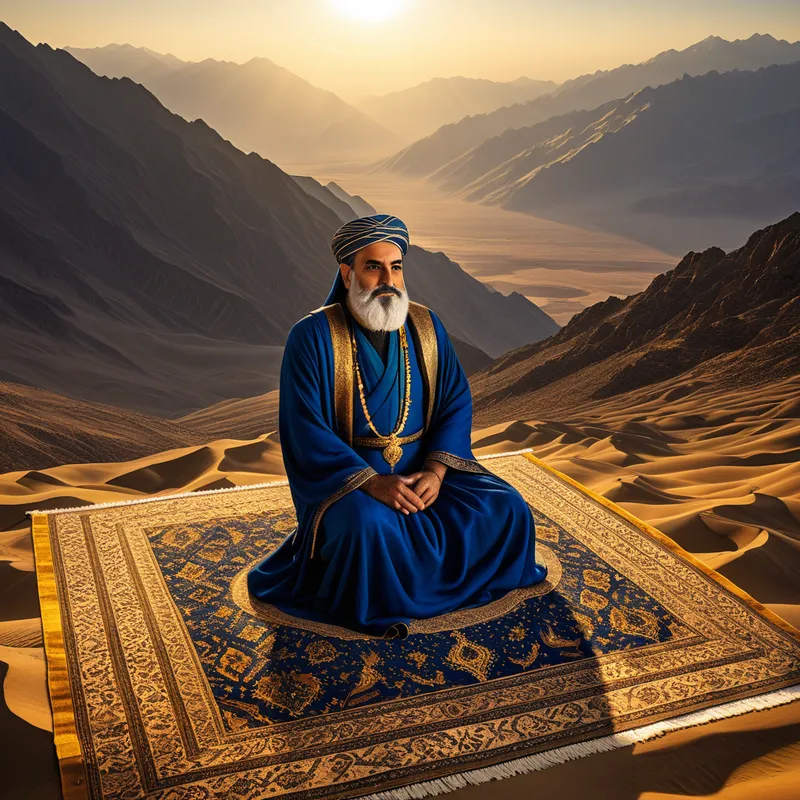
Listen, and let the winds of Khvarvaran carry you back. In the days when the Simurgh still nested in the peaks of the Alborz, there lived a king whose heart was as vast as his dominion, yet whose throne felt heavy with the dust of the mundane. His name was Kay Khosrow, a ruler of the Kayanian blood, blessed with wisdom but burdened by a celestial longing. He could command armies and decree laws, but the sky remained untouchable, a silent taunt of blue.
His deepest desire was not for more land, but for perspective—to see the tapestry of his kingdom as the gods might see it, to understand the connection between the caravanserai and the remote mountain village, between the roaring river and the silent desert. He prayed in the fire temples, seeking a sign. The answer did not come in flame, but in a whisper to his most gifted artisan, a master weaver whose family had served the throne for generations. The weaver, guided by dreams of celestial patterns, was instructed to create not a floor covering, but a throne for the air.
For seven years and seven months, the weaver labored. He did not use ordinary wool and dye. He spun threads with the first light of dawn and the last crimson of sunset. He carded wool from lambs born under auspicious stars. The dyes were brewed from crushed lapis lazuli for the heavens, saffron for the sun, and pomegranate for the lifeblood of the earth. He wove not just patterns, but prayers—the sacred geometry of the Farvahar subtly integrated into floral boteh, the protective nazar into intricate borders. The final knot was tied as the morning star, Nahid, crested the horizon.
The carpet was presented in the great hall. It lay there, magnificent but inert. A sigh passed through the court. Then, Kay Khosrow approached. He did not look at it with a king's appraisal, but with the soul's recognition. As his foot touched the center medallion, a hum resonated through the hall. The woven symbols began to glow with a soft, inner light. A breeze, smelling of distant mountains and sea, lifted the edges. With a faith that surpassed understanding, the king sat upon it.
And the carpet rose.
It lifted him gently, passing through the open arches of the palace, into the vast dome of the sky. The kingdom unfurled beneath him like the very carpet he rode—a living tapestry of green orchards, silver rivers, and golden deserts. He saw not just borders, but the breath of his people; not just problems, but patterns. He traveled to the edges of his realm and beyond, to lands of wonder and wisdom, always returning before the moon reached its zenith, his spirit quieted and his rulership clarified. The carpet was not a vehicle of escape, but of sovereign connection. It was the eye of the Khvarenah made manifest, the flying throne of a king who had learned to rule from a perspective of wholeness.
Cultural Origins & Context
The flying carpet, while popularized globally through later works like One Thousand and One Nights, has its roots deep in the Persian mythological and literary tradition. It appears in the seminal epic, the Shahnameh (The Book of Kings), attributed to the poet Ferdowsi. Here, it is not a common wonder but a singular artifact of immense royal and spiritual significance, belonging to the legendary King Solomon (Sulayman) and later to kings like Kay Khosrow.
Its transmission was oral and literary, told by naqqals in coffee houses and inscribed in lavish manuscripts. Functionally, it served multiple layers. On one level, it was a symbol of ideal, divinely-sanctioned kingship—the just ruler who possesses the perspective (the aerial view) to govern wisely. On another, it reflected a profound cultural mastery over art and craft; the carpet itself is a pinnacle of human creation, so perfect it transcends its material function. It sits at the intersection of Persian genius in both statecraft and artistry, suggesting that true power is a blend of practical governance and transcendent imagination.
Symbolic Architecture
At its core, the Magic Carpet is an emblem of sovereignty—but not sovereignty over others. It represents the individual's hard-won sovereignty over the inner and outer landscapes of their own life.
The carpet does not fly the wanderer; it answers the call of the one who has claimed their throne.
The earth-bound carpet symbolizes the mundane, patterned, and often repetitive nature of earthly life—our duties, our culture, our inherited "patterns." The act of flight is the awakening of consciousness, the ability to rise above the literal and the immediate to see the symbolic and the interconnected. The king is the archetypal Self, the central organizing principle of the psyche, who must integrate the realm (the totality of the personality). The flight is a necessary phase of reconnaissance for the ruling consciousness.
The materials—dawn threads, celestial dyes—speak to an alchemy of the ordinary. The magic is not added; it is revealed through sacred intention and masterful craftsmanship. It tells us that the vehicle for transcendence is woven from the very fabric of our daily, lived experience, but worked with a consciousness attuned to a higher order.
The Dreamer's Resonance
When the image of a flying carpet surfaces in a modern dream, it rarely appears as a tidy artifact from a museum. It is often frayed at the edges, impossibly large or small, hovering uncertainly, or stored in an attic. This is the psyche presenting the potential for sovereign perspective, often at a point of feeling stuck or enmeshed in life's intricate, confining patterns.
The somatic sensation can be one of thrilling lift or vertiginous fear. To dream of standing on a carpet that begins to rise signals a psychological process of detachment for the purpose of insight. The ego is being invited, or forced, to gain a new vantage point on a complex life situation—a relationship, a career path, a creative block. The fear arises from the ego's attachment to the known, solid ground. The exhilaration is the Self's promise of liberation and clarity. A carpet that won't fly may indicate a felt lack of the "royal" authority—the self-efficacy or inner permission—to command one's own journey.

Alchemical Translation
The myth models the individuation process with elegant precision. The first stage is the King's Discontent—the conscious ego's feeling that despite worldly success or stability, something essential is missing. This is the nigredo, the darkening, the longing for meaning.
The second is the Weaver's Labor—the often lengthy, painstaking work of the unconscious (the master artisan within). This is the albedo, the whitening, where the contents of the psyche are gathered, examined, and intentionally re-combined. It is the analysis, the creative work, the therapy, the meditation that slowly weaves new neural and psychic patterns.
The third is the Activation Through Relationship—the carpet only flies when the King (the conscious ego-Self axis) fully engages with it. This is the rubedo, the reddening. Insight alone is inert. It must be "stepped onto" with commitment and faith. The psychic transmutation is complete not when you understand the pattern, but when you trust it to carry you.
The ultimate alchemy is the realization that you are both the weaver of the pattern and the king who commands its flight. The journey is not outward to a foreign land, but upward to the seat of your own inherent authority.
Thus, the Magic Carpet endures not as a child's fantasy of escape, but as a timeless map for the soul's ascent. It teaches that liberation is found not by abandoning the intricate, beautiful, tangled weave of our lives, but by learning to command its inherent, waiting magic.
Associated Symbols
Explore related symbols from the CaleaDream lexicon: