Longevity Noodles Myth Meaning & Symbolism
A celestial cook's quest to weave the unbroken thread of life, challenging the finality of death and celebrating the continuity of the soul.
The Tale of Longevity Noodles
Listen, and hear the tale spun not from silk, but from steam and wheat, a story baked in the oven of heaven and served in the bowl of the earth.
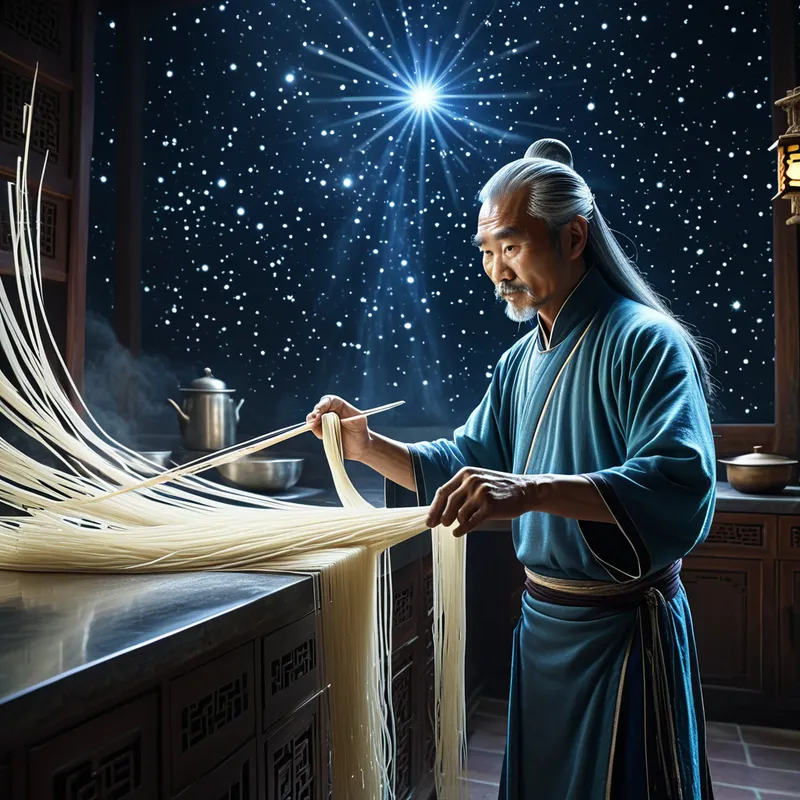
In the time when the Jade Emperor’s court shone with a light that cast no shadow, there lived a cook named Fu Shou. His kitchen was not of brick and flame, but of cloud and celestial breath. While other deities forged thunder or painted the seasons, Fu Shou’s art was sustenance. He crafted banquets that could make a star forget its orbit, but his heart was troubled. He watched the mortal realm below, where lives were like sparks from a fire—brilliant, brief, and gone. The finality of the Yellow Springs weighed upon him, a cold conclusion to the warm, messy story of a life.
One day, as he gazed upon a village celebrating the birthday of a beloved elder, he saw the bittersweet joy in their faces—the celebration tinged with the silent acknowledgement of time’s passage. A resolve, hard and clear as jade, formed within him. He would create a dish that defied not death itself—that was the purview of greater powers—but the spirit of ending. He would make a food that spoke of continuity.
He went to the granaries of heaven and chose the finest, most resilient grains, whispering to them of endurance. He drew water from the Tian He, the River of Heaven, whose current is the flow of destiny itself. For seven days and seven nights, he kneaded not just dough, but intention. He folded into it the cyclical strength of the Yin and Yang, the five phases of change, and the unbroken line of ancestry. Then, he began to pull.
His hands moved, a dance of infinite patience. The dough stretched, not breaking, but yielding, transforming from a lump into a single, impossibly long, unbroken strand. It coiled at his feet like a benevolent serpent, then began to spill over the cloud-balcony of heaven, descending towards the mortal world like a gleaming, edible rope. It was not food for the body alone, but a symbol for the soul—a single, continuous thread from birth, through every twist and turn of fate, refusing to be cut.
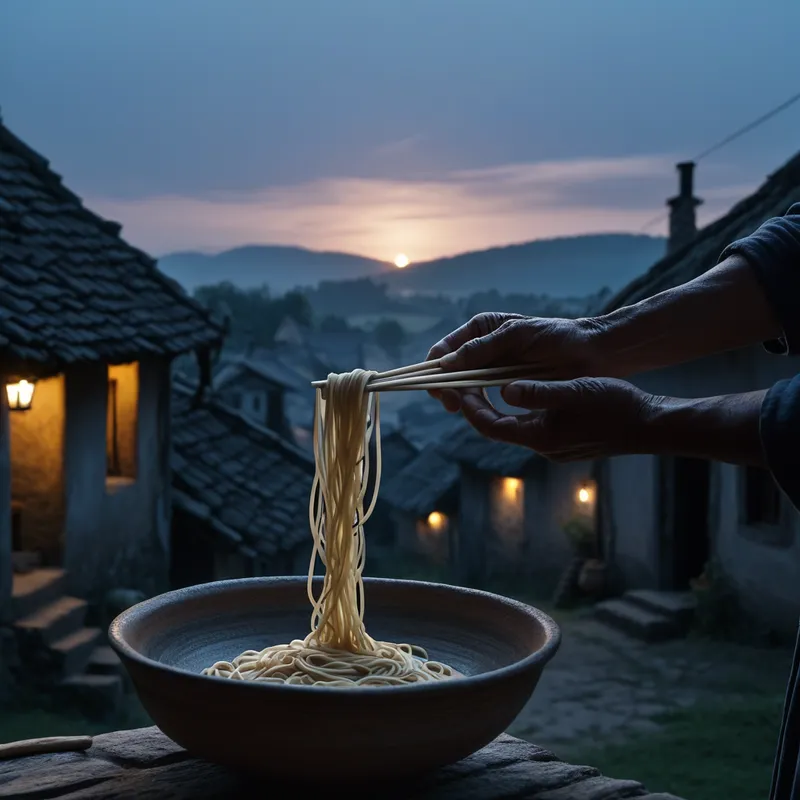
He sent this single, perfect noodle down to the village on the elder’s birthday. The people, awestruck, understood without words. They did not cut it. They gathered, lifting the strand together, slurping the endless, savory thread, their lives metaphorically joined to its unbroken length. In that shared meal, the anxiety of the end softened. The celebration was no longer a marker towards an abyss, but a point on an infinite line. Fu Shou, from his heavenly kitchen, did not grant immortality. He gifted a far more profound magic: the vision of continuity, the taste of an unbroken story.
Cultural Origins & Context
The myth of the Longevity Noodle, or Changshou Mian, is less a single, codified story and more a living narrative embedded in the ritual of the birthday, particularly for elders. Its origins are folkloric, emerging not from imperial canon but from the hearths and hopes of countless families. It was passed down by grandmothers as they taught daughters to knead the dough, by fathers as they explained why the noodle must not be broken during the meal. Its primary storytellers were the family matriarchs and community elders themselves, performing the myth with every birthday celebration.
Its societal function was multifaceted. Practically, it was a centerpiece for filial piety, a tangible way to honor one’s parents and ancestors. Psychologically, it served as a cultural technology against the dread of mortality. In a philosophy that deeply venerates ancestry and continuity of the family line, the abrupt end of an individual life poses a profound existential threat. The Longevity Noodle ritual softens this threat. It transforms a personal milestone into a communal reaffirmation of the unbroken lineage. The myth provided a sacred context for this ritual, giving the simple, skillful act of noodle-making a celestial provenance and a divine purpose, elevating everyday sustenance into a cosmological principle.
Symbolic Architecture
At its core, the myth is a profound meditation on time, identity, and the human confrontation with finitude. The noodle itself is the central symbol—a perfect representation of the thread of life.
The unbroken noodle is the soul’s autobiography, written not in words, but in a single, continuous line from origin to present.
Fu Shou represents the creative, ordering principle of the psyche that seeks to impose meaning and continuity on the raw, fleeting material of existence. His heavenly kitchen is the inner sanctum of the Self, where raw experiences (grain, water) are consciously processed, integrated, and given a coherent form. The mortal realm’s fear of the Yellow Springs is the ego’s terror of dissolution into the unconscious, of personal identity being lost.
The act of pulling the noodle, of making it long and unbroken, symbolizes the psychological process of individuation—the lifelong effort to weave our disparate experiences, conflicts, and phases into a coherent, meaningful whole. The myth does not promise that the thread will never be cut by death; rather, it insists that the quality of the thread—its continuity, resilience, and intentional crafting—is what matters. The shared consumption of the noodle underscores that this continuity is not a solitary achievement, but is woven within the fabric of relationship, family, and culture.

The Dreamer's Resonance
When this myth surfaces in modern dreams, it often appears during life transitions—birthdays, career changes, the birth of a child, or the loss of a loved one. It signals the psyche’s work on the theme of continuity amidst change.
To dream of making the noodles suggests the dreamer is actively engaged in a process of self-creation or integration, perhaps trying to “make sense” of a complex life phase. The somatic feeling might be one of focused effort in the hands and arms. Dreaming of eating an unbroken noodle, especially with others, points to a successful assimilation of a new identity or role into one’s life story, often accompanied by feelings of warmth and connection. Conversely, dreaming of a broken noodle can evoke deep anxiety, reflecting a fear of failure, a perceived rupture in one’s life narrative, or a crisis of meaning. The psyche is wrestling with fragmentation, urging the dreamer to find or create the symbolic “celestial kitchen” within—the inner space where the thread can be repaired and lengthened anew.

Alchemical Translation
The myth models the alchemical opus, the great work of psychic transformation. The base material is the mortal condition—fragmented, time-bound, and anxious. The heavenly kitchen is the vas hermeticum, the sealed vessel of introspection and conscious work.
The transmutation occurs not in avoiding death, but in re-forging one’s relationship to time, from a linear countdown to a participatory weaving.
Fu Shou’s labor—selecting grain, drawing celestial water, kneading with intent—mirrors the stages of nigredo, albedo, and rubedo. The nigredo is the initial recognition of mortality’s shadow. The albedo is the purification of intention, the decision to create meaning. The rubedo is the production of the red-gold thread of the integrated Self, the “longevity” that is not of the body, but of the soul’s coherence.
For the modern individual, the alchemical instruction is clear: your life is the dough. Your conscious attention and reflective work are the hands that pull and shape it. The goal is not to create an endless noodle, but a whole one. Each challenge, joy, and loss is an ingredient to be integrated, lengthening the thread and enriching its flavor. The final “meal” is the realization that you are both the cook and the consumer, the creator and the inheritor of your own unbroken story. In this act of conscious self-creation, one tastes the true longevity—the enduring significance of a life authentically and continuously woven.
Associated Symbols
Explore related symbols from the CaleaDream lexicon: