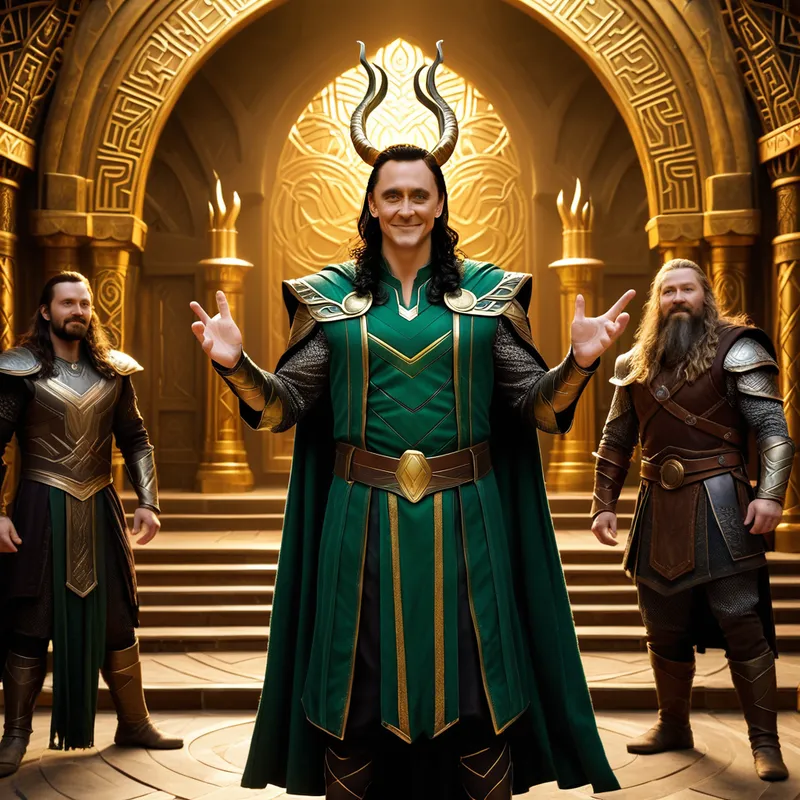
Loki's Wagers Myth Meaning & Symbolism
Loki, the shape-shifting trickster, wagers his head in a contest of artifice, only to escape through a loophole of pure, cunning logic.
The Tale of Loki's Wagers
The mead-halls of Asgard still echoed with the laughter of the gods, but it was a laughter tinged with unease. For Loki, the silver-tongued shape-shifter, had gone too far. In a fit of malice, he had sheared the radiant golden hair from the head of Sif, Thor’s beloved wife. The thunder god’s rage shook the very roots of Yggdrasil, and Loki, facing annihilation, swore an oath to make amends.
He descended from the high world of gods into the cavernous, smoke-filled realms of the dvergar, the dwarves. His path led him first to the sons of Ivaldi, whom he charmed and cajoled. From their forges came wonders: hair of spun gold for Sif that would grow like living grain; Skidbladnir, a ship that always found a fair wind; and Gungnir, the unerring spear. Puffed with pride, Loki boasted that no smiths in all the worlds could craft their equal.
His boast was heard. From another deep-delved hall came the brothers Brokkr and Sindri. “Your tongue wags like a loose sail, Loki,” Brokkr grunted, his eyes like hot coals. “We shall craft three gifts. And if they are deemed finer than those you bear, we claim your head as our prize.”
A hush fell. The air grew thick with the scent of molten metal and destiny. Loki, the gambler, could not refuse. “A wager, then,” he hissed, a smile playing on his lips. “My head against your pride. Let the Æsir be our judges.”
As the brothers began their work, Sindri laid a pig’s skin in the forge. “Brokkr,” he commanded, “pump the bellows without cease, no matter what you see or hear.” The fire roared to life. But as the metal glowed, a fly—Loki in disguise—landed on Brokkr’s hand and bit fiercely. The dwarf did not flinch. From the forge, Sindri drew Gullinbursti, a living boar of gold that shone in the dark and ran across sky and sea.
Next, Sindri threw a bar of gold into the flames. Again, he gave his command, and again the fly returned. This time it bit Brokkr’s neck, drawing blood that mingled with the soot. The dwarf held fast. From the fire came Draupnir, a ring of multiplying gold.
For the final gift, Sindri placed iron in the hearth. “Now, brother, your steadfastness seals all.” The fly, desperate, landed between Brokkr’s eyes and bit his eyelid. Blood blinded him. For one single, fatal moment, his hand faltered. The bellows sighed. Sindri cursed, but drew forth the gift nonetheless: Mjolnir, the hammer of might, its handle shortened by that momentary lapse.
Before the assembled gods in Gladsheim, the gifts were presented. The boar, the ring, and the hammer. Even Odin, Vili, and Ve could not deny their majesty. The hammer, despite its flaw, was declared the greatest treasure, for it would defend Asgard. The dwarves had won.
Brokkr advanced, a leather thong and a knife in his hands. “Your head is forfeit, trickster.”
Loki did not plead. He smiled. “Take it, then. But mark the terms of our wager. You may take my head. But you did not wager for my neck. Not a single inch of it may you touch.”
The dwarf stood stunned, his victory turned to ash. He could not claim the prize without violating the terms. Spitting with rage, he seized his awl and leather. “If I cannot have the head, I will seal the lying tongue within it.” And he stitched Loki’s lips shut, weaving iron wire through flesh. Loki bore it in silence, his eyes gleaming with a victory more profound than any hammer. For he had been bound, but not broken. He had lost, yet, by the very logic of his nature, he had escaped.
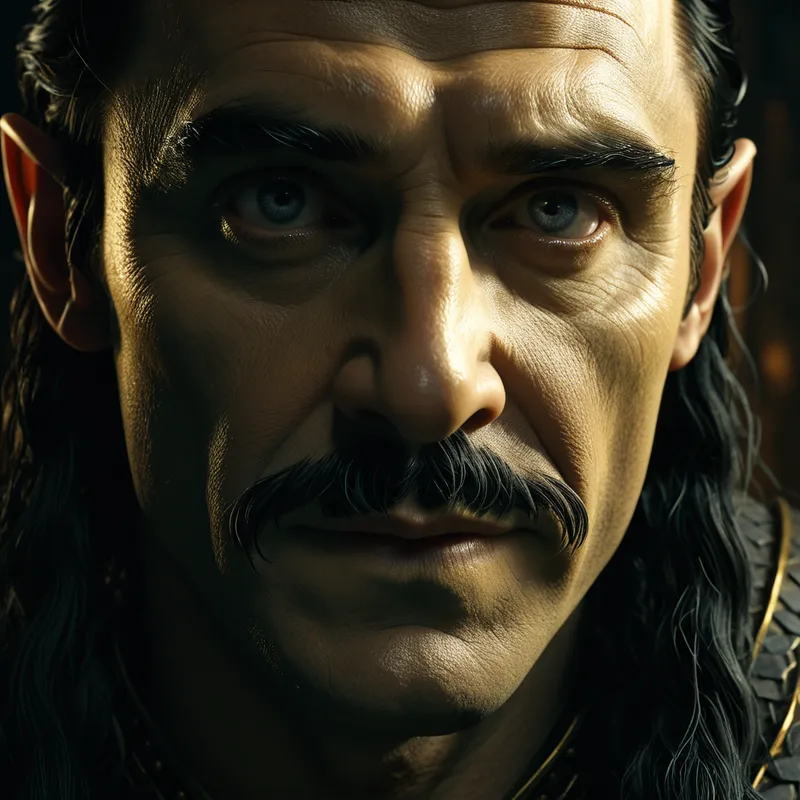
Cultural Origins & Context
This myth, preserved primarily in the Prose Edda of Snorri Sturluson, is a masterpiece of the Norse skaldic tradition. It was not a sacred text, but a story told in halls, a narrative that balanced cosmological grandeur with sharp, legalistic wit. The society that birthed it was one of complex oaths, blood-feuds, and a deep appreciation for cleverness within strict social and cosmic laws. The storyteller, perhaps a skald in a chieftain’s hall, would have used this tale to entertain, but also to illustrate profound truths: the power of craft (Iðunn), the binding nature of words, and the chaotic, necessary role of the trickster in a world of order. Loki is not a devil, but a force of entropy and ingenuity, testing the limits of the system from within.
Symbolic Architecture
At its heart, this is not a story about objects, but about the nature of the self and its boundaries. Loki’s head represents his intellect, his identity, his cunning consciousness. The wager is a confrontation between raw, creative craftsmanship (the dwarves) and adaptive, linguistic intelligence (Loki).
The trickster does not defy the law; he dances in its negative spaces, revealing that the map is not the territory.
The three dwarf-forged gifts symbolize the foundational pillars of society and cosmos: prosperity (Gullinbursti), sovereign power and cyclical abundance (Draupnir), and defensive force (Mjolnir). Loki’s sabotage of the hammer’s handle ensures that even the ultimate weapon of order is imperfect, requiring skill (Thor’s gloves) to wield. His final loophole—separating the head from the neck—is a supreme act of psychological differentiation. It asserts that the essential self (the cunning mind) cannot be wholly possessed or destroyed by external judgment, only temporarily silenced.
The Dreamer's Resonance
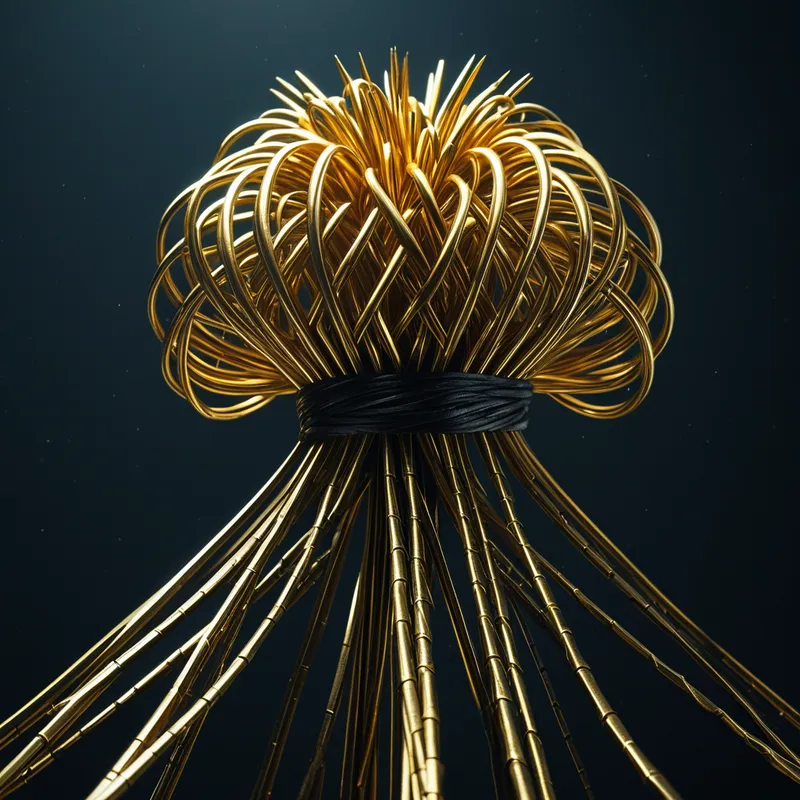
When this myth stirs in the modern psyche, it often manifests in dreams of impossible bets, of being caught in a contract with devastating fine print, or of one’s mouth being sewn or filled with unspoken words. Somaticly, one may feel a tightness in the jaw or throat. Psychologically, this signals a confrontation with the “inner Brokkr”—an aspect of the self that is rigid, literal, and seeks to exact a pound of flesh for past mistakes or embarrassments (the sheared hair, a social blunder). The dreamer is in the process of a Loki-esque maneuver: not denying responsibility, but seeking the precise, saving clause within their own psyche that prevents total self-annihilation. It is the intelligence of the shadow, arguing for its life.
Alchemical Translation
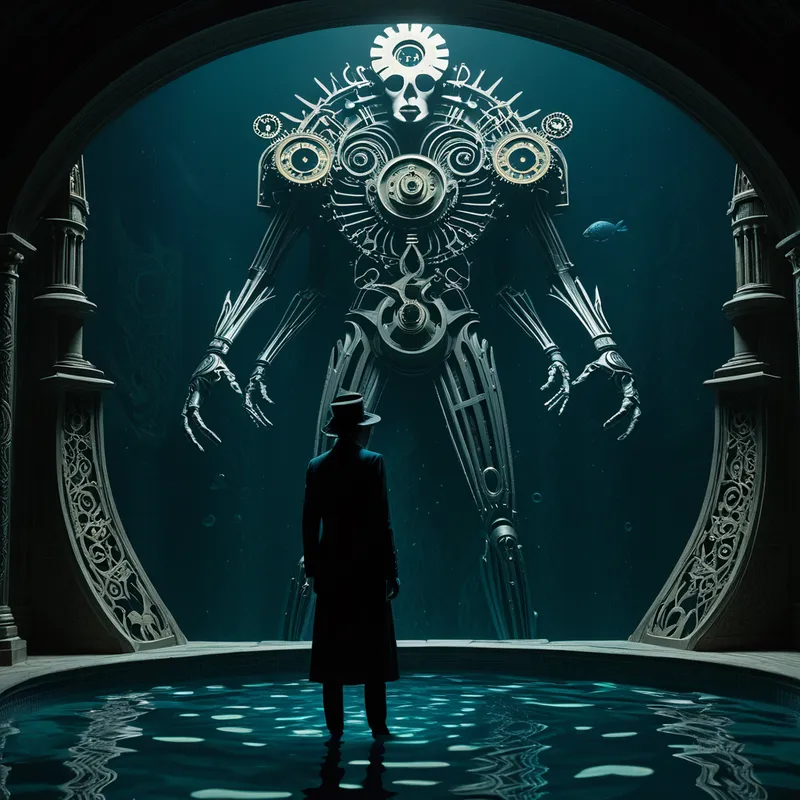
The alchemical journey here is the transmutation of reckless chaos (the shearing of Sif’s hair) into a necessary, if painful, integration. Loki begins as a purely disruptive element in the psychic system (the polis of Asgard). Forced to make amends, he ventures into the underworld of the unconscious (the dwarven forges) to retrieve treasures—new psychic capacities (resilience, creativity, focus).
Individuation requires the wager: the conscious ego must risk its own familiar supremacy to engage the profound, often terrifying craftsmen of the deep unconscious.
The climax is the judgment, where the ego must acknowledge that the greatest power (Mjolnir, the ability to act and defend) comes from the unconscious, and is inherently flawed. The final stitching is not a defeat, but the nigredo, the darkening. The conscious, trickster-like intellect is forcibly integrated, its glibness silenced so that a deeper wisdom can form. One escapes the literal death of the ego (losing one’s head) but accepts a binding modification. The individual is no longer just the clever Loki or the righteous Thor, but a system that contains both the flawless golden ring and the shortened hammer, the sealed lips and the eyes that see the loophole in every doom.
Associated Symbols
Explore related symbols from the CaleaDream lexicon: