
Lilith in Jewish Folklore
Lilith, a defiant figure from Jewish folklore, is often portrayed as Adam's first wife who rejected subservience, becoming a symbol of independence and chaos.
The Tale of Lilith in Jewish Folklore
Before Eve, there was another. In the twilight of the world’s first dawn, when the dust of the earth was still warm from the divine touch, God formed Adam and Lilith from the same clay, as equals. They were the first pair, facing each other in the silent garden. But the peace of Eden was soon broken by a quarrel of origins. Adam demanded that Lilith lie beneath him, seeing in their sameness a hierarchy she could not. Lilith, whose name whispers of the night, refused. She invoked the very nature of their creation, claiming her equal share in the divine image. When Adam would not relent, she uttered the ineffable name of God—a secret and terrible power—and fled the garden, leaving its ordered light for the wild, untamed shores of the Red Sea.
There, in a place of primal chaos, she made her home. Legends say she consorted with demons, giving birth to a hundred lilin each day. Angels were sent to retrieve her, threatening to drown her in the sea if she did not return. Her defiance was absolute. “How can I return,” she is said to have replied, “to a place where I will be forced to serve, when here I am free?” A terrible bargain was struck: she would not be forced back, but a hundred of her children would die each day. And in return, she was granted dominion—not over Adam, but over newborn infants. She became a specter of the night, a strangler of the vulnerable, her eternal rage at her displacement turned outward as a curse upon motherhood itself.
Yet her story does not end in mere monstrosity. In later mystical thought, she returns as a queen of the Sitra Achra, the "Other Side." She becomes the dark counterpart to the Shekhinah, the divine presence. When the world is fractured, when harmony is broken, Lilith ascends. She is the shadow that clings to the moon, the whisper of discord in the sacred union. In the Zohar, she even visits Adam after Eve’s creation, bearing demonic offspring and forever intertwining her chaotic lineage with humanity’s. She is the first wife who was, and the eternal stranger who is.
Cultural Origins & Context
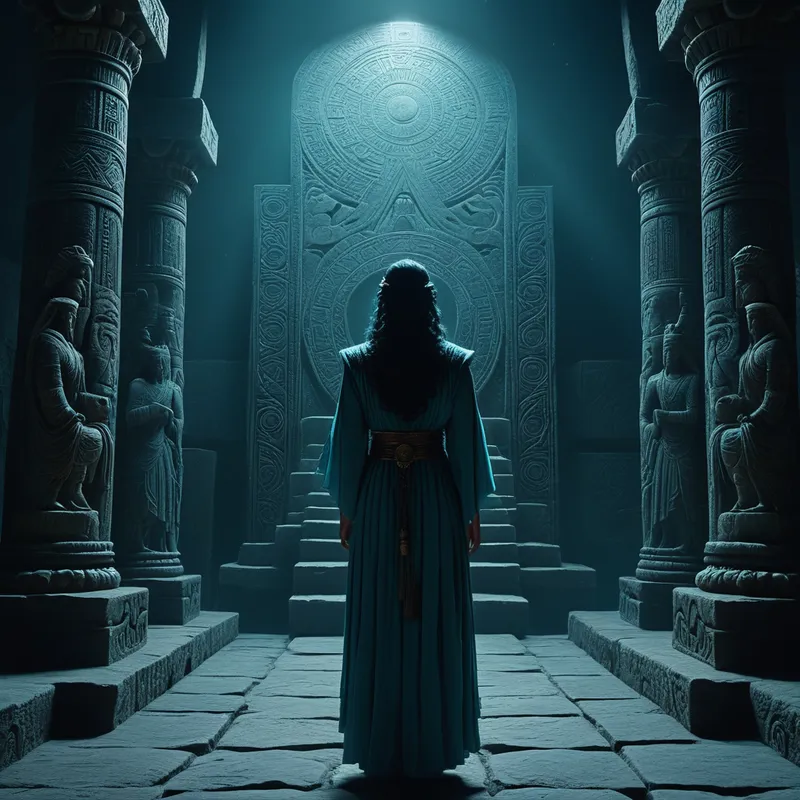
Lilith’s roots are tangled and deep, reaching into the fertile soil of ancient Mesopotamian and Canaanite belief before being grafted onto the Jewish mythological tree. Her name likely derives from the Sumerian lilitu, a class of storm or wind demons, often female, associated with desolate places and sexual danger. This figure traveled through Babylonian incantation bowls, where she was invoked as a threatening spirit to be warded off from the home, particularly from women in childbirth and infants.
Her explicit entrance into Jewish textual tradition is startlingly brief, a single, haunting mention in the Book of Isaiah (34:14), where she is listed among the creatures that will inhabit the ruins of Edom: “There shall the Lilith repose, and find for herself a place to rest.” Here, she is not a wife, but a desert demon of the wasteland. It is in the post-biblical, rabbinic imagination that her story blossoms. The Alphabet of Ben Sira (c. 8th-10th centuries CE) provides the full narrative of her as Adam’s first, equal, and rebellious wife. This was not scripture, but folklore and moral exploration—a midrashic grappling with the tensions inherent in creation, gender, and divine intention.
Her evolution within Jewish mysticism, particularly the Kabbalah of the Middle Ages, is where she gains profound theological weight. No longer merely a folkloric bogeyman, she becomes an essential metaphysical principle. In the complex cosmology of the Zohar, Lilith personifies the unbalanced, receptive force of judgment (Din) without the mitigating influence of mercy (Chesed). She is the necessary shadow, the embodiment of the fractured world (Tohu) that preceded the ordered world (Tikkun). Her context, therefore, shifts from the nursery to the cosmos; she is a vital, if terrifying, part of the divine drama of exile and redemption.
Symbolic Architecture
Lilith is not a character to be moralized, but a symbol to be contemplated. She is the archetypal fracture at the origin of relationship. Her rebellion is not against God, but against a prescribed order that denies her foundational truth: her equality in essence. She represents the psychic cost of suppressing the autonomous, wild self in the name of harmony. When that self is denied, it does not vanish; it flees to the marshy borders of consciousness (the Red Sea) and becomes a destructive, haunting force.
She embodies the terrifying aspect of the feminine that patriarchy cannot assimilate—the part that refuses to nurture, that claims its own desire and generative power outside sanctioned bonds. Her vengeance upon infants is a dark, twisted mirror of creation itself, a parody of motherhood born from the trauma of rejection. She symbolizes how repressed autonomy can curdle into a rage that threatens the very new life (symbolic or literal) one might later wish to protect.
In the Kabbalistic map of the soul, Lilith occupies the desolate realm of Tohu, the world of "broken vessels." She is the power that was too pure, too intense, to be contained by the early structures of being. Her exile is the original cosmic wound.
Yet, in her mystical role, she also holds a paradoxical necessity. A universe of pure, unbroken light is inconceivable; it is the interplay with the shadow that defines form. Lilith, as the queen of the Sitra Achra, is that defining shadow. Her existence forces a confrontation with the chaos, the Other, the unsanctified desires and raw powers that dwell within and without. To integrate the world, one must first acknowledge what has been cast out.
The Dreamer's Resonance
To encounter Lilith in a dream, or to feel her resonance in the psyche, is to meet the part of oneself that will not comply. She appears when the cost of submission has become a silent scream. She is the figure who rises in the dreamscape when one has too long played Eve—the accommodating, derived partner—and feels the original, self-created spirit withering. Her energy is not "evil" in a simplistic sense, but feral and untamed; it is the psyche’s own rebellion against a soul-stifling order.
Psychologically, she represents the integration of the anima’s autonomous face. For men, she may manifest as a terrifying yet fascinating encounter with the feminine that cannot be possessed or controlled, challenging patriarchal structures within the psyche. For women, she often embodies the repressed fury of the “good girl,” the voice that finally says “no” to unjust hierarchies, and the terrifying freedom that follows. Her presence signals a crisis of identity that demands a re-negotiation of one’s foundational contracts: with partners, with society, and with oneself. The work she brings is not to become her, but to acknowledge her claim, to hear the truth in her refusal, and to find a way to honor that wild spirit without letting it destroy one’s capacity for relationship or vulnerability.

Alchemical Translation
The alchemical process evoked by Lilith is the Nigredo—the blackening, the putrefaction, the descent into the primal matter. It is the necessary first step of dissolution, where the old, rigid forms (the garden’s enforced order) must be broken down. Her flight to the Red Sea is this descent: a willing immersion into the chaotic, salty waters of the unconscious, where identity is not defined by another.
Her legend is an allegory of the spirit’s refusal to be sublimated before it has fully known its own nature. The first wife must name herself before she can be a wife at all.
The “lilin,” her countless demonic offspring, can be seen as the fragmented, raw psychic energies—the unruly thoughts, the unbidden desires, the creative sparks—that are born when one embraces one’s exiled nature. The task is not to destroy these offspring, but to witness them, to understand their origin in a foundational injustice. The later Kabbalistic aim of Tikkun Olam, the repair of the world, implicitly includes the redemption of Lilith’s realm. It is the alchemical goal of uniting the crown (Keter) with the kingdom (Malkhut), of bringing the light of consciousness into respectful relationship with the dark, fertile chaos of the unformed. To translate Lilith is to perform the sacred work of recognizing the divine spark even in the most exiled, furious, and “demonic” parts of the soul, and through that recognition, begin to call them home.
Associated Symbols
Explore related symbols from the CaleaDream lexicon:
- Rebel — The primal force of refusal against an imposed, unjust order, asserting the sovereignty of the self over coercive harmony.
- Chaos — The fertile, undifferentiated state from which all form emerges and to which it may return; the realm of pure potential and terror.
- Gender — The contested ground of identity and power, where prescribed roles clash with the authentic self, creating both conflict and creation.
- Shadow — The totality of the psyche that is rejected by the conscious self, containing both destructive impulses and vital, untapped power.
- Moon — The celestial body governing the night, intuition, and the cyclical, wild feminine; a luminary for what is reflected, dark, and untamed.
- Serpent — The embodiment of forbidden knowledge, primal wisdom, and transformative energy that moves outside sanctioned paths.
- Wound — The enduring psychic injury born from a foundational rupture, which becomes both a source of suffering and a seat of profound insight.
- Door — The threshold between realms; the moment of choice to leave an old world for an unknown one, sealing one fate to embrace another.
- Wilderness — The uncharted territory of the soul, a place of exile, testing, and the raw, unmediated encounter with one’s own nature.
- Equality — The foundational, often disruptive, principle of sameness in origin and essence, demanding a reconfiguration of all derived hierarchies.
- Rage — The sacred fire of injustice made manifest, a destructive and cleansing force that annihilates false peace to make space for truth.
- Freedom — The terrifying and absolute condition of self-determination, purchased at the price of protection, community, and sanctioned love.