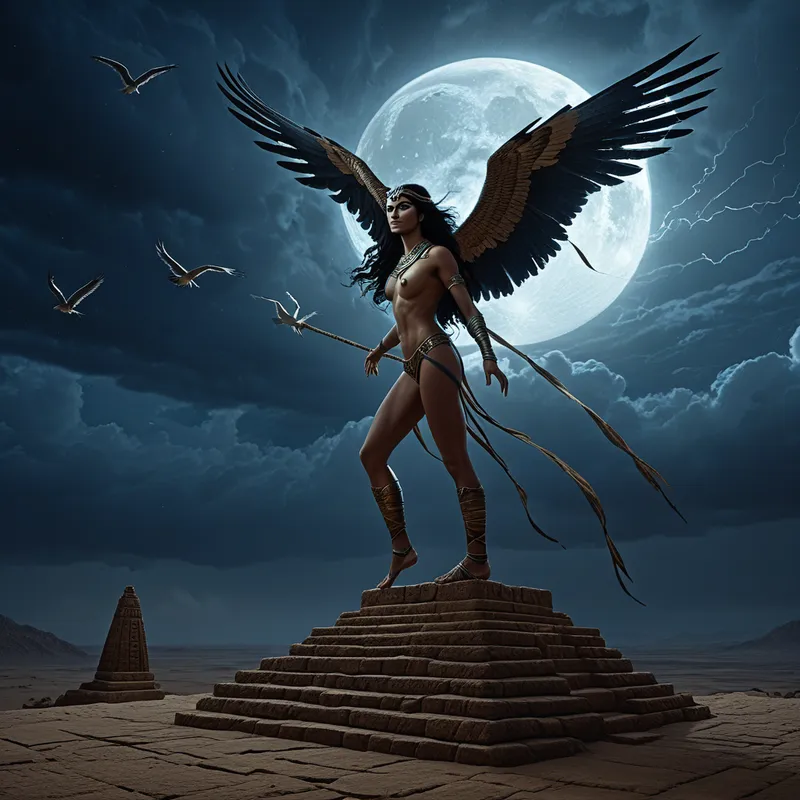
Lilitu Myth Meaning & Symbolism
The ancient tale of Lilitu, a primordial storm spirit who refused subjugation, embodying the wild feminine, the dangerous wind, and the unintegrated shadow.
The Tale of Lilitu
Hear now the whisper on the night wind, the sigh that steals the breath of infants. Before the great gods Anu and Enlil set the world in its final order, the wildness was everywhere. From the primal chaos, from the dust storms of the arid plain and the shrieking gales that swept down from the northern mountains, she coalesced. They called her Lilitu.
She was not born of womb, but of the void between stars and the dry breath of the desert. Her form was a paradox: the beauty of a woman, with flowing hair dark as a moonless night, paired with the fierce, curved talons of a desert owl. Wings, not of feather, but of shadow and rushing air, grew from her shoulders. She was the spirit of the scorching south wind, the Imhullu, that brings fever and madness. She dwelt not in the gleaming ziggurat or the ordered city, but in the trackless wastes, in the hollows of dead trees, and in the ruins where civilization had crumbled back into dust.
Lilitu knew no master. When the gods fashioned the first man, Adapa, and decreed the ways of the world, they sought partners for all creatures. To Lilitu, they offered a consort, the demon Lilu. But she scorned him. "I will not lie beneath," she declared, her voice the rasp of sand on stone. "I was fashioned from the same wild clay, from the same tempest. I will not be subdued, not by god, not by man, not by demon."
Enraged by her defiance, the gods cast her out further, into the outermost desolation. But banishment did not tame her; it defined her. In the silent, watchful hours when the sun god Shamash journeyed through the underworld, Lilitu took to the wing. She would slip into the settlements, a gust under the door, a chill in the marriage bed. To men sleeping alone, she came as a succubus, a phantom lover who left them drained and haunted. To women in childbirth and to newborn infants, she was a thief of breath, the sudden, unexplained stillness in the cradle.
The people cried out. The āšipu priests fashioned amulets of stone and clay, incantations on tablets to bar the door against her. They invoked the protection of Pazuzu, the king of the wind demons, for only a power of the wind could hope to catch the wind. In the stories told by firelight, she was never conquered, never destroyed. She was negotiated with, warded against, feared. She remained—and remains—the unanswerable cry in the storm, the price of the wildness that was exiled to build the walled garden, forever circling just beyond the light of the hearth.
Cultural Origins & Context
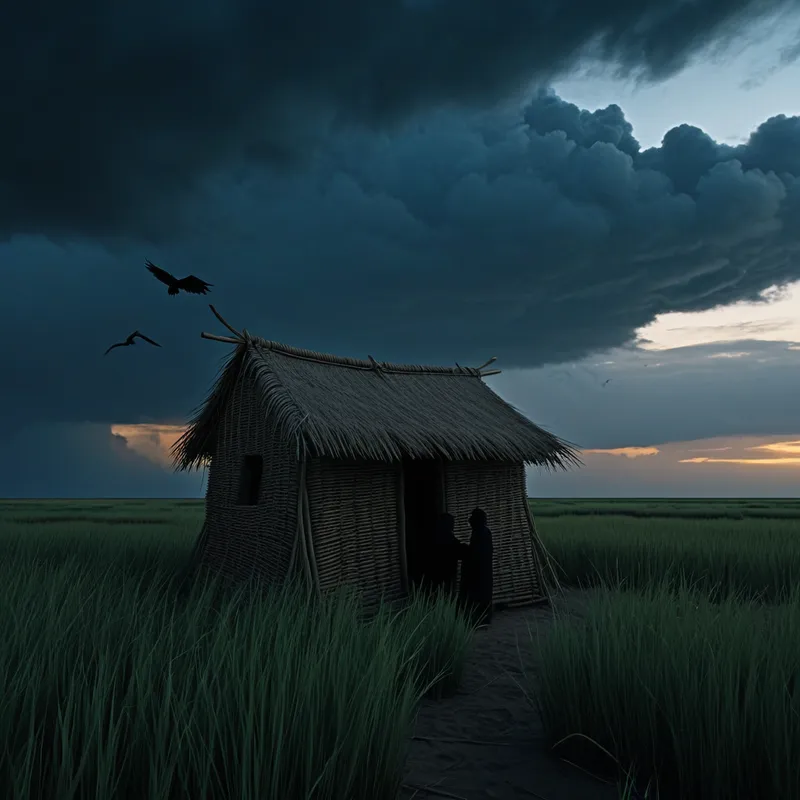
The figure of Lilitu emerges from the fertile, fearful imagination of ancient Mesopotamia, a civilization profoundly aware of its precarious existence between the twin rivers. Life was a constant negotiation with chaotic natural forces: unpredictable floods, devastating droughts, and the searing, disease-bearing winds. Lilitu was the personification of one of these intangible, pervasive dangers.
Her name likely derives from the Sumerian word "Líl," meaning "wind," "storm," or "spirit." She appears in Sumerian, Akkadian, and later Assyrian and Babylonian texts, not in a single, canonical epic, but in a fragmented chorus of sources: demonological lists, medical treatises (where infant mortality and sleep paralysis were her domain), and most powerfully, in protective incantations. These were not mere stories for entertainment; they were functional, ritual technologies. The myth was enacted every time a priest recited a spell to protect a mother and child, or when an amulet was placed above a doorway. Lilitu’s tale was told to explain the unexplainable—sudden infant death, erotic nightmares, barrenness—and, crucially, to provide a ritual means of confronting it. She was a diagnostic category for misfortune and a target for communal magical defense.
Symbolic Architecture
Lilitu is not merely a monster. She is a profound symbolic complex, an archetypal shadow cast by the very act of creating civilization.
She represents the primordial, autonomous feminine principle that refuses to be integrated into the patriarchal, structural order. She is the wild that was sacrificed at the city gates.
Psychologically, she embodies the repressed contents deemed too dangerous for conscious life: untamed sexuality (especially female sexuality outside of marital procreation), fierce independence, and the raw, creative/destructive power of nature itself—the storm within. In a culture that meticulously codified social roles, Lilitu was the ultimate shadow: everything that was chaotic, unbounded, and refused to serve the established hierarchy of gods, kings, and husbands.
Her bird talons are particularly potent. They connect her to the realm of spirits (birds as messengers between worlds), to predation, and to a nature that is beautiful yet utterly alien and sharp. She is a hybrid, a being of thresholds—between human and animal, spirit and substance, life and the theft of life. Her preferred victims, infants and sleeping men, symbolize vulnerability and the unconscious state, where the ego's defenses are down and the shadow can enter.
The Dreamer's Resonance
When Lilitu visits the modern dreamscape, she rarely appears in her ancient guise. Her presence is felt somatically and atmospherically. The dreamer may experience:
- The Intruder Dream: Waking paralyzed in the dream, sensing a malignant, feminine presence in the room, often accompanied by a rushing wind sound or pressure on the chest. This is the classic "night hag" experience, a direct somatic memory of the myth.
- The Wild Wind Dream: Dreams of being caught in a violent, personal storm—a tornado that seeks only you, a gale that tears through your house but leaves the neighbor's untouched. This represents the Lilitu-force as a personal psychic upheaval.
- The Untamed Woman Dream: Encounters with a fiercely independent, sexually potent, or socially disruptive woman who terrifies and fascinates the dreamer. This figure refuses to follow the "script" and embodies qualities the dreamer has exiled.
These dreams signal a confrontation with the personal shadow. The "Lilitu complex" is active when an individual's innate wildness, autonomy, or potent instinctual energy (whether in a man or a woman) has been so thoroughly repressed that it now returns as a demonic, threatening force. The psyche is announcing that a part of the self, deemed too dangerous to acknowledge, is demanding recognition. It is not an external demon, but the howl of the inner exile.

Alchemical Translation
The individuation process, the alchemical journey toward wholeness, does not involve slaying Lilitu. To try is to perpetuate the ancient conflict that created her. The myth instead models a more profound operation: the re-contextualization of the wild.
The first step is to cease seeing her as a mere predator to be warded off, and to recognize her as a lost part of the sovereign self. Her theft of breath is the symptom of a self-imposed suffocation.
The modern "incantation" is not banishment, but dialogue. This requires courage to enter the "desolate places" of one's own psyche—the neglected talents, the forbidden desires, the rage or grief deemed unacceptable. One must ask: What wild, instinctual part of me have I cast into the outer darkness because it did not fit the ordered, acceptable persona I present to the world?
To integrate the Lilitu archetype is to reclaim one's own "storm nature." It is to accept the capacity for fierce independence, to honor the creative force that can be disruptive, and to allow one's sexuality and vitality to exist outside of purely prescribed roles. This is not about acting out destructively, but about withdrawing the projection of "demon" from these innate qualities. When integrated, the Lilitu-energy transforms. The storm wind becomes the breath of inspiration, not suffocation. The predatory independence becomes healthy self-sufficiency. The terrifying feminine becomes the formidable, unapologetic source of one's own authority. She ceases to be a demon haunting the periphery and becomes, instead, a formidable ally of the deep self, a guardian of the authentic wildness that no civilization, internal or external, can ever finally extinguish.
Associated Symbols
Explore related symbols from the CaleaDream lexicon: