Lares Familiares Myth Meaning & Symbolism
The protective spirits of the Roman hearth and family line, embodying the sacred bond between the living, the dead, and the land they inhabit.
The Tale of Lares Familiares
Listen. Before the city’s marble grew tall, before the legions marched, there was [the threshold](/myths/the-threshold “Myth from Folklore culture.”/). There was the door, [the hearth](/myths/the-hearth “Myth from Norse culture.”/), the plot of earth where the first furrow was cut. And in that space, between the inside and the out, the living and the gone, a presence stirred.
It was not born of thunder like Jupiter, nor of sea-foam like [Venus](/myths/venus “Myth from Alchemical culture.”/). Its genesis was quieter, deeper. It was born from the act of staying. From the first fire kindled against the night, a spark leapt not just to wood, but into the very soul of the place. It was born from the sweat of the first harvest, soaked into the soil, and from the whispered names of those who lay beneath that same soil. Their memory did not fade into the gloom of Dis, but lingered, sweet and sharp as woodsmoke, drawn to the warmth of the living flame.
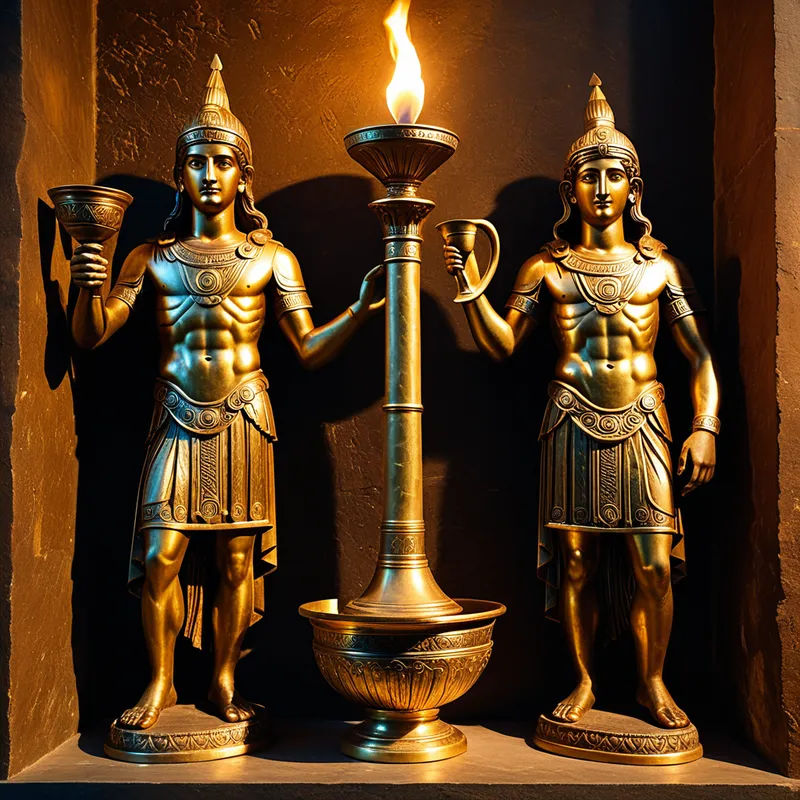
These presences were [the Lares](/myths/the-lares “Myth from Global/Universal culture.”/). They were the genius of the land, the numen of the hearth. In one household, they might appear as youthful, dancing figures, forever vigilant, holding the [horn of plenty](/myths/horn-of-plenty “Myth from Norse culture.”/) and the patera for libations. In another, they were felt as a sudden, profound stillness in the atrium, a sense of being watched over. They were the unseen hands that guided the plow to avoid a stone, that stirred the pot to prevent burning, that brushed a cold warning against the neck of a family member dreaming of a treacherous journey at dawn.
Their domain was the familia, but not merely its people. It was the walls, the storeroom, [the crossroads](/myths/the-crossroads “Myth from Celtic culture.”/) at the end of the property lane. Every meal began with a morsel cast into the cooking fire for them. Every family [triumph](/myths/triumph “Myth from Roman culture.”/)—a birth, a safe return, a good bargain—was celebrated with garlands draped over their small shrine, the [lararium](/myths/lararium “Myth from Roman culture.”/). Their anger was not lightning, but mildew in the grain, a souring of wine, a chill discord among kin. Their favor was health, fertility, and the profound, unshakeable knowledge that here, within this boundary, you belonged.
The story of the [Lares](/myths/lares “Myth from Roman culture.”/) is not one of epic voyage or monstrous battle. It is the story of the fire that never goes out. It is the silent pact between the dead and the living: Remember us, and we will guard your sleep. Honor this place, and it will hold you. It is the myth of the center that holds, whispered not by bards in halls, but by fathers at the hearth and mothers at the cradle, in the simple, daily acts of keeping a home.
Cultural Origins & Context
The Lares Familiares were not gods of the state, but of the soil. Their origins are likely pre-Roman, rooted in ancient Italic ancestor worship and animistic beliefs that every place and [thing](/myths/thing “Myth from Norse culture.”/) possessed a spirit, a numen. As Roman culture formalized from village to Republic to Empire, these intimate spirits were codified but never fully institutionalized. They remained resolutely domestic.
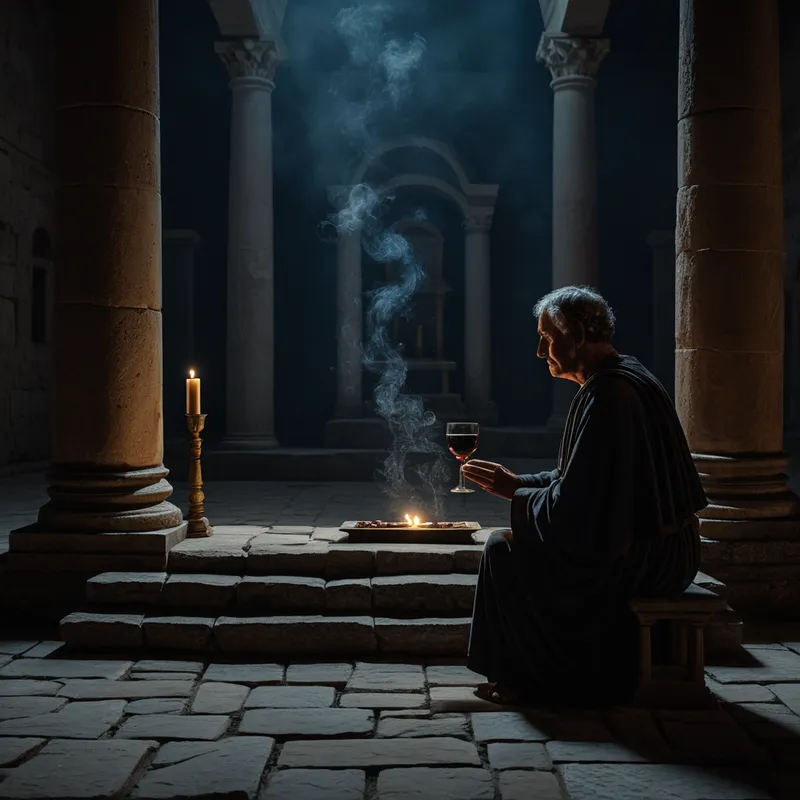
Their primary cult was administered by the paterfamilias. Each day, during the main meal, a portion of food was offered to them. On the Kalends, Nones, and Ides of each month, and on family birthdays, the shrine would be adorned and offerings of wine, honey, and grain made. The Lararium was typically a niche in the wall, often in the atrium or kitchen, containing small statuettes of the Lares and sometimes the Genius of the paterfamilias.
This practice served a critical societal function. It was the ritual engine of family identity and continuity. It taught each member, from birth, that they were part of a chain that extended backward through time and was rooted in a specific piece of earth. In a society built on fides and pietas, piety began at home, with the Lares. They were the first gods a child knew, the most immediate mediators between the human and the divine.
Symbolic Architecture
Psychologically, the Lares represent the [soul](/symbols/soul “Symbol: The soul represents the essence of a person, encompassing their spirit, identity, and connection to the universe.”/) of the container. They are the archetypal [energy](/symbols/energy “Symbol: Energy symbolizes vitality, motivation, and the drive that fuels actions and ambitions.”/) that transforms a physical [space](/symbols/space “Symbol: Dreaming of ‘Space’ often symbolizes the vastness of potential, personal freedom, or feelings of isolation and exploration in one’s life.”/)—a house—into a psychic and spiritual entity—a Home. They symbolize the internalized [presence](/symbols/presence “Symbol: Presence in dreams often signifies awareness or acknowledgment of something significant in one’s life.”/) of ancestry, tradition, and the accumulated “lived [life](/symbols/life “Symbol: The symbol of ‘Life’ represents a journey of growth, interconnectedness, and existential meaning, encompassing both the joys and challenges that define human experience.”/)” of a place.
The hearth is not where the fire is burned, but where the shadow of every past flame is remembered.
They are the guardians of the [limen](/myths/limen “Myth from Roman culture.”/), the threshold. This is their profound symbolic domain: not the faraway frontier, but the immediate [boundary](/symbols/boundary “Symbol: A conceptual or physical limit defining separation, protection, or identity between entities, spaces, or states of being.”/) between [safety](/symbols/safety “Symbol: Safety represents security, protection, and the sense of being free from harm or danger, both physically and emotionally.”/) and [danger](/symbols/danger “Symbol: The symbol of ‘Danger’ often indicates a sense of threat or instability, calling for caution and awareness.”/), known and unknown, self and other. They patrol the edges of our psychic [identity](/symbols/identity “Symbol: Identity represents the sense of self, encompassing personal beliefs, cultural background, and social roles.”/), the walls of [the ego](/myths/the-ego “Myth from Jungian culture.”/)-complex that define “what is me and mine.” In this sense, they are deeply conservative forces, not politically, but psychologically—their function is to conserve, to maintain integrity, to prevent [dissolution](/symbols/dissolution “Symbol: The process of breaking down, dispersing, or losing form, often representing transformation, release, or the end of a state of being.”/).
The offering [ritual](/symbols/ritual “Symbol: Rituals signify structured, meaningful actions carried out regularly, reflecting cultural beliefs and emotional needs.”/) is key. It symbolizes a reciprocal [relationship](/symbols/relationship “Symbol: A representation of connections we have with others in our lives, often reflecting our emotional state.”/) with the past and the invisible. We feed the [memory](/symbols/memory “Symbol: Memory symbolizes the past, lessons learned, and the narratives we construct about our identities.”/) (the Lares) with our [attention](/symbols/attention “Symbol: Attention in dreams signifies focus, awareness, and the priorities in one’s life, often indicating where the dreamer’s energy is invested.”/) and respect, and in return, that [memory](/symbols/memory “Symbol: Memory symbolizes the past, lessons learned, and the narratives we construct about our identities.”/) provides a ground of being, a sense of orientation and protection. The Lares are the psychological equivalent of internalized objects—the comforting, guiding voices of our personal and collective past that provide a stable base from which to engage [the world](/myths/the-world “Myth from Tarot culture.”/).
The Dreamer’s Resonance
When the pattern of the Lares stirs in the modern unconscious, it often manifests in dreams concerning the psychic dwelling. One may dream of their childhood home, but with a charged, numinous atmosphere—a particular room glowing, or a familiar hallway containing a mysterious, ancient shrine. The dream-ego might be engaged in a ritual of repair: fixing a door, relighting a pilot light, or carefully cleaning a forgotten corner.
These dreams point to a somatic process of re-establishing inner sanctuary. After periods of external chaos, trauma, or existential homelessness, the [psyche](/myths/psyche “Myth from Greek culture.”/) seeks to reconsecrate its own boundaries. The dream of the Lar is a dream of remembering one’s roots, not necessarily genealogical, but soulful—reconnecting with the practices, values, and memories that make one feel fundamentally held and real.
Conversely, dreams of a desecrated Lararium, shattered figurines, or a cold, dead hearth signal a profound crisis of belonging and protection. The dreamer may feel their internal boundaries have been violated, their history rendered meaningless, or their core identity under attack. The somatic correlate is often a deep anxiety in the gut—the body’s “hearth”—or a feeling of being exposed and unsafe even in one’s own bed.
Alchemical Translation
The individuation process modeled by the Lares myth is not one of heroic conquest, but of sacred maintenance. In our modern alchemy, where the quest is often outwardly focused on achieving, acquiring, and exploring, the Lares remind us of the essential, inward task of tending.
The first alchemical operation is [nigredo](/myths/nigredo “Myth from Alchemical culture.”/)—the dissolution of the old. For the Lares, this is the painful but necessary recognition when the old “home” (a worldview, a identity, a relationship) can no longer contain the growing soul. The hearth grows cold. The second, albedo, is the purification. This is the conscious, often daily work of sorting through our ancestral and personal inheritance—what to honor and keep on the shrine, and what to respectfully lay to rest. It is the cleansing of the Lararium.
The gold of the spirit is not found only in distant quests, but in the patient polishing of the threshold you cross every day.
The final stage, [rubedo](/myths/rubedo “Myth from Alchemical culture.”/), is the rekindling. It is the creation of a new, conscious sacred domesticity within the psyche. The modern individual must become their own paterfamilias or materfamilias, actively making offerings to what truly sustains them: quiet reflection, gratitude, ritual, the honoring of personal cycles. The Lares are transmuted from external spirits into integrated inner guardians—the instinct for self-care, the voice of healthy boundary-setting, the deep, quiet knowledge of one’s own sacred worth and place in the world. The fire is lit anew, not by chance, but by devoted, daily hands.
Associated Symbols
Explore related symbols from the CaleaDream lexicon: