Lares Compitales Myth Meaning & Symbolism
Spirits of the crossroads, guardians of the neighborhood, embodying the sacred boundary between the known home and the wild, unknown world beyond.
The Tale of Lares Compitales
Listen, and hear the whisper of the stones where the roads meet. This is not a tale of Olympus, thundering with the pride of gods, but a story breathed into the dust of your own street, sung by the wind at the corner where your world ends and the unknown begins.
In the time when Rome was a cluster of hills and hearths, the world was a map drawn in thresholds. The domus, the home, was a sacred circle, warmed by the fire of the Lares Familiares. But step outside your door, and you entered a different realm—the wild, public, and unpredictable world of the via. And where the viae crossed, where one path sliced into another, there lay a place of profound power: the compitum. A crossroads.
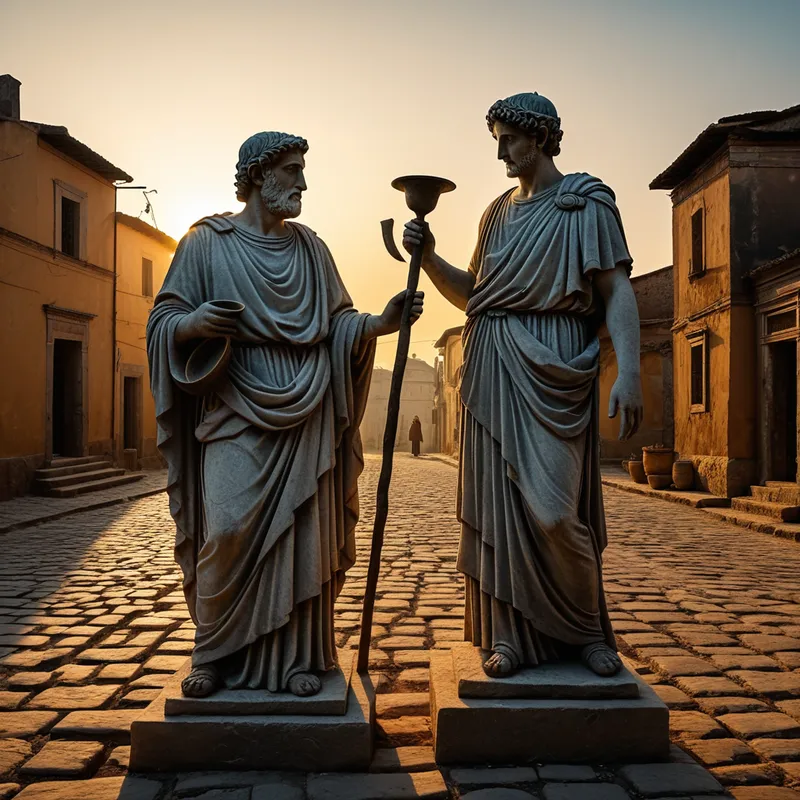
Here, in this liminal breath between neighborhoods, dwelled spirits of a different nature. They were the Lares Compitales. You would not find their likeness in grand temples of marble. Their shrine was a humble post or an altar stone, often crowned with a small, roofed niche. They were the watchers of the boundary stone, the silent witnesses to every departure and return.
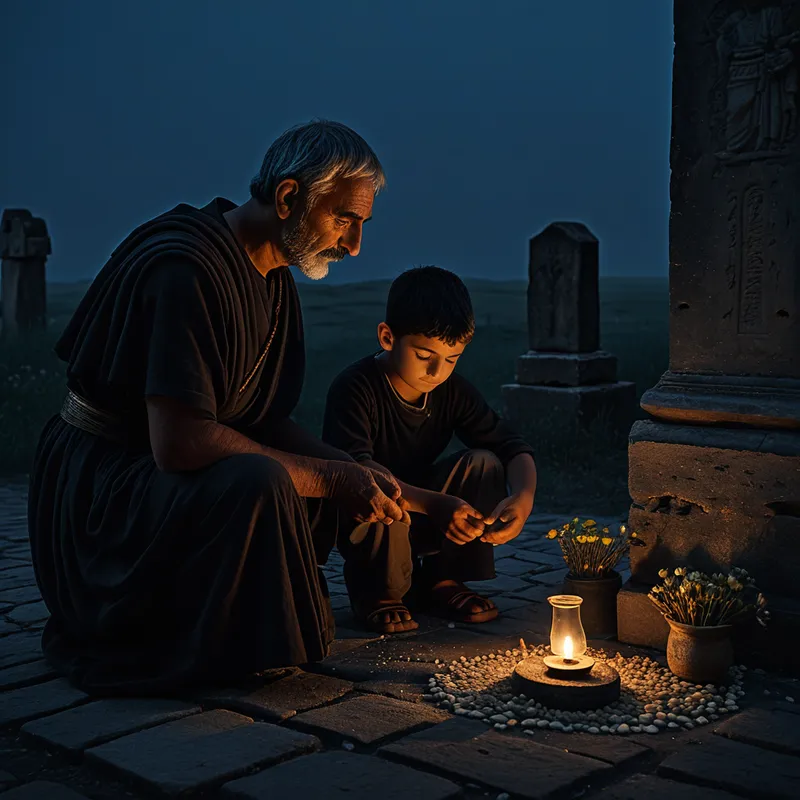
Imagine the scene as the sun bleeds into the west. The air cools, carrying the scent of baking bread and distant earth. A father, his hands calloused from the field, takes his young son by the hand. They carry not grand sacrifices, but simple gifts: a handful of first grains, a few late-season flowers, a drop of wine from the day’s flask. They walk not to the city forum, but to the end of their lane, to the place where their familiar dirt track meets the road from the next farm.
At the compitum, they pause. The father places the offerings on the soot-blackened stone. He murmurs names—not of distant, glorious gods, but of these local guardians. He asks for no empire or fortune. His prayer is a map of the mundane, drawn in hope: “Watch over us, you who stand at the divide. Keep sickness from crossing this boundary. Let my son return safely from his errand. Let the stranger who means well be guided, and the one who means ill be turned away.” The boy watches, learning that protection is not a distant thunder, but a practice, a small ritual of care poured out at the edges of your world.
Once a year, this quiet vigilance erupted into community joy. The Compitalia was celebrated. Woolen dolls and balls were hung at the crossroads—symbolic offerings for the Lares, perhaps substitutes for older, darker rites. Neighbors gathered, sharing food and wine. The magistrate’s authority paused at this boundary; here, the community of the vicus, the neighborhood, ruled itself. It was a festival of laughter and connection, affirming that the sacred boundary did not only divide, but also connected. It defined the “we” who lived within the watchful gaze of these shared, silent guardians.
Cultural Origins & Context
The Lares Compitales were not gods of mythic epic, but deities of lived topography. Their origins are shadowed, likely reaching back to the ancient Italic practice of worshipping the spirits of the dead, particularly benevolent ancestral protectors. Some scholars trace them to the Lar Familiaris, the deified spirit of the family founder, whose protective power was extended beyond the single hearth to the community’s edge.
Their societal function was profoundly practical and psychological. Rome was a culture obsessed with boundaries—pomerium, limen, finis. The terminus was itself sacred. The Lares Compitales were the spiritual enforcement of this principle. They policed the most vulnerable points: the crossroads, where directions multiplied and intentions could be obscured. By worshipping them, the community collectively maintained the psychic and social integrity of their neighborhood. The Compitalia festival, overseen by the vici and their locally chosen magistrates, was a powerful act of local, bottom-up social cohesion, a temporary autonomous zone that reinforced communal identity against the centralized power of the state.
Symbolic Architecture
Psychologically, the myth of the Lares Compitales builds a symbolic architecture for the self. The home (domus) represents the conscious ego, the known and ordered identity. The wild world beyond is the unconscious, teeming with potential, danger, and the unknown. The crossroads is the critical threshold between the two.
The guardian does not reside in the fortress of the known self, but at its porous gate. True security is not found in walls, but in a conscious relationship with the boundary itself.
The Lares represent the protective, regulating function of the psyche that manages this exchange. They are not warriors who destroy the foreign, but discerning sentinels who facilitate safe passage for what is beneficial (the returning son, the benign stranger) and filter out what is harmful (sickness, malice). They symbolize the ego’s necessary capacity for discrimination—the ability to say “this belongs to me, and this does not.”
The two common attributes seen in their depictions—the rhyton (drinking horn) and the patera (offering bowl)—are profound symbols. The horn signifies abundance and the flow of life from the outer world into the community. The bowl represents the vessel of the community itself, ready to receive and contain that flow. Together, they depict a sacred economy of give-and-take at the boundary.

The Dreamer’s Resonance
When this myth stirs in the modern unconscious, it often manifests in dreams of thresholds and neighborhoods. You may dream of the end of your street, a familiar intersection that now feels charged and strange. You might see a faded, neglected shrine that you feel compelled to tend to, or encounter a silent, watchful figure at a doorway or gate.
Somatically, this can correlate with feelings of anxiety about personal boundaries—feeling “invaded” by others’ demands or the pressures of the world, or conversely, feeling trapped and isolated within your own “home.” The psychological process is one of boundary reassessment. The dream is asking: Where are the edges of my psychic property? What am I allowing to cross into my emotional space? What beneficial connections am I failing to invite in? The Lares Compitales pattern emerges when the ego’s simple, rigid defenses (the walls of the domus) are insufficient, and a more nuanced, active guardianship of the self is required.

Alchemical Translation
The alchemical work modeled by the Lares Compitales is the transmutation of fear into vigilant care, and isolation into connected integrity. The initial state is often a brittle ego, either barricaded in defensive isolation or dissolved in chaotic enmeshment with the world. The “prima materia” is the anxiety felt at life’s crossroads—every decision, every new influence, every relationship is a potential compitum.
Individuation is not the construction of an impregnable self, but the conscious appointment of guardians for its frontiers. The goal is not to conquer the unknown, but to establish a respectful treaty with it.
The process begins with the recognitio—the recognition of one’s own boundaries as sacred. This is the building of the internal altar. The next step is the sacrificium—the regular offering of attention and discernment. What “grain and wine” of your awareness will you place at the boundary of your energy, your time, your emotional capacity? The final transmutation is the festum—the joyful realization that a well-tended boundary does not isolate, but defines the space where authentic community and exchange can safely occur. The integrated individual becomes both the hearth-keeper (Lar Familiaris) within and the crossroads guardian (Lar Compitalis) without, capable of deep internal warmth and wise, protective engagement with the vast, intersecting paths of the world.
Associated Symbols
Explore related symbols from the CaleaDream lexicon: