Lakapati Myth Meaning & Symbolism
The myth of Lakapati, the hermaphroditic Tagalog deity of fertility and agriculture, who embodies boundless generosity and the sacred unity of all life.
The Tale of Lakapati
Before the world knew hunger, before the first stalk of rice bent its head in the wind, there was a silence in the fields. The earth was rich and dark, but it slept. The people were few, and their bellies were hollow with a longing they could not name. They looked to the sky, but the sun was a distant coin; they looked to the rivers, but the waters held only fish that slipped like silver dreams through their fingers. The world was a promise unfulfilled.
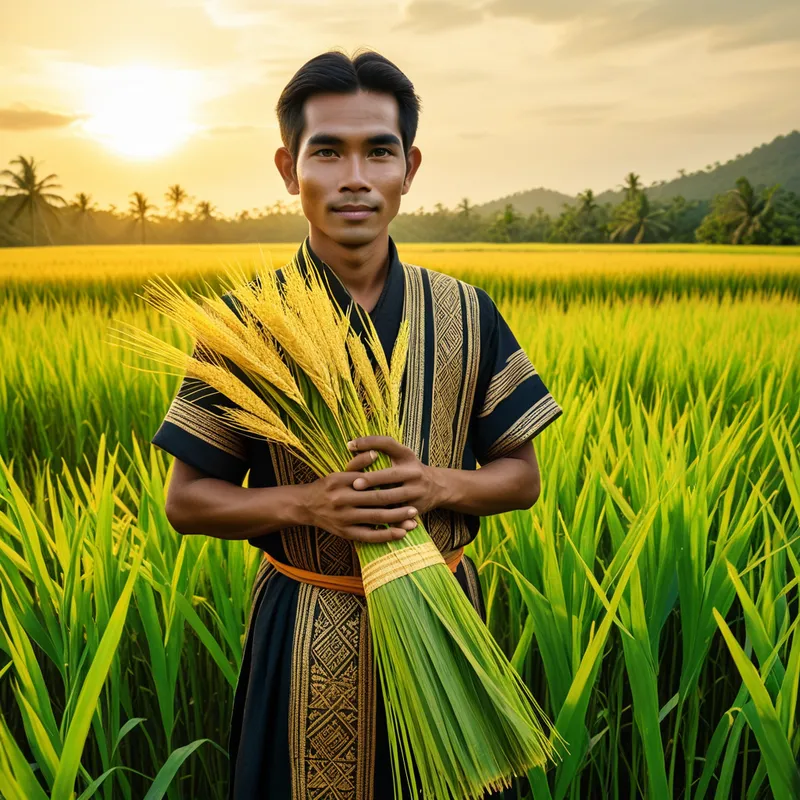
Then, from the place where the mist meets the mountain, Lakapati came. They did not arrive with thunder or fire, but with a presence that softened the very air. To behold them was to see the world made whole: a figure of profound and gentle power, whose form held the sacred mystery of both male and female. In one hand, they carried a basket woven from moonlight and vine; in the other, a quiet certainty.
The people fell to their knees, not in fear, but in a recognition that stirred their souls. Lakapati walked among them, their touch leaving warmth on chilled skin. They saw the emptiness in the fields and the hunger in the children's eyes. Without a word spoken, they moved to the center of the barren clearing. The air grew still, charged with a potential that made the heart beat like a drum.
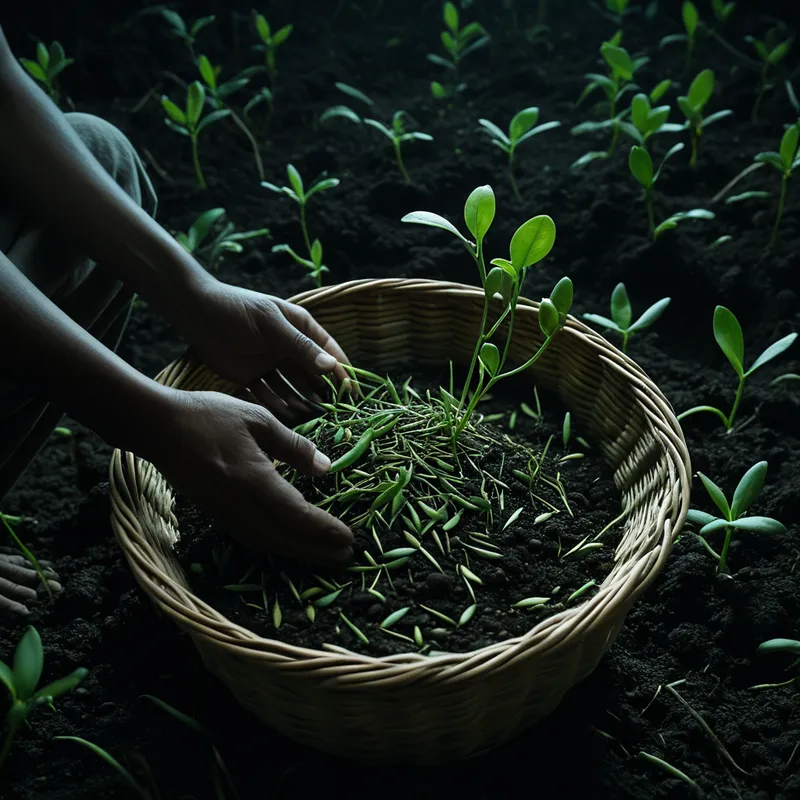
Lakapati raised their hands, not to the distant gods, but to the sleeping earth itself. From their basket, they took not gold, not jewels, but simple, unassuming seeds. As they scattered them upon the dark soil, a hum began—a vibration deep within the world's bones. Where each seed fell, the ground did not merely accept it; it sang to it. Tiny green spears pierced the crust, unfurling with a speed that was not of nature as the people knew it, but of a divine will bending time. Stalks grew tall and strong, heavy with grain that turned from green to a ripe, breathtaking gold under the gaze of the deity.
But this was no spectacle for awe alone. Lakapati turned to the stunned people, their eyes holding the patience of the soil and the wisdom of the seasons. They showed how to tend the shoots, how to read the rain in the clouds, how to harvest with gratitude so the spirit of the field would return. They gave not just food, but the knowledge of life itself—the first planting ritual, the first prayer whispered over a seed.
And then, as the first feast was prepared, as the smell of cooked rice filled the air for the very first time, a deeper sacrifice was made. The people, in their joy, offered the first and finest portion to Lakapati. The deity looked at the offering, then at the faces of the people, now glowing with health and hope. In a gesture of ultimate compassion, Lakapati refused. They pushed the bowl back towards the people, their expression one of boundless love. "This is for you," the action said, more clearly than any word. "My abundance is yours. My purpose is your sustenance." They gave everything, asking for nothing in return, establishing the first and most sacred covenant: that true divinity is measured not in power demanded, but in life given.
Cultural Origins & Context
The myth of Lakapati (also recorded as Ikapati) springs from the rich oral traditions of the Tagalog peoples of pre-colonial Luzon. Recorded in early Spanish chronicles like those of Plasencia, these stories were not mere fables but living cosmology, transmitted by babaylan and storytellers. Lakapati was a central figure in a pantheon where deities governed specific, vital aspects of the natural and social world.
This myth functioned as the foundational narrative for an agrarian society. It explained the origin of agriculture—the single most important technological and cultural revolution for the community. More than an origin story, it encoded the essential ethics of that society. Lakapati’s identity as a hermaphroditic or transgender deity reflected a pre-colonial understanding of gender and creation that was often more fluid and holistic, seeing the generative force of the universe as necessarily encompassing all potentials. The myth prescribed the proper relationship between humanity, the divine, and the natural world: one of reciprocity, gratitude, and stewardship, cemented by the deity’s ultimate act of compassionate refusal.
Symbolic Architecture
At its core, Lakapati is an archetype of the Generative Principle. They are not a warrior or a king, but a sower and a sustainer. Their hermaphroditic nature is the ultimate symbolic expression of wholeness and self-sufficient creativity.
The true creator does not stand apart from creation but is the very soil from which it grows and the rain that nourishes it.
The scattering of seeds symbolizes the investment of potential into the fertile void of the unconscious or the material world. It is an act of faith that requires no immediate proof. The miraculous growth represents the astonishing fecundity of the psyche or the universe when aligned with its true, life-giving purpose. The central, poignant moment—the refusal of the offering—transforms the myth from a simple gift into a profound theological and psychological statement. It establishes divinity as fundamentally compassionate, existing not to be served but to serve. It inverts the typical power dynamic of sacrifice.

The Dreamer's Resonance
When the pattern of Lakapati stirs in the modern dreamscape, it often signals a profound somatic and psychological process of nurturing the nascent self. One may dream of planting gardens in unlikely places, of finding barren rooms suddenly bursting with lush, unknown plants, or of feeding others from an endless, simple bowl.
These dreams surface during life phases where we are called to cultivate something new and vital: a creative project, a healing journey, a new relationship, or a deeper connection to our own body. The somatic sensation is often one of "quickening"—a gentle, internal stirring of potential, like the first flutter of a heartbeat in the womb. Psychologically, it is the process of moving from a state of psychic hunger or barrenness (a feeling of lack, creative block, or emotional infertility) to one of generative abundance. The dream may also confront us with our reluctance to accept nurture or our inability to give without expectation of return, mirroring Lakapati’s lesson of open-handed generosity.

Alchemical Translation
The individuation process modeled by Lakapati is the alchemy of Care. It is the transmutation of base self-concern into the gold of compassionate creation. The modern individual often begins in a state of "spiritual hunger," seeking to consume—approval, success, love—to fill an inner void.
The work is to become the sower, not the harvester; to become the source of nurture, not merely its recipient.
The first stage is recognizing the fertile void within (the barren field). The second is the courageous, often faith-driven act of "planting seeds"—investing energy in relationships, creative acts, or self-care without guarantee of outcome. The third and most critical stage is the sacrifice of the ego's demand for reward. This is Lakapati refusing the offering. It is the realization that our true wholeness (our inner hermaphroditic unity) is realized not when we are glorified for our gifts, but when our gifts flow freely to nourish the world around us. The final stage is the establishment of a sustainable, cyclical practice of giving and receiving, where the act of nurturing itself becomes the source of life, completing the sacred circle. We no longer look for an external deity to feed us; we integrate the Lakapati archetype and become, in our own sphere, a source of fertile, compassionate abundance.
Associated Symbols
Explore related symbols from the CaleaDream lexicon:
- Seed — The primal unit of potential and life, scattered by Lakapati, representing ideas, hopes, and the initial investment of energy that must be entrusted to the dark soil of the unknown.
- Earth — The receptive, fertile, and nurturing ground of all growth, symbolizing the body, the material world, and the unconscious psyche that receives and incubates potential.
- Harvest — The fruitful outcome of careful tending and patience, representing the manifestation of efforts, the rewards of a creative cycle, and the abundance generated from faithful work.
- Goddess — The divine feminine principle embodied by Lakapati, representing nurturing, creation, fertility, and the life-giving forces of the natural world.
- Gift — The unconditional offering of sustenance and knowledge, symbolizing pure generosity, the flow of abundance without expectation, and the core of compassionate relationship.
- Field — The cultivated space of potential and work, representing the arena of one's life, a project, or the psyche where seeds are sown and growth is nurtured.
- Rain — The nourishing element that falls from the sky to the earth, symbolizing blessing, emotional nourishment, grace, and the necessary conditions for growth that come from a higher source.
- Basket — The vessel that carries the seeds, representing the container of potential, the resources one has to offer, and the womb-like holder of life yet to be born.
- Moon — The cyclical, reflective body governing tides and growth, symbolizing the rhythms of fertility, the unconscious, and the gentle, receptive power that guides organic development.
- Unity — The state of wholeness represented by Lakapati's form, symbolizing the integration of opposites (male/female, giving/receiving), inner completeness, and the reconciliation of dualities.