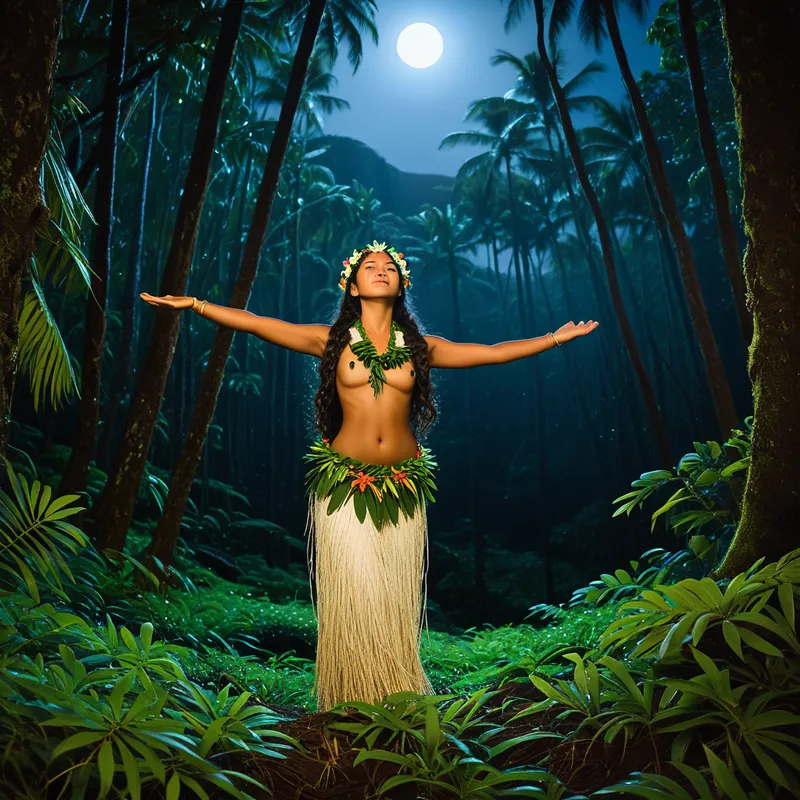
Laka Goddess of the Hula Myth Meaning & Symbolism
The myth of Laka, goddess who birthed the sacred hula from the wild forest, embodying the alchemy of chaos into beauty and discipline.
The Tale of Laka Goddess of the Hula
Listen. Before the chants were fixed in memory, before the drums found their steady heartbeat, there was only the wild voice of the forest. The wind screamed through the ʻōhiʻa branches. The rain beat a chaotic rhythm on the broad leaves of the kalo. In the deep, green shadows of wao akua, the realm of the gods, something stirred—not with violence, but with a yearning for form.
Her name was Laka. She was not born of human womb, but emerged from the very essence of the grove. She was the latent pattern in the vine’s curl, the potential harmony in the bird’s call, the secret geometry of the falling blossom. She walked where the Pele’s fires had not scorched, in the lush uplands where life was damp and prolific. And she was troubled. The beauty around her was profound, but it was untamed. It was a beauty that overwhelmed, that swallowed the senses whole without offering a path through.
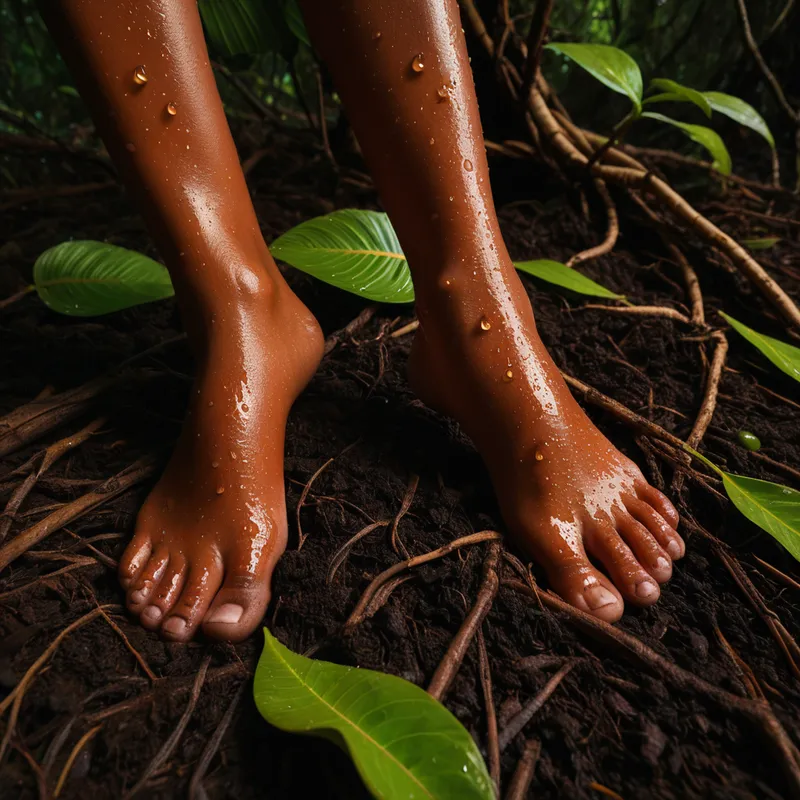
So Laka began to move. Not randomly, as the ferns in the wind, but with intention. She watched the sway of the hāhā tree. She mimicked the flicker of the ʻiʻiwi’s wing. She felt the push and pull of the surf, far below, echoing in her bones. Her hands began to speak what words could not. Her hips traced the arc of the crescent moon. Her feet pressed into the soft earth, claiming it, blessing it. This was the first pulse. The first step.
But a formless god is a lonely god. Her dance was a question thrown into the green silence. The answer came from the forest itself. The spirits of the plants—the maile with its heady scent, the delicate ʻilima, the sturdy palapalai—drew close. They were not just materials; they were willing participants. Laka wove them into lei and skirts, and as she adorned herself, the dance gained purpose. It became an invocation, a way to draw the diffuse spirit of the place into a focused, beautiful presence.
She gathered these plant kin and descended from the deepest forest to its sun-dappled edges. Here, she found the first people who dared to listen with their bodies, not just their ears. She did not command; she revealed. She showed them how the tilt of a wrist could tell of searching, how a stomp could speak of foundation, how a sweeping arm could chart the path of a voyaging canoe across the starry night. The wild rhythm of the wao akua was not silenced, but given a vessel. Chaos became choreography. The overwhelming beauty of the world now had a language, and in that language, humans could converse with the divine. Thus, the hula was born—not as entertainment, but as a sacred bridge, a disciplined prayer born from untamed grace.
Cultural Origins & Context
The myth of Laka is the foundational charter for one of Kanaka Maoli’s most profound cultural arts: the hula. It originates in the wa kahiko, the ancient period, and was transmitted orally through oli and mele by kāhuna and kumu hula. This was not a story told lightly; it was embedded in the ritual transmission of the dance itself. To learn the hula was to enter into Laka’s story, to become a living part of its continuation.
Societally, the myth served multiple vital functions. It sanctified the art form, elevating it from mere movement to kapu ritual, essential for honoring gods, aliʻi (chiefs), and recording history. It established the ecological protocol of the hula—the gathering of specific plants from the forest with prayer and reciprocity, making the dancer an extension of the landscape. Most importantly, it provided a model for cultural order. Just as Laka transformed wild forest energy into structured dance, the kumu hula transformed raw human energy (the students) into disciplined vessels of cultural memory and spiritual expression.
Symbolic Architecture
At its heart, the myth of Laka is a supreme act of symbolic ordering. The forest, or wao akua, represents the undifferentiated unconscious—teeming with life, power, and potential, but also overwhelming and formless. Laka is the archetypal principle of the mea hana, the creator, who ventures into this chaos not to conquer it, but to engage with it, to listen, and to draw out its inherent patterns.
The sacred dance is not an imposition of human will upon nature, but nature discovering its own eloquent voice through the human form.
The plants that ally with her—maile, ʻilima, palapalai—symbolize the contents of the unconscious (memories, instincts, emotions) that are willing to be integrated into a cohesive identity. The resulting hula is the ʻike, the conscious expression—a living symbol that bridges the deep, instinctual self with the outer, social world. It is psyche in motion, where every gesture holds meaning, and discipline is the container for ecstasy.
The Dreamer's Resonance
When this mythic pattern stirs in the modern dreamer, it often manifests as dreams of chaotic, beautiful, or overwhelming natural environments—a dense jungle, a stormy sea, a garden run wild. The dreamer may feel lost in it or mesmerized by it. Alternatively, they may dream of trying to perform a dance or ritual without knowing the steps, feeling clumsy and exposed.
Somatically, this signals a process of reorganization within the psyche. The "wild forest" is a surge of unprocessed emotional or creative energy breaking into awareness. It can feel like anxiety, creative block, or a flood of ideas without direction. The dream is presenting the raw material. The psychological task, modeled by Laka, is not to flee this chaos or let it consume you, but to begin to move with it intentionally. To find one simple, repeatable gesture—a daily practice, a journaling habit, a physical discipline—that begins to give form to the formless. The dreamer is being called to become the dancer who can hold the tension between wild inspiration and necessary form.
Alchemical Translation
The individuation process mirrored in Laka’s myth is the alchemy of inspiration into incarnation. We all contain our own wao akua—a wilderness of unlived life, primal drives, and creative daimons. The initial stage is often a passive immersion in this inner chaos, which can manifest as mood swings, procrastination, or a sense of being haunted by potential.
Laka’s journey teaches that the catalyst for transmutation is embodied engagement. One must "go into the forest"—through active imagination, deep reflection, or engaging with art—and begin to "move." This is the hana, the dedicated practice. The first movements will be awkward, the first forms crude. This is the haumāna stage.
The kuahu you build is not for a distant goddess, but for the nascent spirit of your own wholeness taking form.
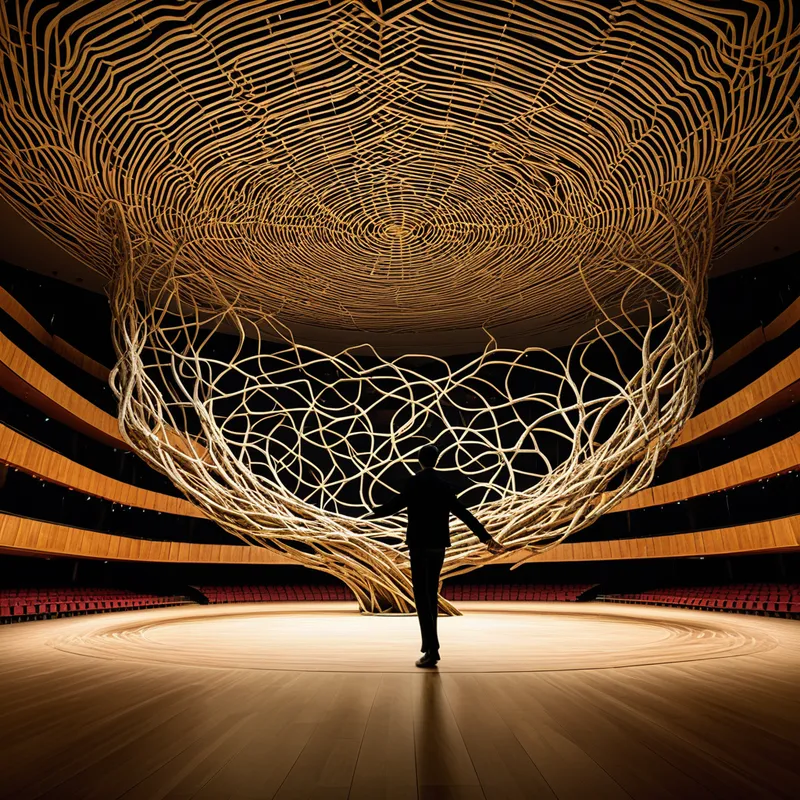
The disciplined practice (the daily ritual, the honing of a skill) acts as the kuahu, the altar, upon which the raw material of the self is offered up and transformed. Slowly, the chaotic energies ally with you, becoming the very attributes and talents that define you. The final stage is not a static perfection, but the ability to perform your own "hula"—to express the complex, beautiful, and often tragic story of your unique life with grace, power, and meaning, thereby creating a bridge between your deepest self and the world. You become both the dancer and the dance, the creator and the creation.
Associated Symbols
Explore related symbols from the CaleaDream lexicon:
- Goddess — The divine feminine principle as creator and source of artistic inspiration, representing the psyche's capacity to give birth to form from formless potential.
- Forest — The symbolic wao akua, representing the untamed, fertile, and sometimes overwhelming realm of the personal and collective unconscious.
- Dance — The archetypal act of psychic integration and expression, where inner chaos is transformed into meaningful, communicative movement and ritual.
- Ritual — The structured, repetitive practice that contains and directs raw spiritual or psychological energy, as the hula ritualizes the relationship between human and divine.
- Flower — Symbolizes beauty, fragility, and ephemeral revelation, like the ʻilima offered to Laka; it represents moments of conscious insight blossoming from the unconscious.
- Order — The principle Laka imposes on chaos, representing the necessary structures, disciplines, and forms that make creative expression and psychological coherence possible.
- Creation — The fundamental act at the heart of the myth; the bringing forth of something new, sacred, and meaningful from the void or the wild.
- Temple — The human body and the dance space as a consecrated vessel, a kuahu, where the divine is invited to manifest through disciplined artistry.
- Spirit — The animating life force (mana) that flows through the forest, into Laka, and through the dancer, connecting all realms of existence.
- Root — The connection to the earth, tradition, and the source materials (the forest plants) from which all true creation must draw its sustenance and authenticity.
- Healing — The integrative power of the sacred dance, which heals the rift between nature and culture, unconscious and conscious, by making a beautiful whole from disparate parts.