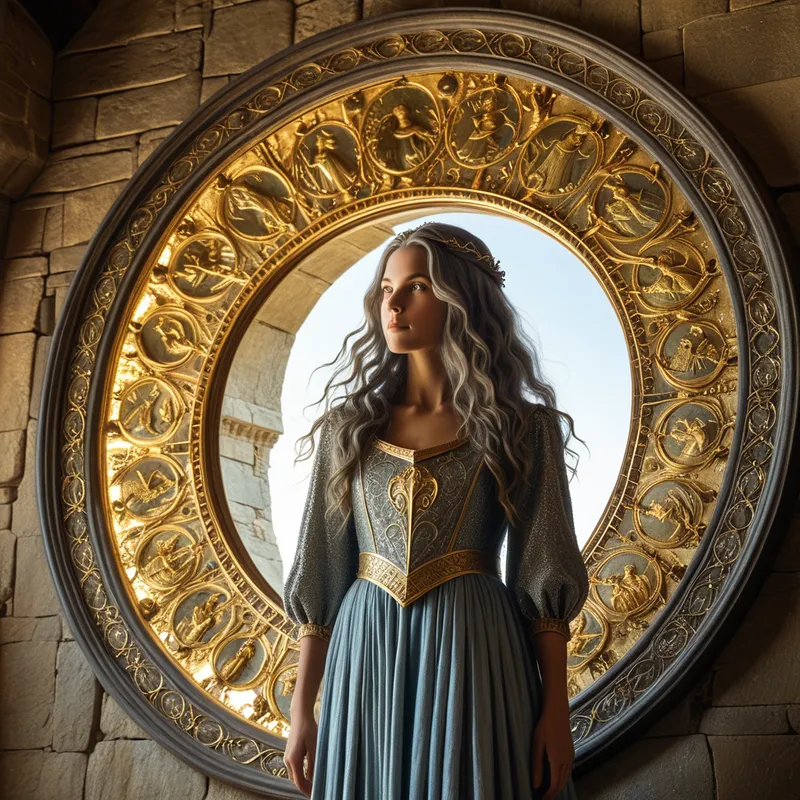
Lady of Shalott's Mirror Myth Meaning & Symbolism
A woman cursed to see the world only through a mirror weaves its reflections into a tapestry, until a glimpse of Lancelot shatters her life of mediated reality.
The Tale of Lady of Shalott's Mirror
Hear now of the isle, the silent isle, set in the river that runs down to Camelot. Upon it stands a grey tower, windowless but for one narrow slit facing the north, where no sun ever warms the stone. Within dwells the Lady. She knows not her name, for it was lost with her childhood; she is known only by the place of her imprisonment: the Lady of Shalott.
A curse lies upon her, whispered by winds from a forgotten time. The nature of the curse is this: she must not look upon Camelot directly. Should she turn her living eyes to the world beyond her river, a doom unspoken and swift will fall. Thus, she lives in a world of second-hand light. A great mirror, round and clear as a frozen moon, hangs upon her wall. In its silvered depth passes all the pageantry of life: the reapers in the fields, the market girls with baskets, the shepherd lads, and, most glorious of all, the knights in bright steel riding the road that winds to the king’s high hall.
This reflected world is her sole occupation. From dawn to dusk, she sits before her loom, a mighty frame that groans with the weight of her work. She does not weave scenes from memory or fancy. She weaves the shadows in the mirror. With threads of many colors, she captures the moving reflection—a knight’s crimson plume, a lady’s azure gown, the green of the riverbank. Her tapestry is vast, an endless, beautiful record of a life she cannot touch, a chronicle of shadows. And as she weaves, she sings a low, haunting song, a tune with no words, the sound of the shuttle passing through the warp.
Seasons turn in the glass. She sees the funeral and the wedding, the plowman and the pilgrim. She weaves them all into her endless cloth, and her song becomes the tower’s only voice. She is content, perhaps, in her craft. Or perhaps she is numb, her soul as mediated as her sight.
Then comes the autumn, and with it, a new reflection. Sir Lancelot. He rides like a sunburst trapped in steel, his shield a blaze, his helmet crowned with a plume, his bridle bells ringing a melody that even the silent mirror seems to echo. He passes, a flash of unmediated glory, singing a song of “tirra lirra” that cuts through the glass and stone.
The Lady stops. The shuttle falls from her hand. For the first time, the reflection is not enough. The curse, long a cold fact, becomes a prison wall she must breach. The direct light, the true sound, the un-reflected life—it calls with a voice louder than doom.
“I am half-sick of shadows,” she says, and the words break the spell of her song.
She turns from the mirror. She walks, a sleepwalker, to the window slit. She looks east, to the road where he rode. She sees Camelot in the living light, its banners bright, its river sparkling. The curse, swift and true, is upon her. The mirror cracks from side to side. The tapestry, her life’s work, billows out as if in a great wind. The threads snap, singing their death knell.
She knows what comes. There is no fight, only a terrible, accepting clarity. She descends the tower stairs, finds a boat at the island’s edge, and writes her name upon its prow—The Lady of Shalott. She lies down in the boat, clad in a snowy white robe, and loosens the chain. The current takes her, bearing her down the long river to Camelot, the place she has only ever seen in reverse. She sings a final, mournful carol as her life ebbs, a dirge for shadows, heard by the reeds and the willows. She dies singing, arriving at the king’s steps a mystery, a beautiful corpse, her face turned at last to the real sky, her tapestry the only testament to her prison of glass.

Cultural Origins & Context
The tale of the Lady of Shalott is not a medieval chronicle but a 19th-century Romantic reinvention, a myth born from the loom of poetry. While rooted in the Arthurian tradition—specifically the Italian Donna di Scalotta—it was Alfred, Lord Tennyson who, in his 1832 and 1842 poems, gave the story its profound and enduring shape. Tennyson was part of a Victorian revival that sought the soul of the nation in legendary pasts, using Arthuriana as a mirror to reflect contemporary anxieties about art, industrialization, and the individual’s place in society.
The myth was passed down not by bards in mead-halls, but through printed verse, pre-Raphaelite paintings, and later, musical adaptations. Its societal function was complex: for the Victorians, it was a poignant allegory for the artist’s isolation, the woman’s confined societal role, and the terrifying allure of authentic experience in an increasingly mediated and rule-bound world. It asked a question modernity still grapples with: is a life of curated, beautiful reflection preferable to the raw, potentially destructive engagement with reality?
Symbolic Architecture
The myth’s power lies in its stark, perfect symbols. The Lady is the Creator archetype in its most imprisoned form. Her tower is not just a physical prison but the psyche itself, isolated from the outer world. The curse represents a foundational psychic law, a core wound or defense mechanism: to look upon life directly is to be destroyed.
The mirror is the symbol of mediated consciousness. It is the defense of intellect, fantasy, and artistic sublimation—a way to process the world safely, at one remove.
But the mirror is also an instrument of profound artistry. She does not merely watch; she weaves the reflections. Her tapestry is the life’s work built from secondary experience—the novel written from research, not life; the philosophy built on other texts; the identity formed from others’ expectations. It is beautiful, intricate, and utterly devoid of the animating spark of direct encounter.
Sir Lancelot represents the Animus, the inner other who catalyzes transformation. He is not just a handsome knight, but the embodiment of unreflective action, chivalric passion, and lived destiny. His “tirra lirra” is the call of the instinctual, joyful life-force that the mediated psyche cannot withstand. To answer that call is to initiate a psychic crisis where the old structures—the mirror of defense, the tapestry of the adapted persona—must shatter.
The Dreamer's Resonance
When this myth stirs in the modern dreamer, it signals a critical juncture in the relationship between the inner self and the outer world. To dream of being in a room with a large mirror showing a world you cannot access points to a feeling of living vicariously, perhaps through social media, others’ lives, or sterile intellectualism. The somatic feeling is often one of muffled frustration, a deep restlessness beneath a calm surface—the “half-sick of shadows” state.
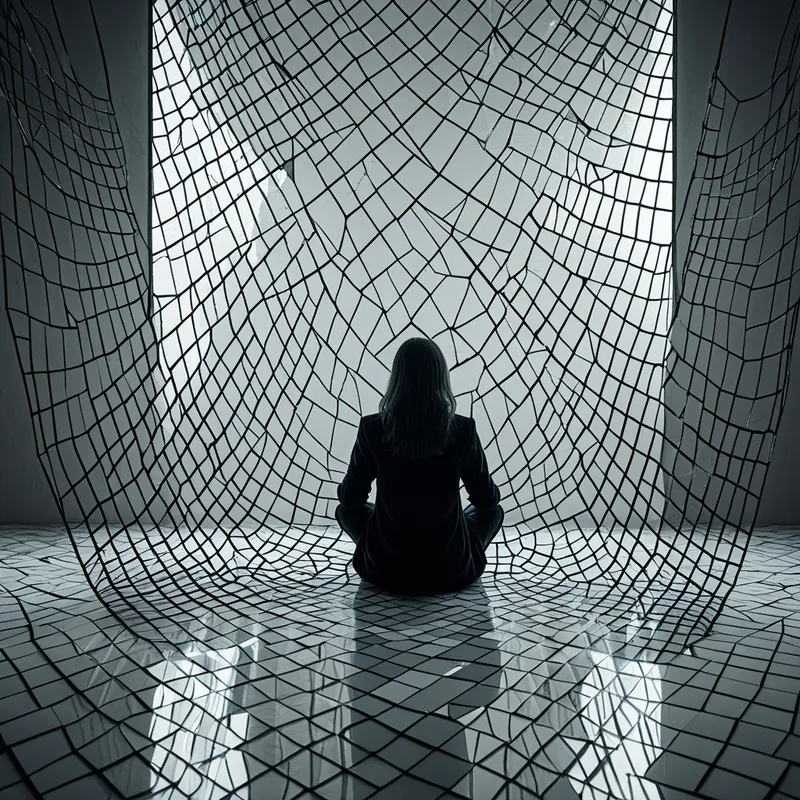
Dreams of the mirror cracking are dreams of a defense mechanism failing. This can feel terrifying, a moment of psychological vertigo. Dreams of weaving an endless, meaningless pattern correlate with burnout in creative or professional pursuits that have lost their connection to authentic desire. The appearance of a luminous, compelling figure (like Lancelot) in the dream-mirror often precedes a significant life choice—to leave a job, end a relationship, or finally express a long-suppressed truth. The psyche is rehearsing the death of an old, safe way of being.
Alchemical Translation
The Lady’s journey is a brutal but complete model of psychic alchemy, the individuation process. Her initial state is the nigredo, the blackening: she is confined, her life-force (libido) bound up in the repetitive, shadowy act of weaving. The mirror is the vas, the sealed vessel of her introspection.
The sight of Lancelot is the catalytic coniunctio, the call for union with the rejected other—in this case, the outer world and her own unlived life. Her decision to look is the moment of mortificatio, the necessary death. The cracking mirror is the shattering of the conscious attitude, the ego’s worldview. The unraveling tapestry is the dissolution of the complex—the intricate but false identity she has woven.
The final voyage down the river is the albedo, the whitening. Clad in white, she submits to the unconscious current (the river of life, the Self). She is passive, yet moving toward integration.
Her arrival at Camelot in death is the paradoxical culmination. Psychologically, it represents the ego’s surrender to a larger pattern. The integrated self often feels like a death to the old personality. For the modern individual, the “alchemical translation” is this: we must risk the death of our curated, safe, reflective selves. We must allow our defining structures (our “mirrors” of perception, our “tapestries” of achievement) to crack and unravel when called by the deep, authentic voice of our own Animus or Anima. The creation that follows such a rupture is no longer a reflection of life, but life itself, lived directly, with all its mortal beauty and cost. The boat’s journey is not a failure, but the only true completion her story could have.
Associated Symbols
Explore related symbols from the CaleaDream lexicon: