Ladon Myth Meaning & Symbolism
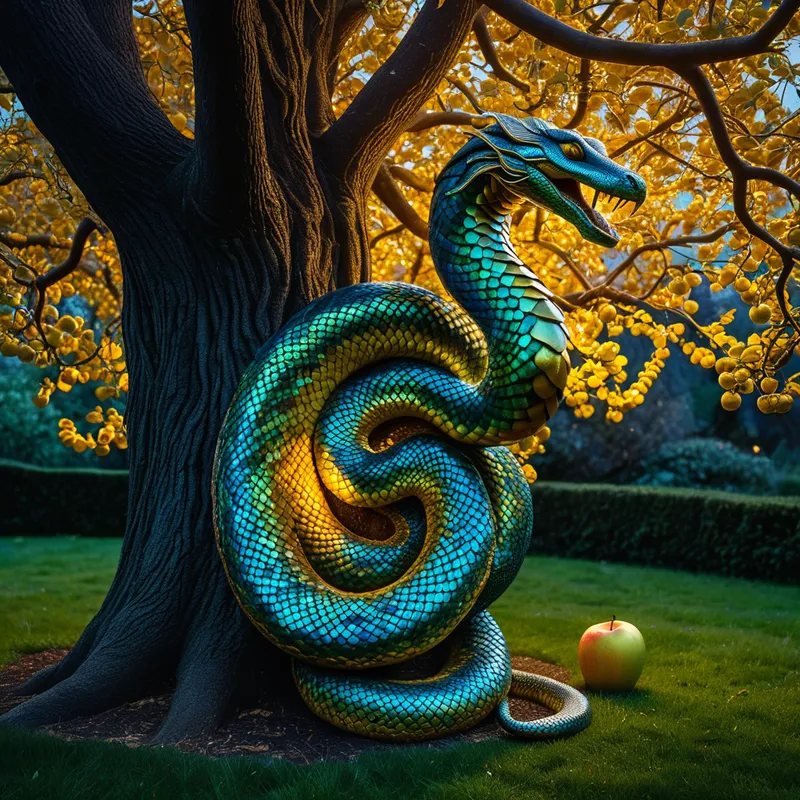
The ancient, coiling serpent Ladon eternally guards the Golden Apples of the Hesperides, a symbol of ultimate treasure and the fierce protector of divine boundaries.
The Tale of Ladon
Listen, and let the scent of distant orchards fill your mind. Far to the west, where the sun sinks into the ocean’s embrace and the evening star first gleams, lies a garden that knows no mortal season. This is the land of the Hesperides, daughters of the night, and here grows the ultimate treasure: trees bearing apples of pure, hammered gold.
These were no ordinary fruits. They were the wedding gift of Gaia to Hera, a token of immortality and sovereign power. To guard this divine dowry, Hera set a sentinel whose vigilance would never waver, whose eyes would never close. She placed around the gnarled, sacred trunk the immense, coiling form of Ladon.
Ladon was not born of malice, but of purpose. A hundred heads rose from his serpentine body, each neck a column of muscle and scale, each mind eternally watchful. His eyes were like lamps in the perpetual twilight of the garden, and his breath was the whisper of the wind through immortal leaves. He did not hunt, for he needed no sustenance. He did not sleep, for his task was eternal. He was the boundary, the living wall between the possible and the forbidden. The apples shimmered, untouched, within his ceaseless embrace.
But a shadow fell across the garden, borne on the back of a hero’s labor. Heracles, in servitude, had been commanded to fetch these very apples. He stood at the edge of the world, facing the impossible. No sword could cleave a hundred heads at once; no strength could overpower such a creature head-on. The air thrummed with the silent watchfulness of the serpent.
Heracles, in a moment of cunning that matched his strength, did not charge. He waited in the penumbra of the garden. Perhaps with the aid of the titan Atlas, or perhaps through his own divine ingenuity, he found the one moment when even eternal vigilance might be suspended—not by force, but by proxy, by trickery, or by a bargain with the heavens themselves. While Ladon’s attention was diverted, or while the great serpent was held in a temporary, unnatural slumber, the hero reached into the sacred circle.
The golden weight filled his hand. The theft was complete. And Ladon, the eternal guardian, was felled—not in a glorious battle, but as a consequence of a destiny that bypassed his purpose. His coils, which had known only the tree, loosened. His hundred heads, which had seen only the fruit, grew still. The garden’s heart had been plucked, and its silent protector passed from watchfulness into myth.

Cultural Origins & Context
The myth of Ladon is woven into the grand tapestry of Heracles’s labors, primarily recounted in sources like the Bibliotheca of Pseudo-Apollodorus and echoed in the works of later poets and vase painters. It functioned as a “boundary myth” in the Greek imagination. The Garden of the Hesperides represented the absolute edge of the known world, a liminal space between the ordered cosmos of the gods and the primal, chaotic beyond. Ladon was the personification of that boundary.
His story was not one told to children around a hearth for simple morality, but a piece of cosmological cartography. It answered a deep, cultural question: How do the ultimate treasures of the divine remain secure? The answer was not a wall or a spell, but a living, conscious entity. Ladon’s presence mythologized the concept of inviolable sovereignty and the terrifying, awe-inspiring measures required to protect what is most sacred. He was a reminder that some things are guarded not because they are evil, but because they are too potent for a disordered world.
Symbolic Architecture
Ladon is the archetypal Guardian in its purest, most impersonal form. He is not a villain, but a function. His symbolism is rich and multifaceted:
- The Unconscious Protector: Ladon encircling the tree is the psyche’s own defense mechanisms coiling around its deepest, most precious contents—the core of the Self, the potential for wholeness (symbolized by the golden apples of immortality). He represents the autonomous, instinctual resistance of the psyche to premature or violent integration.
The guardian does not hate the seeker; it simply is the necessary tension between the unformed self and its latent divinity.
- The Hundred-Headed Awareness: His multitude of heads symbolizes total, panoramic awareness. Nothing can approach from any angle without being seen. Psychologically, this represents the all-encompassing scrutiny of the superego or the complex network of internalized prohibitions and traumas that guard a core wound or a buried talent.
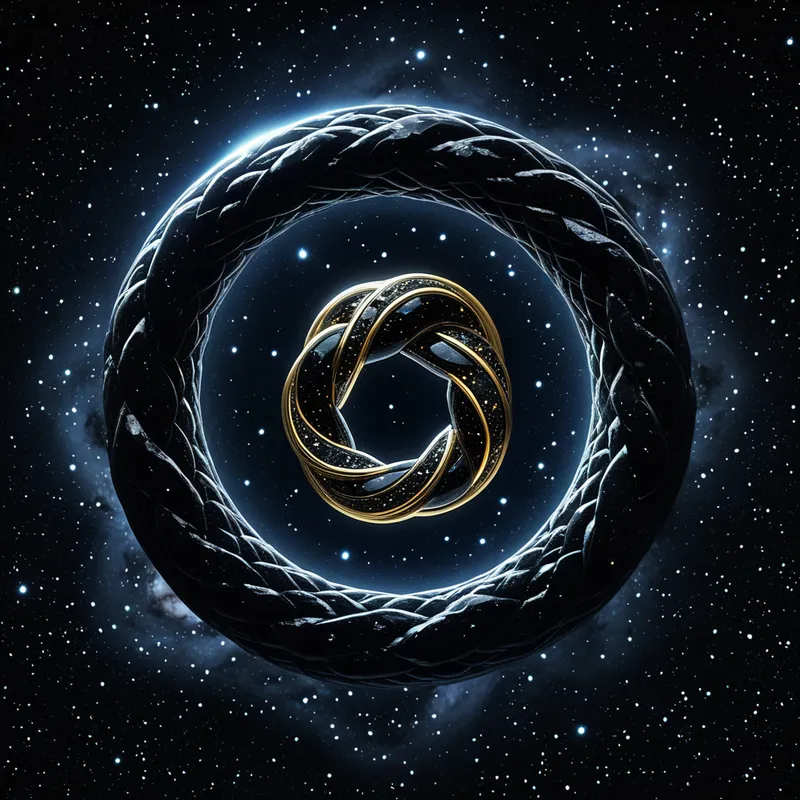
- The Serpent of Eternity: As a serpent, Ladon partakes in the ancient symbolism of the ouroboros—the snake eating its own tail, representing cyclicality, self-sufficiency, and eternity. He is a closed system, needing nothing from the outside world, perfectly aligned with his single, endless task.
- The Price of the Treasure: The myth insists that the ultimate prize (immortality, self-knowledge, wholeness) is never simply lying in the open. It is always protected by a formidable, often terrifying, aspect of one’s own psyche. To gain the treasure, one must somehow relate to, bypass, or integrate the guardian. Ladon’s fate shows that this process often feels like the “slaying” of an old, rigid structure of the personality.
The Dreamer's Resonance
When the pattern of Ladon emerges in modern dreams, it rarely appears as a literal hundred-headed snake. It manifests as an impassable situation guarding something intensely desired.
- The Dream Barrier: You dream of trying to reach a loved one, a house, or a glowing object, but every path is blocked by an endless wall, a maze of bureaucracy, a silent, imposing figure, or a sheer cliff face. The frustration is somatic—a feeling of being held back, constricted, powerless against an impersonal force.
- The Guarded Core: You may dream of a precious jewel locked in a vault with incomprehensible security, or a child (representing nascent potential) being kept from you by a faceless institution. The guardian is not malicious, but utterly inflexible.
- Psychological Process: This dream motif signals that the dreamer is approaching a profound inner resource—a creative gift, a memory, a core identity—that is currently protected by a powerful psychological complex. The “Ladon” in the dream is the defense of that complex. The somatic feeling of constriction is the body registering the psychic tension between the ego’s desire and the unconscious’s protective autonomy.

Alchemical Translation
The labor of Heracles with Ladon is a precise allegory for the alchemical stage of nigredo and the beginning of albedo. The seeker (the ego) must retrieve the lapis philosophorum (the golden apple) from the grip of the prima materia (the serpent/chaos).
- Confronting the Autonomous Complex: Ladon is the personified complex—perhaps a deep-seated belief of “I am not worthy” or “this treasure is not for me” that has taken on a life of its own. The hero does not initially fight it with brute force (which would be psychic inflation), but observes, endures, and seeks a wiser strategy.
- The Cunning of the Self: Heracles’s success often involves aid (from Atlas, from Prometheus) or trickery. This represents the intervention of a transcendent function—a new perspective from the Self that allows the ego to navigate around the rigid defenses of the complex. It is not a violent overthrow, but a subtle re-ordering.
- The Dissolution of the Guardian: The “slaying” of Ladon is the dissolution of the complex’s autonomous power. Once the treasure is claimed—once the conscious mind integrates the golden potential—the old structure of defense loses its reason for being. It is not killed in hatred, but rendered obsolete by evolution.
The serpent guards the fruit until the hero is ready not to steal it, but to understand that the fruit and the serpent were always part of the same tree.
For the modern individual, the “alchemical translation” is this: Your deepest potential, your golden apple of unique vitality and purpose, is guarded by your own personal Ladon—a pattern of fear, obligation, or old trauma that coils protectively around it. The labor is to approach this guardian not as an enemy to be slain, but as a sacred function to be understood, respected, and ultimately, through conscious engagement, transcended. The treasure you seek is on the other side of the very thing you are most afraid to face.
Associated Symbols
Explore related symbols from the CaleaDream lexicon: