Labyrinth Walls Myth Meaning & Symbolism
The story of the Minotaur imprisoned within Daedalus's impossible maze, and the hero Theseus who must navigate its treacherous, winding walls to find his center.
The Tale of Labyrinth Walls
Hear now the tale of walls that breathe, of stone that dreams of blood. It begins not with a hero, but with a king’s shame and a god’s cruel jest. In the island kingdom of Crete, King Minos, favored son of Poseidon, prayed for a sign of his divine right to rule. From the foaming sea, the Earth-Shaker sent a bull, a creature of such dazzling white perfection it seemed carved from moonlight on the waves. This was the sacrifice Minos must make to seal his pact with heaven.
But the king’s heart was seized by greed. The bull was too magnificent, too potent a symbol of his own power. He hid the divine beast among his herds and slaughtered another in its place. The sea is not so easily deceived. Poseidon’s wrath took a form most terrible: he inflamed the king’s own wife, Pasiphaë, with a monstrous desire for the white bull. From this unholy union, born of royal deceit and divine vengeance, came a creature that was both and neither—a child with the body of a man and the head of a bull. They named him the Minotaur.
His cries were not the wails of an infant but the deep bellows of a beast. His hunger was insatiable. King Minos, drowning in shame and terror, turned to the only man whose mind could contain such a horror: Daedalus, the architect of wonders. “Build me a prison,” commanded the king, his voice a whisper of dread. “A prison from which this… thing… can never escape, and into which the world can never see.”
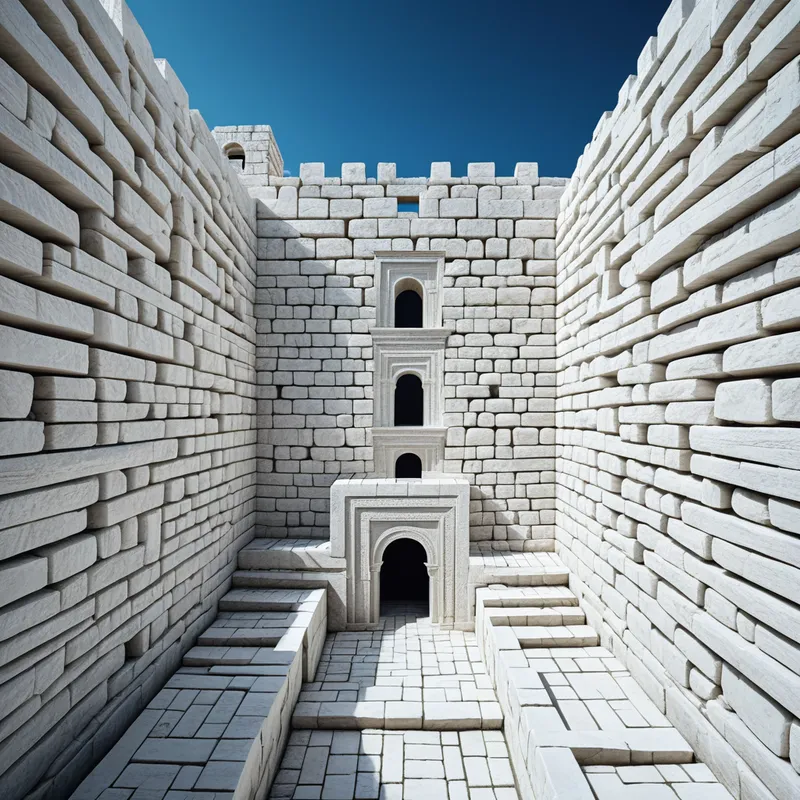
Daedalus, his genius now bent to a dark purpose, conceived of a place that was itself a living riddle. He built not a dungeon, but a Labyrinth. Its walls were high and blank, fashioned of cold, white stone that drank the sunlight and gave back only shadow. The paths did not merely twist; they folded in upon themselves, a single, unbroken, meandering line that led inexorably to a center and then, impossibly, back out again. To step within was to be swallowed by geometry. The very air grew still and heavy, the only sounds the echo of one’s own breath and, from the deep, unseen heart, the slow, heavy scrape of horn on stone and a low, ruminative snort.
Into this stone intestine, the Minotaur was cast. And into it, by the cruel tribute demanded of a defeated Athens, went seven youths and seven maidens, delivered every nine years to be lost and devoured. The labyrinth’s walls became a silent god, receiving its sacrificial due.
Until a prince with the blood of gods in his veins took the place of a tribute. Theseus, son of Poseidon or of the mortal king Aegeus—his lineage was a maze itself—volunteered to enter the beast’s gut. His guide was not a map, for none existed, but a thread of love. Ariadne, Minos’s own daughter, gave him a simple ball of twine. “Tie one end to the entrance,” she whispered, her eyes wide with fear and hope. “Let the labyrinth unwind it as you walk. The thread will remember the way home.”
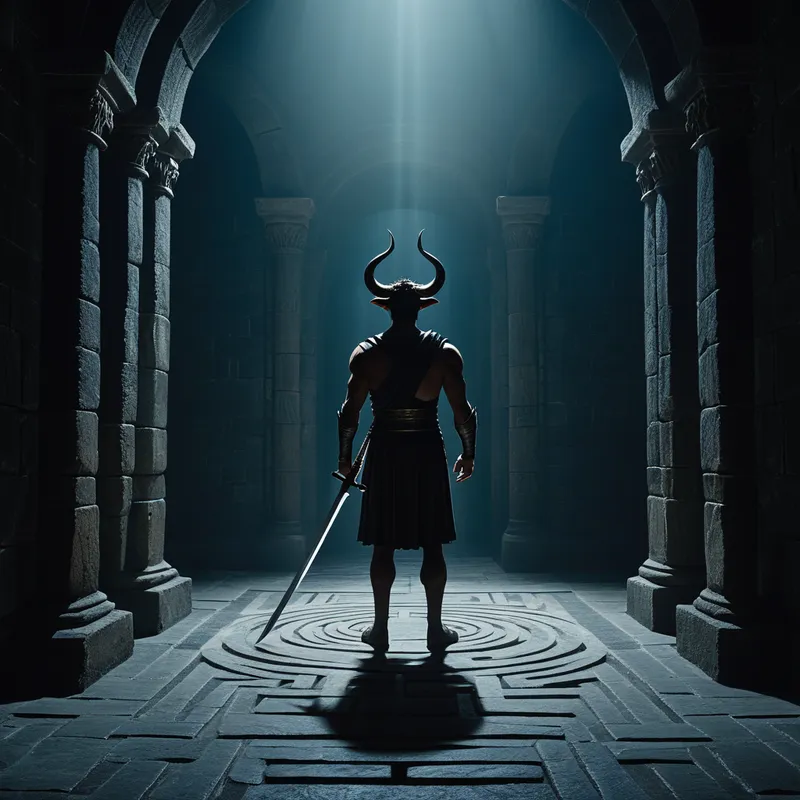
And so Theseus descended. The walls closed around him, a silent, judging presence. He moved through a world of pure stone, the only reality the cool line of the thread running through his fingers. Deeper he went, the Minotaur’s scent—of straw, hide, and old blood—growing thick in the air. In the central chamber, beneath a shaft of dusty light, the monster waited. It was not a battle of epic flourishes, but a brutal, intimate struggle in a stone womb. With strength and fate, Theseus prevailed. Then, hand trembling on the blood-slick thread, he retraced his steps, the walls now a passage out of nightmare, following the slender, miraculous line back to the world of sun and wind, leading his people from the belly of the beast.
Cultural Origins & Context
The myth of the Labyrinth is not a single author’s tale but a cultural dream, woven from the deep strata of Aegean history. Its earliest echoes resonate in the very ruins of Knossos, with its complex, multi-level layout that may have inspired the idea of an inescapable maze. The story was kept alive in the oral tradition, a foundational narrative for the Greek world, crystallized later in the epic cycles and the tragedies. It functioned as an etiological myth for Athenian tribute and hegemony, a thrilling hero tale, and a profound religious metaphor.
The Labyrinth’s primary tellers were the bards and, later, playwrights like Euripides. In a society deeply concerned with hybris (arrogance before the gods) and miasma (ritual pollution), the myth served as a powerful cautionary tale. Minos’s deceit brings forth a monstrous “double” of his own corrupted kingship—the Minotaur—which he must then hide away. The story articulated the terrifying consequences of broken oaths and the perversion of the natural order, while also celebrating the Athenian ideal of the cunning, courageous hero who navigates impossible chaos to restore balance.
Symbolic Architecture
The Labyrinth is the ultimate symbol of the complex, winding structure of the psyche itself. Its walls are not merely barriers; they are the boundaries of consciousness, the defenses and blind spots we construct.
The Minotaur is not waiting at the center of the maze; it is the center. It is the embodied truth the maze was built to contain.
The creature represents the repressed, the unacceptable, the “beastly” complex born from a foundational betrayal or trauma (Minos’s broken vow, Pasiphaë’s transgressive desire). It is the shadow of the royal family, and by extension, the shadow of the civilized self—the untamed, instinctual, and terrifying aspect of our nature that we wall off from daily life.
Theseus is the ego-consciousness that dares to enter the unconscious (the Labyrinth) on a quest for integration. He does not go unarmed, but his primary weapon is not his sword; it is the clew—Ariadne’s thread. This thread symbolizes the connecting principle: love, intuition, the therapeutic alliance, or the transcendent function that can link conscious intention to the deep, meandering patterns of the unconscious. It is the promise that one can go into the madness and not be lost forever.
The Dreamer's Resonance
When the Labyrinth appears in modern dreams, it signals a profound encounter with the architecture of one’s own psyche. The dreamer is not lost in a random maze, but in the specific, personalized labyrinth of their own defenses and unresolved complexes.
Somatically, this can feel like constriction in the chest, a shortness of breath, or a heavy weight—the body experiencing the “walls” of anxiety or depression. Psychologically, it is the process of confronting a seemingly inescapable problem, a repetitive life pattern, or a deep-seated fear whose origins feel obscured and winding. The dream Minotaur is rarely a literal bull-man; it manifests as a pursuing figure, an overwhelming emotion, a monstrous situation, or a terrifying aspect of the dreamer themselves. The dream is an enactment of the psyche’s imperative: you have built walls around something. You must now, with great courage and a thread of awareness, walk those walls to meet what you have imprisoned.
Alchemical Translation
The myth models the complete alchemical cycle of psychic transmutation, or individuation. The initial state is one of nigredo—blackening, corruption, and the hidden monster (Minos’s sin creating the Minotaur). The Labyrinth is the vas or vessel of transformation, the sealed container where the difficult work must occur.
The hero’s journey is not about killing the monster, but about facing the fact that the monster is made of the same substance as the throne.
Theseus’s descent is the mortificatio—a dying to the old, naive conscious attitude. His battle is the fierce, separatio where the ego confronts the shadow in its raw, undifferentiated form. This is not annihilation, but a necessary engagement. His victory, followed by the retracing of steps via the thread, represents the coniunctio—the integration of the shadow material. He does not bring the Minotaur out; he takes its power (often symbolized by his taking Ariadne, the thread-giver). The final stage is the return to daylight, the albedo or whitening, where the purified consciousness emerges, having navigated its own darkest depths and found a way back, forever changed.
For the modern individual, the myth instructs: your most bewildering confinements are self-made. Your greatest terror is a part of you, waiting not to destroy you, but to be seen. The path through is not brute force, but the patient, faithful laying down of a connecting thread—of self-reflection, of therapy, of creative expression—that allows you to venture into the interior chaos and return, whole. The center of your labyrinth is not an end, but the turning point.
Associated Symbols
Explore related symbols from the CaleaDream lexicon: