Koschei the Deathless Myth Meaning & Symbolism
A tale of an immortal sorcerer whose soul is hidden in a needle within an egg, revealing the secret of vulnerability and the hero's transformative journey.
The Tale of Koschei the Deathless
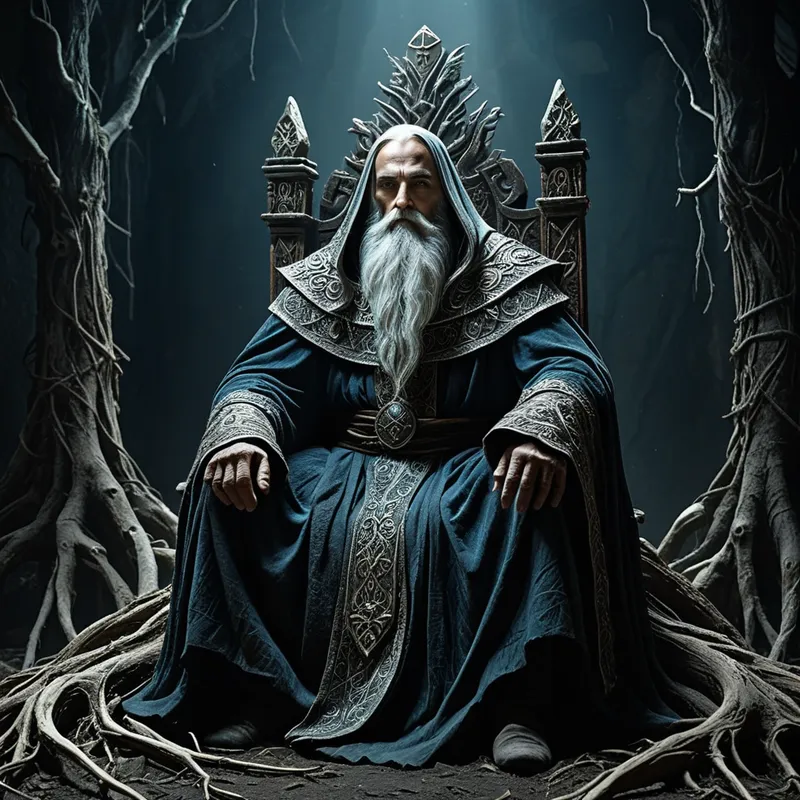
Listen, and hear a tale spun from the deep forests and wide steppes, a story whispered by the wind in the birch trees and carried on the smoke of the hearth fire. It speaks of Koschei the Deathless, a being whose name chills the blood. He is not a god, but something older and more cunning—a sorcerer-king who has cheated death itself. His form is that of a gaunt, ancient man, yet his strength is that of a tempest. His palace is a place of shadows and stolen treasures, and his greatest treasure is always a beautiful maiden, spirited away from the world of sun and song.
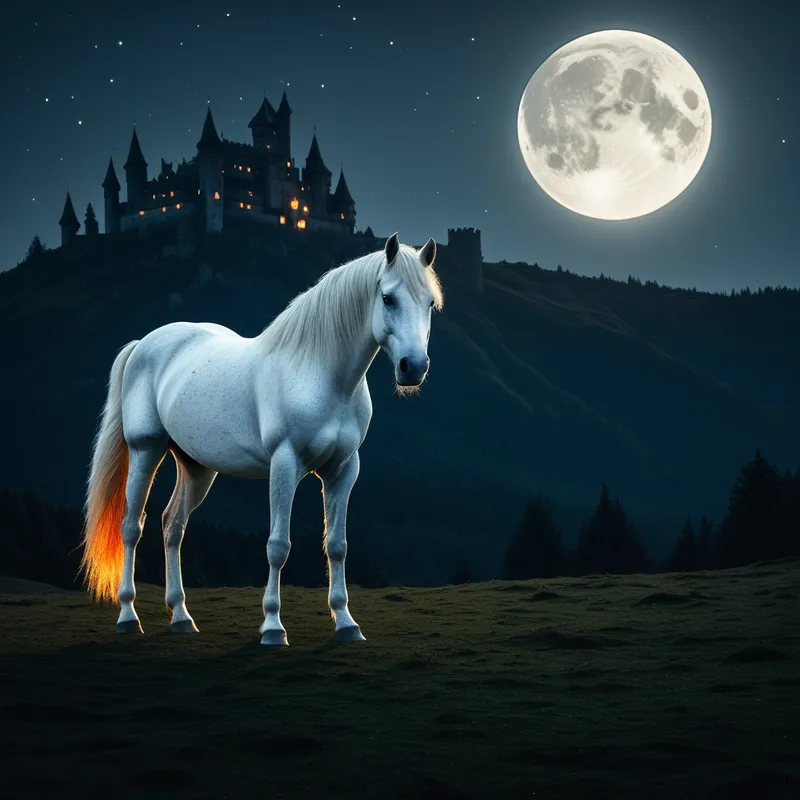
Into this gloom comes the hero, often named Ivan Tsarevich. His journey begins with a loss—a beloved bride, a sister, a mother—snatched away by a whirlwind or a shadow that smells of cold earth and iron. Ivan’s heart, a burning coal of grief and honor, will not let him rest. He saddles his faithful steed, a creature of power and wisdom, and steps onto the path that leads away from the known world.
The road is a thread through a living tapestry of peril. He must outwit the guardians of the wild: a giant pike in a silver river, a great bird that darkens the sun, a witch in a hut that spins on chicken legs. Each demands a price, a riddle solved, or a kindness repaid. Ivan learns that brute force is a dull tool; cunning and compassion are the true keys. He is guided, perhaps, by Baba Yaga, who gives him not a weapon, but a secret: "To kill Koschei, you must find his death. It is far from here. His death is hidden in an egg, the egg is in a duck, the duck is in a hare, the hare is in an iron chest, and the chest is buried under a green oak tree on the far island of Buyan."
The quest becomes a peeling away of layers, a journey into ever-smaller, ever-more-protected sanctuaries. Ivan crosses phantasmal seas to the island. He finds the oak, monstrous and ancient. He unearths the chest, chases the hare, captures the duck, and finally, in his hands, he holds a simple, unassuming egg. Within it, he feels a faint, rhythmic pulse.
He returns to Koschei’s decaying kingdom. The sorcerer laughs, a sound like stone grinding on stone, for no sword can pierce his flesh, no fire burn him. But when Ivan raises the egg and squeezes, Koschei’s laughter turns to a gasp. The immortal being clutches his chest, staggers, and falls to dust. The shadows lift. The stolen maiden is free, and the hero’s journey ends not just with a rescue, but with a profound, silent understanding held in the palm of his hand.
Cultural Origins & Context
The myth of Koschei is a foundational narrative of the East Slavic world, primarily Russian, Ukrainian, and Belarusian folklore. It was not preserved in sacred texts but lived and breathed in the oral tradition, told by skaziteli (storytellers) during the long winter nights. These tales functioned as more than entertainment; they were a communal psychic toolkit. In a world where life was harsh and mortality ever-present, the story of Koschei provided a framework for understanding power, vulnerability, and the structure of the cosmos itself.
The myth reflects a pre-Christian, animistic worldview where the soul (Zhiva) was not inseparable from the body but could be externalized and hidden in objects. This concept of the "external soul" is a widespread Indo-European motif, but in the Slavic context, it intertwines with the imagery of the world tree (the oak) and the mythical island of Buyan, a place of primordial power and the seat of the winds. The tale thus maps a spiritual geography, showing the hero’s journey from the ordinary world into the mythic, chthonic realm where the rules of life and death are literalized and can be challenged.
Symbolic Architecture
At its core, the myth is a profound allegory for the nature of the Self and its defenses. Koschei is not merely a villain; he is the embodiment of a psychic complex that has achieved a terrible, static immortality. He represents the petrified ego, the aspect of the personality that, in its terror of death, change, and vulnerability, has walled itself off from life. His immortality is a curse, a state of non-living preservation. His hoarding of maidens symbolizes the capture and freezing of anima—the soulful, connective, life-giving energy—within this complex.
The greatest fortress is built not around the body, but around the point of vulnerability. To be truly deathless is to be forever separate from the soul.
The nested hiding places of the soul—oak, chest, hare, duck, egg, needle—are a symbolic map of the layers of psychic defense and incarnation. The Buyan island is the distant, unconscious realm where our core vulnerabilities reside. The oak is the ancient, protective structure of habit and family legacy. The animals represent instinctual life, constantly moving, making the soul difficult to pin down. The egg is the potential for new life, and the needle within it is the precise, piercing point of ultimate fragility—the punctum where transformation can occur.
Ivan’s quest is the ego’s necessary journey into the unconscious to confront this complex. His success depends not on overpowering Koschei directly (which is impossible), but on understanding the symbolic system, following the clues provided by the deeper wisdom (Baba Yaga), and having the courage to hold the delicate, pulsating truth of his own—and the other's—vulnerability.
The Dreamer's Resonance
When this myth pattern stirs in the modern dreamer, it signals a profound encounter with a "Koschei complex" within the psyche. The dreamer may find themselves in a labyrinthine castle (a rigid mindset), pursued by a feeling of cold, inescapable dread (the immortal shadow), or trying to rescue a trapped, vital part of themselves (the lost anima/animus).
Somatically, this can feel like a constriction in the chest, a sense of being frozen or petrified, or an obsessive, circling anxiety—the psychic equivalent of Koschei’s hoarding. The dream task is the quest for the nested symbols. A dream of chasing a hare, finding a strange egg, or holding a small, incredibly significant object points to the active process of soul-retrieval. The emotional tone upon finding the "egg" is key: it is often a mix of awe, terror, and profound tenderness. The dreamwork is the process of gently holding that discovered vulnerability without prematurely "squeezing" it—that is, without forcing a confrontation before one is prepared to integrate what it means.
Alchemical Translation
The myth models the alchemical process of individuation—the journey toward wholeness. Koschei represents the prima materia, the leaden, fixated state of the unconscious personality. Ivan’s journey is the opus, the long and arduous work. The guidance from figures like Baba Yaga represents the reconciling function of the transcendent Self, offering the cryptic formula for transformation.
The climax is the alchemical coniunctio, not a marriage of opposites, but a fateful meeting between the conscious ego (Ivan) and the hidden, protected core of the unconscious complex (the needle-soul). The destruction of Koschei is the mortificatio and calcinatio—the necessary death and burning away of an old, rigid structure of being.
Immortality is found not in stasis, but in the courage to locate and embrace one's mortal point. The soul must be hidden to be protected, but it must be found to be lived.
For the modern individual, the "Koschei work" involves identifying what in their life has become deathless—a grudge, a defensive identity, a trauma response that refuses to change. It requires embarking on an inner quest to find where the life of that complex is truly hidden, often in the smallest, most innocuous, and most protected memory or feeling (the needle). The triumph is not the destruction of a part of oneself, but the liberation of the vital energy—the "stolen maiden"—that was locked within it, allowing it to flow back into the psyche and restore the capacity for love, connection, and flexible, mortal life.
Associated Symbols
Explore related symbols from the CaleaDream lexicon:
- Egg — The ultimate vessel of potential and hidden life; in this myth, it contains the secret of both immortality and mortality, representing the protected core of the soul.
- Needle — The precise, piercing point of ultimate vulnerability and truth; the infinitesimal object upon which an entire immortal existence precariously balances.
- Forest — The realm of the unknown and the testing ground for the hero; it represents the tangled, instinctual depths of the unconscious where the quest truly begins.
- Horse — The instinctual power and enduring spirit that carries the hero on his journey; it symbolizes the vital, animal energy necessary to traverse the mythic landscape.
- Journey — The essential process of seeking and transformation; the myth is a map for the perilous but necessary voyage from ignorance to gnosis, from captivity to liberation.
- Oak — The ancient, steadfast world tree; it represents the deep-rooted, protective structures of tradition, family, and the unconscious that often hide our most precious secrets.
- Duck — A creature of two realms, water and air; it symbolizes the elusive, transformative nature of the soul as it moves between states of being, making it hard to capture.
- Hare — An animal of swiftness, fertility, and lunar mystery; it represents the quick, instinctual, and cyclical nature of the life force that must be apprehended.
- Chest — A container for treasure and secrets; it symbolizes the personal unconscious, a locked repository where traumatic or potent memories are stored away for safekeeping.
- Island — An isolated, mythic place separate from the ordinary world; it represents the remote, introverted state of consciousness where deep psychic work must be done.
- Death — Not as an end, but as a transformation; Koschei's "death" is the dissolution of a rigid complex, allowing for the rebirth of trapped energy and the integration of vulnerability.
- Shadow — The hidden, rejected, or feared aspect of the psyche; Koschei is the personification of the ultimate shadow—the part that seeks to live forever by refusing to live at all.