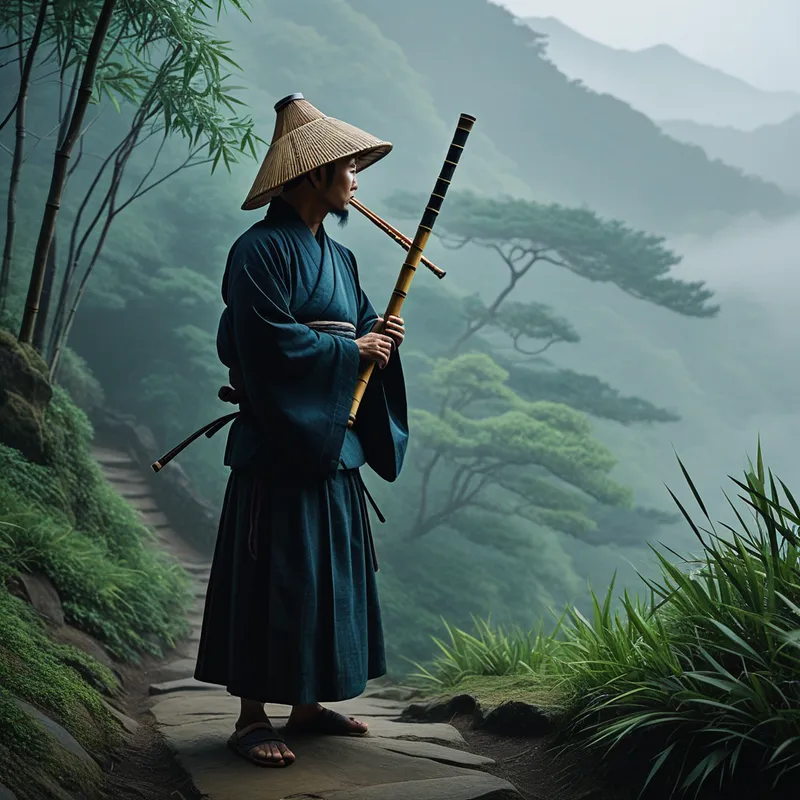
Komusō Myth Meaning & Symbolism
The myth of the Komusō, wandering monks who played the shakuhachi to embody emptiness, seeking alms and enlightenment beneath woven baskets.
The Tale of Komusō
Listen. In the spaces between the clamor of the world, in the quiet that follows the storm, a different kind of sound is born. It is not the ring of the swordsmith’s hammer, nor the chant from the temple hall. It is the breath of the void given voice, a single, aching note that winds its way through the pine forests and over the rice fields of a land called Edo.
He walks the roads, this figure of woven shadow. His face is hidden beneath the deep basket of a tengai, a portable hermitage, a cage of anonymity. He is a Komusō—a monk of nothingness. He carries no sword, only a length of seasoned bamboo, a shakuhachi. This is his only scripture, his only prayer.
His journey has no map, for the destination is not a place, but a state. He walks to wear away the self. He stops at crossroads, at the gates of mighty shoguns, and in the dust of forgotten villages. There, he lifts the flute to the slit in his basket. He does not play a song for entertainment. He breathes. The breath becomes wind in the bamboo, a raw, unadorned tone that seems to pull the silence around it tighter. It is a single note that contains the question of existence itself.
The people hear it. The farmer pauses, hoe in hand, feeling a strange hollow open in his chest. The samurai, polishing his blade, feels the steel grow heavy, a sudden weight of purpose beyond battle. They offer alms—a handful of rice, a coin—not to a man, but to the emptiness he manifests. The coin drops into his bowl with a soft clink, a sound swallowed by the sustained note of the flute. This is the transaction: sustenance for the body in exchange for a reminder for the soul. The note hangs in the air long after the basket-headed figure has bowed and moved on, a ghost of sound haunting the mundane world, a puncture in the fabric of ordinary reality through which the infinite whispers.
His path is one of perpetual departure. He is always leaving, because to arrive would be to solidify, to become someone. The conflict is not with dragons or demons, but with the most insidious foe: the persistent, whispering "I." The rising action is the accumulation of miles, the weariness in the bones, the thousand temptations to remove the basket, to seek a name, a home, a face. The resolution is in the next breath, the next note—the continual letting go. The myth does not end with enlightenment in a flash of light, but with the next step down the dusty road, the next breath through the bamboo, an endless, gentle unraveling into the sound of the wind.
Cultural Origins & Context
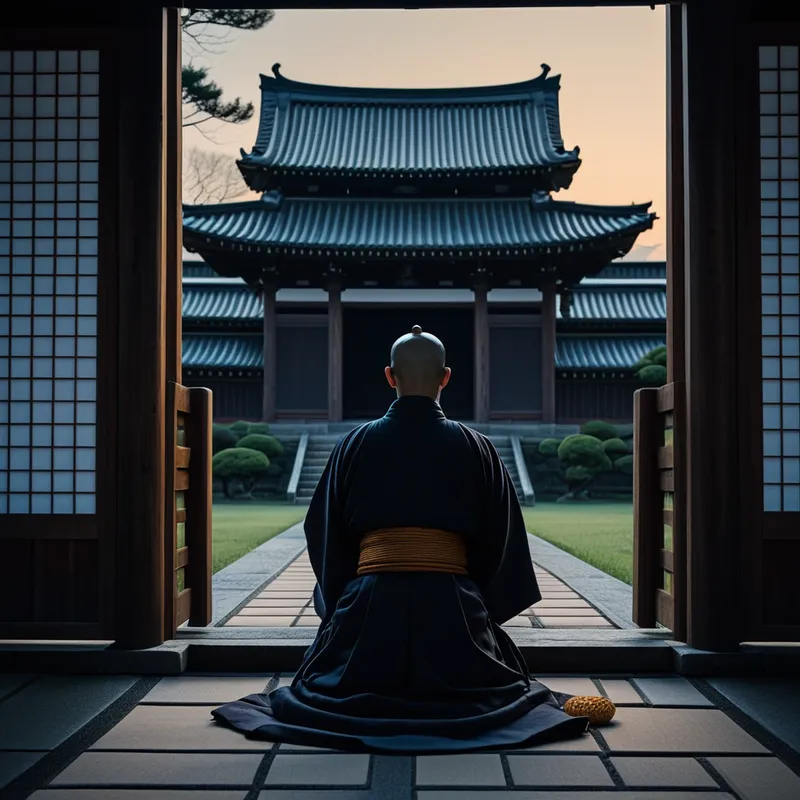
The Komusō were not creatures of ancient myth, but historical figures who became mythologized by their own radical practice. They emerged from the Fuke school of Zen Buddhism during the Edo period (1603-1868). In a society locked into a rigid four-class system (samurai, farmers, artisans, merchants), the Komusō occupied a unique, liminal space. Officially recognized by the bakufu, they were granted extraordinary privileges, including the freedom to travel unrestricted across domain borders—a right denied to almost everyone else.
This historical reality is the fertile ground of the myth. The Komusō were often rumored to be ronin, masterless samurai who had exchanged the sword for the flute, using the tengai to shed their former identities and social shame. They were "men of the clouds and water," with no fixed abode. Their societal function was dual: as mendicants, they relied on alms, performing a spiritual service for the lay community; as privileged wanderers, they could have been spies, messengers, or simply living symbols of the impermanence that the stable Edo society tried so hard to deny. They passed down their practice not through complex texts, but through the direct transmission of honkyoku (original pieces) from teacher to student, each breath a link in a chain of emptiness.
Symbolic Architecture
The Komusō is a walking, breathing symbol of the psyche's journey toward integration, where the central goal is not acquisition, but divestment.
The basket is not a barrier to the world, but a sieve for the self. It filters out the face, the name, the history—all the costumes of the persona—allowing only the raw, unadorned breath of being to pass through.
The tengai is the ultimate symbol of ego death. It represents the voluntary dismantling of the persona, the social mask we present to the world. To wear it is to become nobody, to embrace anonymity as a sacred state. It is a portable cave of meditation, creating a darkness in which inner light—or the acceptance of inner darkness—can be perceived.
The shakuhachi is the channel for what remains when the persona is set aside: the breath of life itself, the kokoro. Its music, called suizen, is not art for an audience, but alchemy for the player. Each note is a probe into the nature of mind, a sonic koan. The act of begging while playing transforms the transaction. The alms are not payment for a performance, but an energy exchange—material sustenance given in recognition of the spiritual sustenance offered by the demonstration of emptiness.

The Dreamer's Resonance
When the figure of the Komusō appears in a modern dream, it signals a profound psychological process underway. It is the psyche's announcement of a necessary kenosis—an emptying out.
Somatically, the dreamer may feel a constriction around the head or a powerful focus on the breath. Psychologically, they are likely in a phase of shedding an outworn identity. This could be a career role, a relationship-defined self, or a long-held self-narrative that has become a cage. The basket-headed figure represents the deep, often frightening, impulse to become anonymous, to step away from the performance of the self. The flute's single, sustained note resonates with the dreamer's search for their own essential tone beneath the cacophony of internal and external demands. To dream of being the Komusō is to feel the call to walk away from the known map of your life, trusting that the path is made by walking, and the destination is the walking itself.
Alchemical Translation
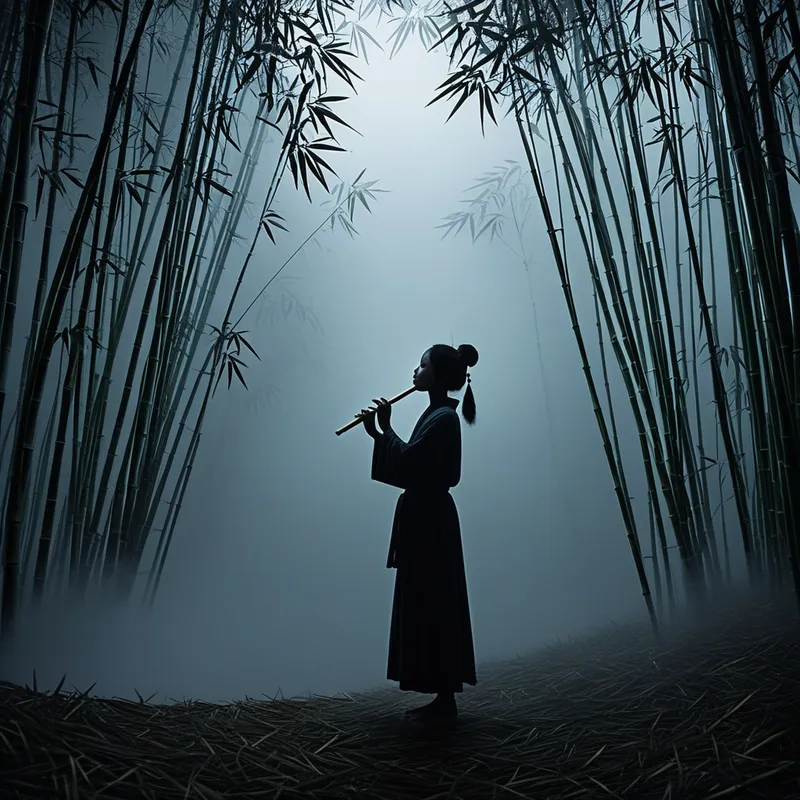
The Komusō myth models the alchemical opus of individuation not as a heroic conquest, but as a humble, relentless subtraction. The goal is the Lapis Philosophorum, but here it is not a stone, but empty space—the capacity to hold all things without being defined by any of them.
The first stage, nigredo (the blackening), is the donning of the tengai. It is the conscious entry into the darkness of the unknown self, the willing embrace of the shadow and the dissolution of the ego's bright, familiar landmarks.
The wandering is the albedo (the whitening), the purification. Each step, each refusal to settle, each breath through the flute scours away another layer of psychic dross—attachment, ambition, fear. The act of receiving alms without presenting a face is the ultimate practice of non-attachment to outcome and identity.
The resolution is not a climax, but a state of perpetual rubedo (the reddening), understood as vibrant, dynamic emptiness. Enlightenment is not a static achievement but the ongoing ability to breathe the single note of one's authentic existence, moment by moment, without the need for a story to justify it. For the modern individual, the Komusō's path translates into the courage to periodically "become nobody." It is the practice of silent retreat, of digital detox, of engaging in an activity (like music, walking, or breathwork) not for achievement or recognition, but purely as a vessel for experiencing the unadorned self. It is the alchemy of transforming the leaden weight of ego into the golden lightness of being—a being that is, finally, no-thing, and thus free to truly be.
Associated Symbols
Explore related symbols from the CaleaDream lexicon: