Kayabuki Myth Meaning & Symbolism
A myth of a kami born from a humble roof, embodying the sacred covenant between shelter, sacrifice, and the enduring human spirit.
The Tale of Kayabuki
Listen, and let the wind through the pines carry you back. To a time when the mountains were younger and the valleys hummed with the silent prayers of the earth. In a village nestled like a sleeping child in the folds of the hills, the people knew a simple truth: a home is not merely wood and nails, but a living pact with the world.
Each autumn, when the susuki grass turned the hillsides to oceans of silver and gold, the villagers would undertake a sacred labor. They would journey forth, not with swords, but with scythes. They cut the tall grass with reverence, whispering thanks to the field kami. This was not harvest; it was an invitation. They bundled the grass, these sheaves of captured sunlight and rainwater, and carried them to the skeleton of a new home—a frame of sturdy cedar waiting to be clothed.
The master thatcher, an old man with hands like gnarled roots, would begin. Layer upon layer, he wove and stacked and bound. His movements were a slow, deliberate dance, a prayer in motion. He was not building a roof; he was weaving a skin. A skin to separate the warm, breathing world of the family within from the vast, whispering world of wind, rain, and stars without. As the final bundle was secured, as the last knot was tied on the thick, sloping roof, something shifted.
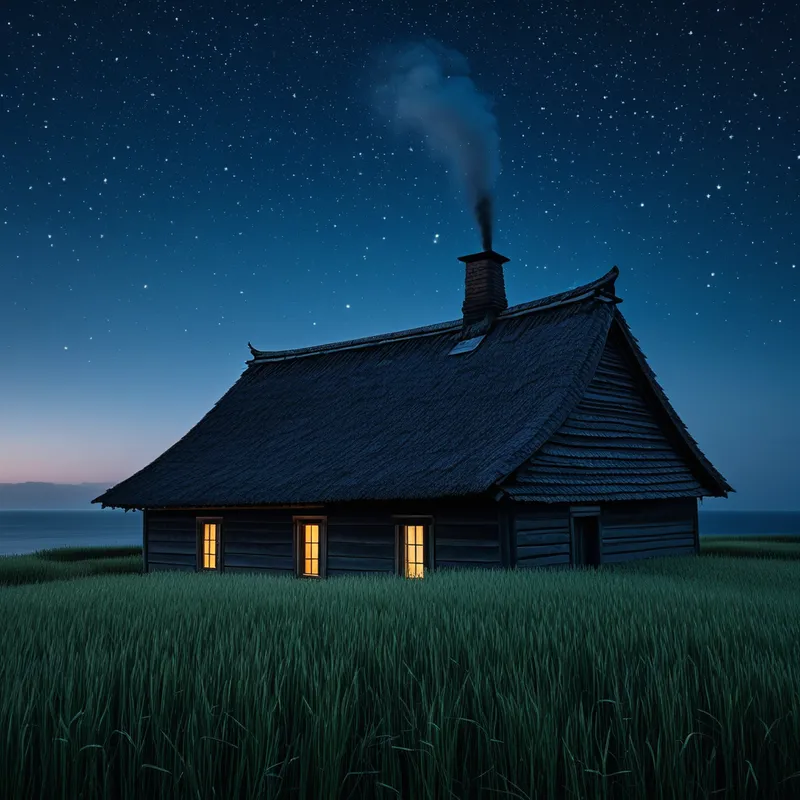
The first fire was lit in the irori. Smoke, the breath of the home, began to curl up through the thatch. It did not escape quickly. It lingered, seeping into the dry grass, staining it with the essence of human life—of cooked rice, of shared stories, of laughter and tears. Season after season, year after year, the roof drank in this smoke. It weathered under the sun, grew heavy with snow, was scoured by typhoons. It grew dark, mossy, and immensely strong.
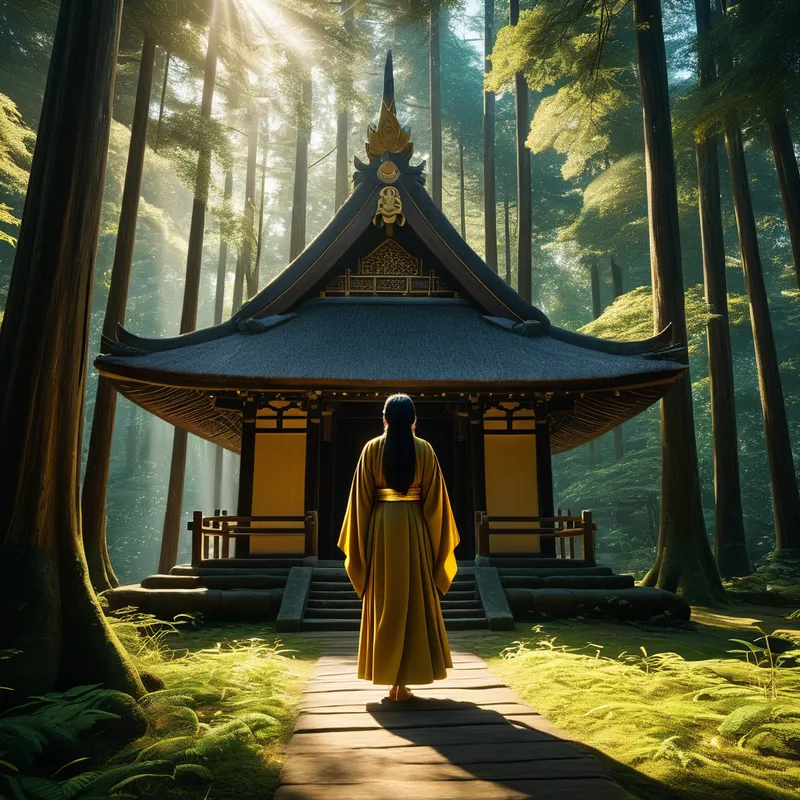
And then, on a night when the moon was a silver sliver and the world held its breath, the old roof stirred. From the deep, resin-blackened thatch, a form coalesced. It was not born in a burst of light, but emerged with the slow certainty of a tree growing. This was Kayabuki-no-Kami. Its body was the texture of ancient, polished wood and bundled straw. Its presence was the smell of rain on dry earth and hearth-smoke. It stood not as a conqueror, but as a silent guardian, the very spirit of the shelter. It had been crafted by human hands, animated by human breath, and hardened by time. The house was no longer just a structure; it was a temple, and the kami was its heart.
Cultural Origins & Context
The veneration of Kayabuki-no-Kami springs from the deep roots of Shinto, where the sacred (kami) resides not only in majestic waterfalls and ancient trees but in the intimate, crafted objects of daily life. This myth is a folk belief, less a formalized epic and more a lived understanding passed down through generations of farmers, carpenters, and thatchers. It was told not in grand courts but by the fireside, in the very homes the myth sanctified.
Its societal function was profound yet practical. It transformed the act of building maintenance from a chore into a ritual of renewal and respect. The cyclical re-thatching of the roof, typically every 20 to 30 years, was not seen as the replacement of a worn-out component, but as the respectful retirement of an elder kami and the careful midwifery of a new one. This belief enforced community cohesion—thatching was a collective effort—and instilled a sense of sacred reciprocity. One cared for the home because the home, as a living entity, cared for you.
Symbolic Architecture
At its core, the myth of Kayabuki is a profound meditation on the vessel. The thatched roof is the ultimate symbol of the containing, protective function—a psychic skin.
The roof is the boundary that makes the sacred interior possible; it is the necessary separation that defines the sanctuary of the self.
The susuki grass represents the raw, untamed bounty of nature (physis). The human craft of thatching represents culture and conscious shaping (techne). Kayabuki is the divine child born of this marriage. The kami is not purely natural nor purely man-made; it is a tertium quid, a third thing that emerges from the dialogue between the wild world and the human need for order and safety.
The darkening of the thatch by smoke is the critical alchemical ingredient. It symbolizes the infusion of the structure with soul—the accumulated experiences, emotions, and life-force of the inhabitants. The roof becomes a psychic archive, a physical record of the family's history. Kayabuki, therefore, is the personification of the genius loci, the spirit of a place, specifically forged through sustained, embodied relationship.

The Dreamer's Resonance
To dream of a kayabuki roof in the modern psyche is to encounter imagery of one's own psychological container. A dream of a leaking, dilapidated thatch roof often surfaces during times of emotional overwhelm or psychic exhaustion; the dreamer's boundaries are compromised, and the unconscious signals that the structures that hold their inner life are in need of repair.
Conversely, dreaming of being safely beneath a vast, sturdy, and beautifully weathered thatched roof, perhaps while a storm rages outside, speaks to a hard-won sense of inner security and resilience. The dreamer has successfully built a durable Self, capable of sheltering their vulnerability. To dream of the act of thatching itself—the meticulous, hands-on work of weaving and layering—can indicate an active, conscious process of self-care and boundary-setting in waking life. The somatic sensation is often one of grounding, of feeling the weight and reality of one's own existence.
Alchemical Translation
The journey from cut grass to living kami is a perfect map for the process of individuation—the forging of a coherent, resilient Self. We all begin as the "susuki grass": potential, raw, and scattered to the winds of instinct and collective expectation.
Individuation is not about escaping nature, but about crafting a conscious home from its materials, then having the courage to live within it until it becomes sacred.
The conscious ego is the "master thatcher." It must gather these disparate parts of the psyche—instincts, talents, shadows—and consciously, patiently, weave them into a functional structure. This is the persona, the initial roof. But this is only the first stage. The crucial, transformative phase is the "smoke-darkening": the lived experience. We must inhabit this structure we've built. We must light the fire of our passions, our relationships, our sufferings and joys. This daily life—this psychological "smoke"—seeps into the crafted structure of the ego and transforms it. It stains it, strengthens it, and eventually animates it.
What emerges over time is not just a well-defended ego, but Kayabuki-no-Kami—the Self in Jungian terms. This is the autonomous, guiding center of the total personality, a sacred presence born from the marriage of our innate nature and our conscious endeavor. It is the feeling that one's life, with all its weathered imperfections, has become a holy shelter. The final alchemy is realizing that we are both the builder and the sacred inhabitant; we craft the vessel that, in turn, becomes the spirit that guards us. The myth teaches that true homecoming is not about finding a place in the world, but about becoming a living sanctuary for the soul.
Associated Symbols
Explore related symbols from the CaleaDream lexicon: