Kay Khosrow the Mystic King Myth Meaning & Symbolism
A legendary Persian king who achieved perfect justice, then abdicated his throne to vanish into a mystic mountain, achieving ultimate spiritual sovereignty.
The Tale of Kay Khosrow the Mystic King
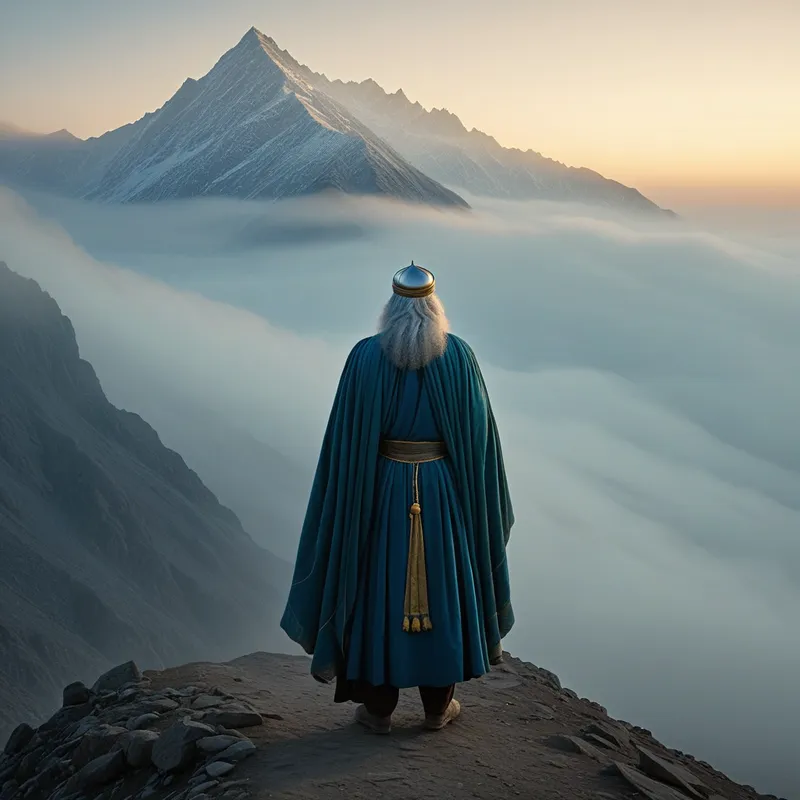
Hear now the tale not of a king’s conquest, but of his vanishing. In the age when heroes were giants and the world was woven with magic, there reigned Kay Khosrow, son of Siavash, whose blood was a covenant with truth. His reign was the golden mean of the world. Under his hand, the wolf drank beside the lamb, and the rain fell on the just and unjust alike, for he had made them one. His justice was not a decree, but a climate. The land breathed in peace.
Yet, within the palace of perfect order, a deeper music called. It was a whisper in the wind off the Alborz, a chill in the cup of wine at the height of feasting, a hollow echo in the applause of the court. His eyes, which saw every petition with clarity, began to see through the marble walls, through the silks and jewels, to the great, silent Nothing that cradled everything.
He summoned his most loyal knights—Giv, Fariborz, and a handful of others whose hearts were true steel. “The kingdom is established,” he said, his voice like a low bell. “The Farr shines upon it. My work here is complete. Now I must go to the work that has called me since my father’s blood soaked the earth.” No war called him. No enemy threatened. He was answering a summons from the mountain itself.
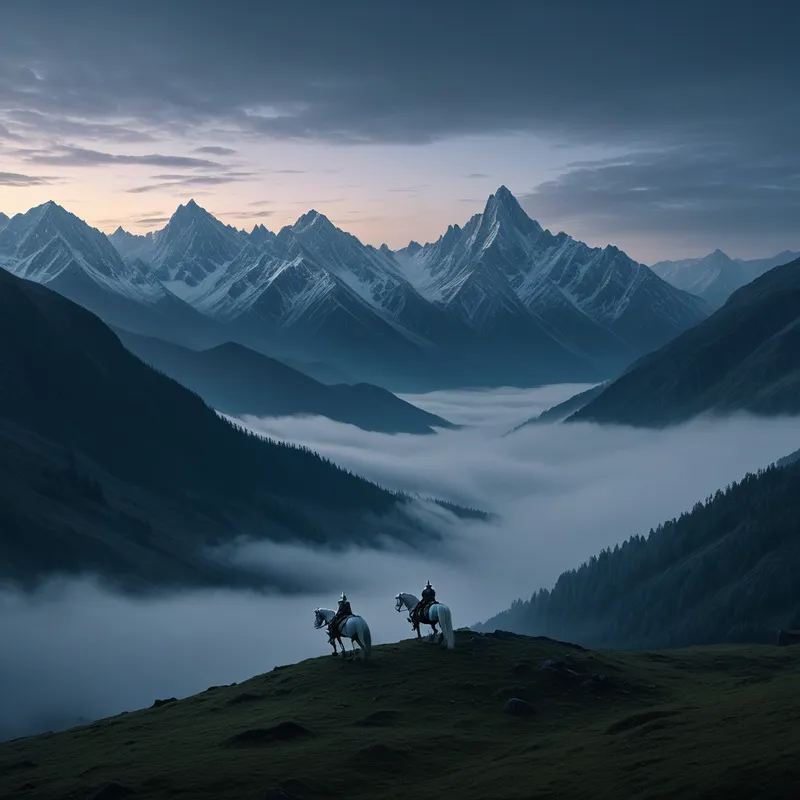
They journeyed, this king and his band, away from gardens and into the embrace of stone. They climbed where the air grew thin and thoughts grew clear. The path became a thread, then a guess. At a high pass, where the winds screamed like lost spirits, Kay Khosrow dismounted from his white horse. He removed his royal armor, piece by piece, laying it upon the cold rock—a cuirass for a boulder, a vambrace for a scrub thorn. He kept only a simple staff.
He turned to his companions, his face already seeming half-made of the mountain mist. “Here our paths diverge. You must return. Tell them the king has gone to a council from which no envoy returns. Seek not to follow, for the way is for one alone.” Grief-stricken, they pleaded, but his resolve was as immovable as the peaks around them. He blessed them, turned, and walked into a wall of swirling cloud and snow.
They waited for days, staring until their eyes ached. He did not return. Some say a final blast of wind erased his footprints. Some say a strange, serene light glowed for a moment in the mist before it faded. The king was gone. Not dead. Not sleeping. Gone. Vanished from the world of deeds and names, having passed from the throne of a kingdom to the sovereignty of the soul.
Cultural Origins & Context
This profound conclusion to the saga of Kay Khosrow is the heart of his story within the Shahnameh, the monumental Persian epic composed by the poet Ferdowsi at the turn of the first millennium. While the epic is filled with heroic battles, romances, and tragedies, the tale of Khosrow’s abdication and disappearance stands apart as a uniquely mystical climax.
The story was preserved and recited by naqqals (storytellers) in coffee houses and courts, serving a function far beyond entertainment. In a culture deeply invested in concepts of divine-right kingship and cosmic justice (Arta), Kay Khosrow’s story presented the ultimate paradox: the perfect king is one who recognizes the impermanence of worldly power. His journey modeled a spiritual ideal for the ruling class and the common listener alike—that true authority culminates in surrender, and the greatest victory is a purposeful vanishing act. It legitimized the mystic’s path within the framework of the warrior-king ethos, suggesting that the pinnacle of worldly success is but a prelude to the only journey that matters.
Symbolic Architecture
Kay Khosrow is the archetype of the ruler who has internalized his kingdom. His perfect earthly reign symbolizes a psyche that has achieved order, balance, and the integration of opposites—the heroic ego at its most mature and effective.
The throne is not a seat of power, but a testing ground for sovereignty. To rule justly is to prepare the soul to rule itself.
His abdication is not an act of defeat, but of profound completion. The Alborz mountains represent the transcendent function, the call from the Self beyond the ego’s achievements. Laying aside his armor is the ultimate divestment of persona—the titles, achievements, and identities that shield us from the naked truth of being. His disappearance into the mist is the final mystery: the dissolution of the individual consciousness into the unitary ground of existence, what mystics might call fana (annihilation in the divine). He does not die; he transcends. The myth presents not an afterlife, but an alife—a state of being beyond the categories of the mortal world.
The Dreamer's Resonance
When this myth stirs in the modern dreamer, it often manifests at a crossroads of profound success or existential saturation. One may dream of leaving a prestigious job, a beloved home, or a long-held identity at the peak of its function. The somatic sensation is not of loss, but of a deep, magnetic pull toward an empty, majestic landscape—a “sinking stomach” not from fear, but from the gravity of a calling.
Psychologically, this is the process of the ego, having successfully built a competent and valuable life, hearing the summons of the Self. It is the beginning of the later-stage individuation process, where the task shifts from building a life to meaning that life. The dreamer is confronting the question: “Now that I have achieved what I set out to achieve, who am I, really?” The dream may feature abandoned horses or towers, and a path leading into a cave or door in a mountainside. There is grief, but beneath it, an undeniable, serene certainty.

Alchemical Translation
The alchemy of Kay Khosrow is the transmutation of King into Sage. His myth maps the final, most radical phase of psychic integration.
The initial nigredo, or blackening, is not a failure, but the dark night of the successful soul—the melancholy of the fulfilled throne. The albedo, or whitening, is his clear-eyed realization and his purification through divestment on the mountain pass. The final rubedo, the reddening, is not a return to the world in a new form, but the ultimate integration: the conscious ego’s willing journey into the unconscious, not to battle it, but to unite with it.
The ultimate sacrifice is not of life, but of identity. The final journey is not over land, but into the essence of being.
For the modern individual, this translates to the courage to define completion on a soul-level, not a societal one. It is the process of relinquishing the “crown” of our hard-won achievements, social roles, and even spiritual credentials, to answer a more profound call that leads off the map of conventional success. It is the alchemy of “doing” into “being,” where the constructed self dissolves so that the essential self can, at last, simply be. The kingdom he sought was never of land, but of presence. His vanishing was his final, and greatest, act of sovereignty.
Associated Symbols
Explore related symbols from the CaleaDream lexicon:
- Mountain — The ultimate symbol of transcendence and spiritual ascent in Kay Khosrow's myth, representing the arduous journey from worldly sovereignty to divine unity.
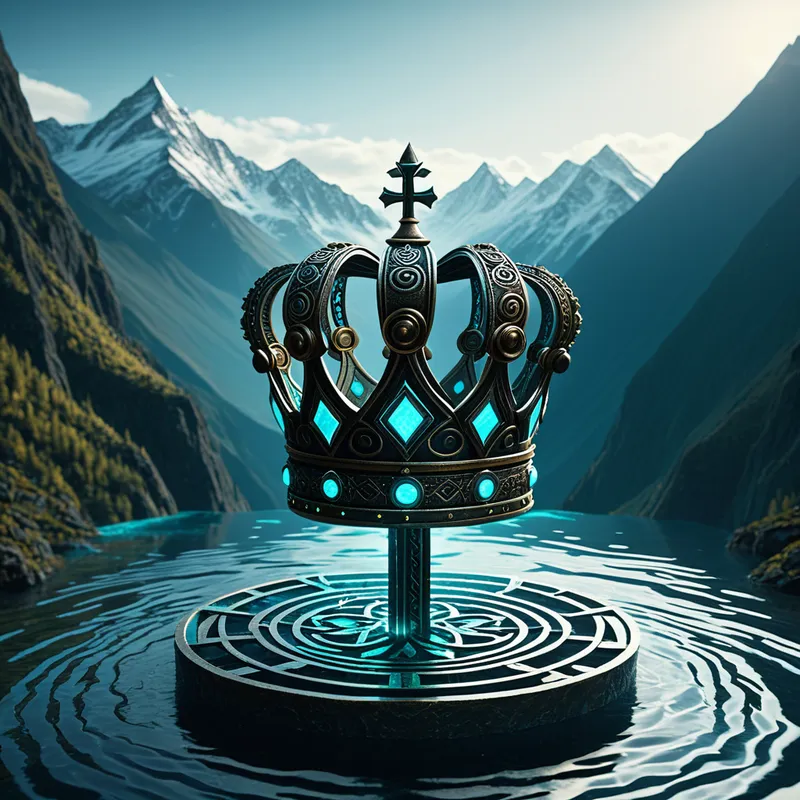
- Crown — The symbol of earthly power and responsibility that Kay Khosrow metaphorically lays aside, representing the ego's achievements that must be relinquished for higher wisdom.
- Journey — The core narrative structure of the myth, reflecting the internal pilgrimage from external rule to inner sovereignty and mystical dissolution.
- Door — The mystical threshold on the mountain pass through which Kay Khosrow vanishes, representing the point of no return between the conscious world and the transcendent unknown.
- Key — The implicit symbol of Kay Khosrow's enlightenment, the spiritual knowledge that unlocks the door to liberation from the cycle of worldly power and identity.
- Horse — The noble steed left behind on the mountain pass, representing the instincts, passions, and worldly vehicle that cannot accompany the soul on its final, footsore journey inward.
- Shadow — The psychological process Kay Khosrow integrates; his just rule implies mastery over his inner darkness, which allows him to finally walk into the literal shadow of the mountain.
- Light — The divine Farr (glory) that shines on his just reign and the luminous certainty that guides him into the mist, representing the inner illumination that replaces external validation.
- Stone — The cold, enduring reality of the mountain path and the rock upon which he lays his armor, symbolizing the absolute, impersonal truth he seeks.
- Spirit — The ultimate destination and essence of Kay Khosrow's quest, the non-material reality into which his conscious being dissolves and unites.
- Sacrifice — The voluntary renunciation of the highest possible worldly achievement—a perfect kingdom—which becomes the necessary offering for spiritual transcendence.
- Cave — The potential endpoint of his mountain journey, a classic symbol of the unconscious and the womb of rebirth into a non-corporeal state of being.