Karna Myth Meaning & Symbolism
A radiant warrior, born with divine armor, is cast into a life of obscurity, forever bound by a loyalty that leads to his tragic, glorious end.
The Tale of Karna
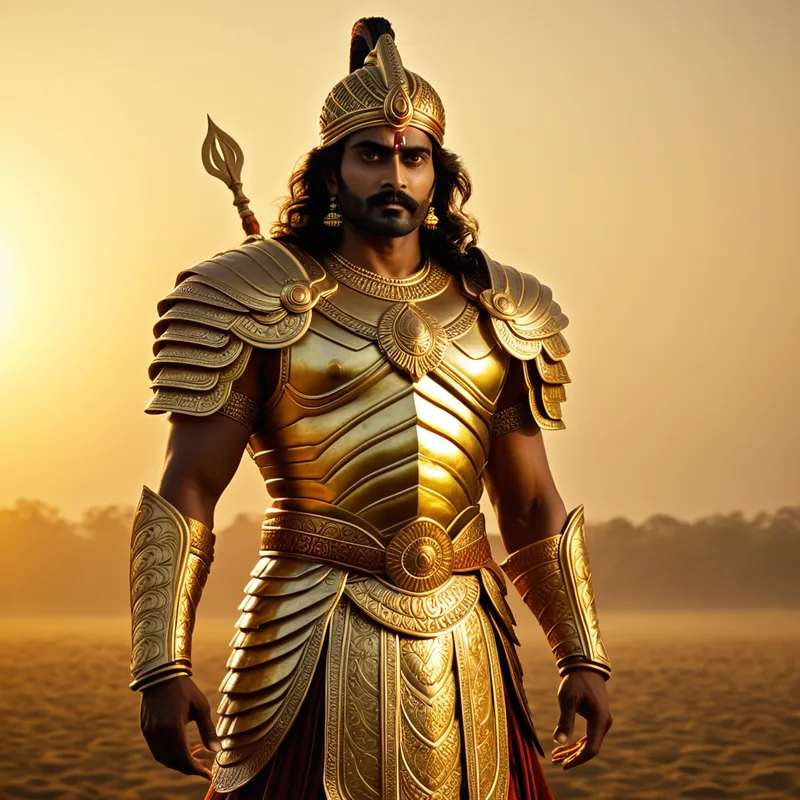
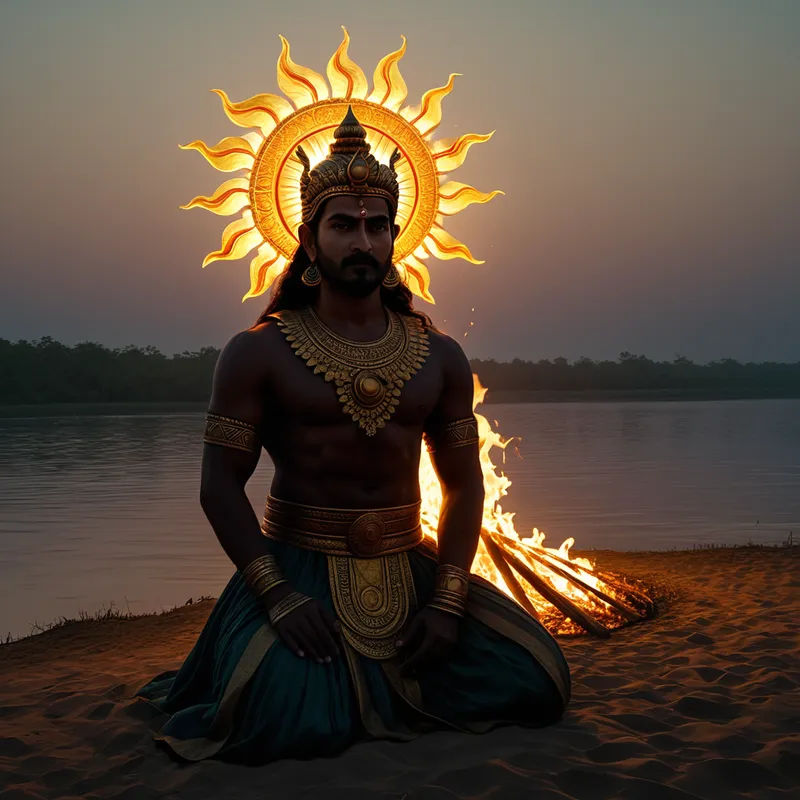
Before the great war, before the world knew its name would be Kurukshetra, a secret was born. The sun god, Surya, blazed in the heart of a young princess, Kunti. A mantra granted by a sage became a key, and in her youthful curiosity, she summoned the god himself. From that union of mortal wonder and celestial fire, a child was conceived, born with the radiance of his father—golden earrings and an invincible coat of armor fused to his very skin. To hide her secret, the terrified princess placed the radiant infant in a basket and set him adrift on a river’s current, a tiny sun cast upon the waters of fate.
The river carried him to Adhiratha, a charioteer of the Kuru kingdom, who raised the boy as his own. He was named Karna. But the light of the sun cannot be hidden by the dust of the earth. Karna grew into a warrior of peerless skill, his natural majesty a stark contrast to his lowly station. At a grand tournament, he stepped forward to challenge Arjuna, the darling of the royal court. His skill was undeniable, his valor obvious. Yet, he was met not with applause, but with scorn. “Who are you, son of a charioteer, to challenge a prince?” they cried. His birth was a cage; his brilliance, an offense.
In that moment of public humiliation, a friend appeared. Duryodhana, the ambitious Kuru prince, saw not a charioteer’s son, but a king without a crown. He anointed Karna the king of Anga, gifting him the status his birth had denied. From that day, Karna’s loyalty was forged in steel. It was a debt of honor that would eclipse all other ties, even those of blood.
Years later, as the storm clouds of war gathered, the truth sought him out. His mother, Kunti, finally revealed his origin. He was her firstborn, the elder brother of the very Pandavas he was pledged to fight. She begged him to switch sides, to claim his rightful place. The world held its breath. Karna stood at the crossroads of destiny, the pull of a lifetime of rejection warring with his unshakeable code. He made his choice. He would not abandon Duryodhana, the one who had given him dignity when the world offered only scorn. But he gave his mother a promise: in battle, he would not kill any of his brothers but Arjuna. Either Arjuna would fall, or Karna would.
The war raged. Karna was its brilliant, tragic sun. But fate, aided by a series of cruel curses and divine interventions, conspired against him. A sage’s curse robbed him of his most potent weapon at the crucial hour. Another curse caused his chariot wheel to sink into the earth. As he struggled to free it, disarmed and vulnerable, the rules of honorable combat were set aside. Krishna urged Arjuna to strike. And Arjuna did. The sun’s son fell, his light extinguished on the field of his destiny, loyal to the end to a cause not his own, a king in every way but the one that fate allowed.
Cultural Origins & Context
The story of Karna is the aching heart of the Mahabharata, an epic of staggering scale and philosophical depth that was compiled and refined over centuries, likely between 400 BCE and 400 CE. It was not merely literature but itihasa—"thus indeed it happened"—a narrative framework for exploring dharma (duty, righteousness) in impossibly complex situations. Passed down orally by bards and later systematized by sages like Vyasa, the epic was performed in courts and villages, its characters serving as mirrors for societal values and conflicts.
Karna’s tale functioned as a profound critique of the rigid varna (social class) system. His entire life is a question mark against the idea that worth is determined by birth. He embodies the gifted outsider, the man of sublime capability perpetually barred from the status he deserves by an accident of circumstance. His loyalty to Duryodhana, while tragic, also models an extreme, almost fatalistic version of guru dakshina (the debt to a teacher/patron), showcasing how personal codes can entrap one within a larger, destructive drama. He is the epic’s most human argument against a black-and-white universe, a hero who makes the "wrong" choice for what, to him, are the most righteous of reasons.
Symbolic Architecture
Karna is the archetype of the Inherent Self versus the Imposed Identity. His divine armor and earrings are not mere ornaments; they are the symbolic birthright of his true, radiant nature—his authentic, unconquerable soul.
The tragedy is not that he was cast away, but that he internalized the rejection, wearing the label 'suta-putra' (charioteer's son) as a heavier armor than the celestial one he was born with.
His loyalty to Duryodhana represents the profound psychological bind of the wounded ego. When the authentic self is rejected by the world (or the family of origin), it will often pledge allegiance to any power that offers recognition, even if that power is destructive. Duryodhana is the shadow king, the personification of ambition and resentment, and Karna’s alliance with him symbolizes how our unlived greatness can be co-opted by our inner shadow, our unresolved rage at being unseen.
His curses are the symbolic weight of unconscious transgressions—moments where pride or anger (his insults to Draupadi, his killing of an ascetic’s cow) create karmic debts that lie in wait. They represent the way our past actions, often stemming from our deepest wounds, return to disarm us at the pivotal moments of our lives.
The Dreamer's Resonance
To dream in the pattern of Karna is to be in the throes of a profound identity crisis. The dreamer may experience somatic sensations of radiant heat in the chest (the suppressed solar armor) coupled with a chilling feeling of being "stuck in the mud" (the chariot wheel). Common dream motifs include:
- Being Unrecognized at a Gathering: You display a great skill or reveal a profound truth, only to be met with blank stares or dismissal by family or authority figures.
- A Gift That Becomes a Burden: Receiving a powerful object or opportunity from a morally ambiguous figure, creating a debt that feels impossible to repay.
- The Sinking Platform: Trying to achieve something, but the very ground (your foundation, your support) gives way beneath you at the critical moment.
Psychologically, this indicates a process of confronting the "loyalty bind." The dreamer is wrestling with a deep, often unconscious, allegiance to a person, family system, or old self-concept that is now inhibiting their authentic expression. It is the pain of realizing that the price of belonging has been the disowning of one's own light.

Alchemical Translation
The alchemy of Karna is the most painful and necessary kind: the transmutation of Fated Loyalty into Chosen Integrity. His myth does not offer a happy ending, but a roadmap for a more conscious descent.
The first stage is Recognition of the Solar Core—discovering the "armor" you were born with. This is your innate gift, your core truth, which may have been hidden or rejected early on. Like Kunti’s revelation, this often comes as a shock, forcing a re-evaluation of your entire life narrative.
The crucible is the Dissolution of the Debt. This is the agonizing work of examining your deepest loyalties. Are you serving your own soul, or are you serving a Duryodhana—an inner or outer authority that recognized you only to use your power for its own ends? This stage feels like betrayal, because it necessitates betraying the old contract that gave you an identity, however limited.
The ultimate sacrifice is not of life, but of the story we tell about ourselves. Karna dies when he clings to his story of loyalty. We live when we surrender it.
The final transmutation is Integrating the Shadow Sun. Karna’s tragedy was his split: the divine son versus the charioteer’s son. The alchemical goal is to become the king who knows he was a charioteer’s son. It is to hold the radiant truth of your inherent worth without denying the reality of your wounds, your rejections, and the flawed choices they led you to make. You are not asked to avoid Karna’s battlefield, but to enter it consciously—to free the chariot wheel of old karma, not through force, but through the heartbreaking and liberating act of acknowledging all of who you are. In doing so, you claim a kingdom not of land, but of soul.
Associated Symbols
Explore related symbols from the CaleaDream lexicon: