
Kapre Myth Meaning & Symbolism
A myth of a giant, cigar-smoking spirit dwelling in ancient trees, embodying the untamed wilderness and the shadow at the heart of the familiar.
The Tale of Kapre
Listen, and let the night air grow still. Let the rustle of the leaves become a whisper, and the scent of damp earth and blooming sampaguita fill your senses. This is not a story for the bright sun, but for the hour when the world is painted in silver and shadow, when the path ahead is swallowed by the dark.
In the heart of the gubat, where the trees are so ancient they remember the first rain, there dwells a presence. He is not a god of the high peaks, nor a spirit of the rushing river. He is of the tree itself, a part of the slow, deep pulse of the wood. They call him Kapre. He is a giant, his skin the color of rich, dark soil, his eyes like smoldering coals that see through the deepest night. His hair is wild, tangled with vines and moss, and the scent of him is the forest: of rotting leaves, of sweet resin, and always, always, the rich, pungent aroma of a burning tabako.
He does not seek the villages. He watches from his throne—the great, sprawling limbs of a balete or a mighty narra. His smoke curls up through the leaves, a silent signal against the moon. To see his ember glow like a low-hanging star is to know you have strayed into a realm that does not belong to the day.
The tale is often told of a traveler, a farmer returning late from his field, or a child who chased a firefly too far. The familiar path twists. The sounds of home—the barking dog, the mother’s call—fade, replaced by the chorus of frogs and night insects. Then, a new scent cuts through: tobacco, sweet and strong. The traveler looks up. There, in the impossible height of the old mango tree at the bend in the road, a red eye winks. Not an eye—an ember. And below it, the faint outline of immense shoulders, a patient, observing form.
Fear is a cold stone in the belly. To run is the first instinct, but the stories say the Kapre enjoys the chase. His laughter is a low rumble, like distant thunder in the dry season. He may follow, his long strides covering ground without sound, his presence felt as a pressure, a thickening of the shadows. He does not strike. He does not harm. He presences. He turns the known world strange. The path that should lead home now spirals; the landmark tree appears ahead, then behind. The traveler is caught in a loop, a prisoner of the liminal hour, guided not by malice, but by the profound, indifferent amusement of the wild.
The resolution is never an epic battle. It is a release, a forgetting. Sometimes, as dawn bleeds grey at the edge of the sky, the scent of tobacco fades. The path straightens. The traveler stumbles into their yard, exhausted, clothes snagged with thorns, with only a vague, dreamlike memory of a giant’s shadow and the smell of smoke. The Kapre has returned to his tree, his watchful game complete. He remains, the eternal dweller on the threshold, the guardian of the line between the cleared field and the untamed heart of the world.

Cultural Origins & Context
The Kapre is a fixture of Philippine oral lore, a folk narrative born from the intimate, daily relationship between people and the powerful, often intimidating, tropical landscape. These stories were not formal myths recited in temples but living narratives told in bahay kubo after dusk, warnings whispered to children, and explanations crafted for the uncanny experiences of rural life. The storytellers were the lolos and lolas, the farmers, the gatherers—anyone who knew the forest as both provider and profound mystery.
Societally, the Kapre served multiple functions. Primarily, he was a pedagogical boundary-marker. His mythic presence around specific, large trees (especially the balete, which has a distinctive, often eerie morphology) served to protect those ecosystems. By making the deep woods spiritually occupied, the lore discouraged reckless exploitation and taught respect for ancient, non-human centers of life. Secondly, he provided a narrative container for very real disorientations: getting lost in the uniform greenery of the jungle, experiencing sleep paralysis (bangungot), or the simple, profound fear of the dark in a land where the dark is truly absolute. The Kapre gave a face and a pattern to these formless anxieties, making them knowable, narratable, and survivable.
Symbolic Architecture
The Kapre is not a monster of outright destruction, but a spirit of profound shadow and liminality. He symbolizes everything the conscious, daylight ego has pushed to the periphery to build its ordered world: the untamed, the patient, the non-linear, and the autonomously alive.
He is the embodied truth that the wild is not out there, but is the foundational reality upon which our clearings are precariously built.
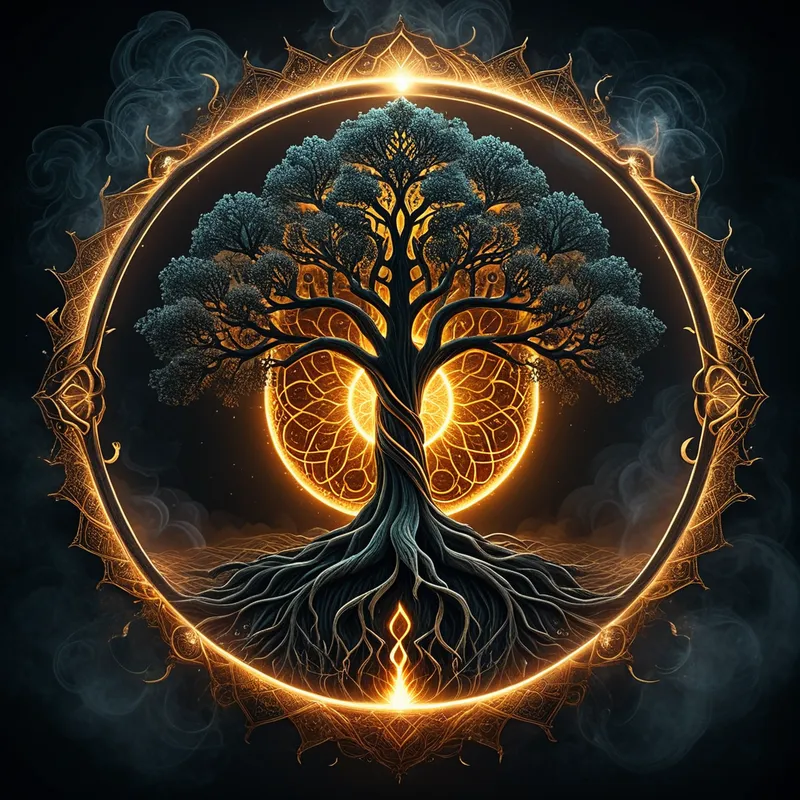
His giant stature represents the overwhelming magnitude of the unconscious when it confronts the individual ego. His dwelling in the tree is deeply symbolic; the tree is a universal axis mundi, connecting the underworld (roots), the earthly realm (trunk), and the heavens (canopy). The Kapre, sitting in its heart, is the guardian of this vertical pathway, the mediator between deep instinct (earth), conscious life (the human path), and transcendent awareness (sky). His cigar is a fascinating detail—a human artifact (fire, culture) adopted by a nature spirit. It represents a slow, smoldering consciousness, a contemplative fire that consumes and transforms, emitting a scent that alters the atmosphere. He does not attack; he intoxicates, he alters perception, he leads one astray from the linear path of ordinary life into the circular, confusing paths of the psyche.
The Dreamer's Resonance
When the pattern of the Kapre emerges in modern dreams, it rarely appears as a literal giant. It manifests as an experience of being watched, followed, or subtly influenced by a large, calm, yet intimidating presence within a familiar yet distorted environment. You might dream of a towering figure in the corner of your childhood home, or of a beloved backyard tree that now feels ominously sentient and observing.
Somatically, this echoes the experience of the myth: a feeling of being "spun around," lost in one's own life, of routines becoming strange and disorienting. Psychologically, it signals that a content of the personal or collective shadow has grown too large to ignore. It has taken up residence in a fundamental structure of your psyche (the "tree" of your identity, your family system, your core beliefs) and is now making its presence known through its "smoke"—a pervasive mood, a recurring anxiety, a sense of being trapped in a loop of behavior. The Kapre-dream is a call to stop running the familiar path. The chase is the neurosis. The resolution lies in turning to face the watcher in the tree.

Alchemical Translation
The Kapre myth models the initial, crucial stage of psychic transmutation: the confrontation with the shadow not as an enemy to slay, but as a formidable, resident intelligence to be recognized. The individuation process begins not with a heroic quest into a distant land, but with the shocking realization that the wilderness is here, in the oldest, most central "tree" of your being.
The traveler’s lost, circular journey is the ego’s dissolution of its old, rigid maps. The Kapre’s game is, in fact, a brutal kindness. He destroys the illusion of the purely safe, known world to introduce the psyche to its own vast, non-human ground. The alchemical work is to cease fleeing, to sit beneath that tree in the dark, and to acknowledge the watcher.
To integrate the Kapre is to inhale the shadow’s smoke, to allow its intoxicating truth to alter your perception of reality itself.
This is the nigredo, the blackening. The ego’s light is dimmed by the shadow’s presence. But in this dark night, the smoldering cigar ember becomes the only source of light—a dark fire of introspection. One discovers that the giant is not blocking the path home; he is the way home, for "home" is no longer the small clearing of the persona, but the whole, integrated forest of the Self. The Kapre, once a figure of fear, transforms into an inner figure of immense, grounded presence, a part of the psyche that is forever wild, forever patient, and forever connected to the ancient roots of being.
Associated Symbols
Explore related symbols from the CaleaDream lexicon:
- Tree — The central axis and dwelling of the Kapre, representing the structure of the psyche, the connection between deep unconscious roots and conscious awareness, and ancient, autonomous life.
- Shadow — The Kapre is a quintessential embodiment of the psychological shadow: the large, overlooked, often intimidating aspect of the self that resides just outside the light of consciousness.
- Forest — The domain of the Kapre, symbolizing the untamed, complex, and fertile wilderness of the unconscious mind where logic fails and deeper instincts rule.
- Smoke — Emanating from his cigar, it represents the intangible yet pervasive influence of the unconscious, altering perception, creating confusion, and signaling a hidden, smoldering presence.
- Moon — The celestial body governing the time of the Kapre’s activity, symbolizing the reflective, non-rational, and shadowy realm of intuition, dreams, and the cyclical nature of the psyche.
- Path — The traveler’s road, representing the linear, conscious direction of the ego, which is disrupted and made circular by the intervention of the shadow/Kapre.
- Fear — The primary emotion evoked by the Kapre, which in the myth’s alchemy is not an end but a gateway to encountering a greater, more complete reality within.
- Trickster — The archetype the Kapre embodies, one who disrupts order and convention not out of malice, but to expose a larger, more complex truth.
- Circle — The looping, disorienting path the traveler is forced onto, symbolizing the cyclical processes of the psyche, ritual, and the necessity of confronting the same core issue from new angles.
- Dream — The state into which the Kapre experience often slips, representing the direct, symbolic communication from the unconscious that feels real yet operates by its own mysterious logic.
- Root — The hidden, anchoring foundation of the Kapre’s tree, symbolizing the deep, often unseen ancestral, instinctual, and karmic patterns that support conscious life.
- Bridge — The Kapre himself, dwelling in the tree at the edge of the clearing, acts as a living bridge between the human world and the wild, unconscious world.