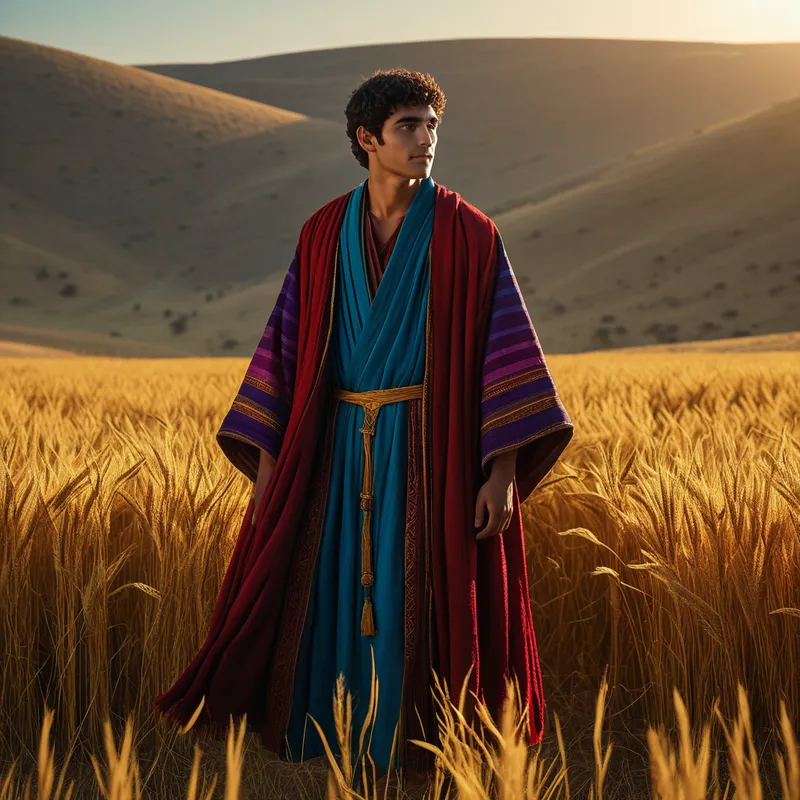
Joseph's Coat Myth Meaning & Symbolism
A father's gift of a coat sparks fraternal envy, leading to betrayal, descent, and an ultimate, redemptive rise to power through dream and fate.
The Tale of Joseph's Coat
Listen, and hear the tale spun from the threads of fate and favor.
In the land of Canaan, under a sky that baked the earth to clay, lived an old man named Jacob. His heart, scarred by a lifetime of striving, held a softness for one son above his eleven others: Joseph, born of his beloved Rachel. To this son, Jacob gave a gift—not a simple tunic of rough wool, but a ketonet passim, a coat of many colors. It was a garment of distinction, a robe of long sleeves that spoke not of work in the field, but of a father’s singular, blazing love.
When Joseph wore it, the world changed. The sun caught the threads of crimson, ochre, and lapis, making him a walking flame against the dun-colored hills. His brothers, the sons of Leah and the handmaids, saw this and their blood turned cold. The coat was a banner of a love they did not share, a silent proclamation that echoed in the silence of their shared meals.
And Joseph dreamed. He stood in a field binding sheaves, and his sheaf rose upright while his brothers’ sheaves bowed down to it. He saw the sun, the moon, and eleven stars bowing to him. He spoke these visions aloud, his voice bright with the certainty of youth, and the hatred of his brothers curdled into a plot. “Here comes this dreamer,” they sneered. “Let us see what will become of his dreams.”
They seized him far from their father’s sight, in the lonely pastures of Dothan. They stripped the radiant coat from his shoulders, the very skin of his favored identity torn away. They cast him into a dry, echoing cistern—a stone womb of despair. As he cried out from the pit, they sat and ate, the crunch of their bread drowning his pleas. A caravan of Ishmaelites appeared on the horizon, a line of camels against the sky like stitches on a hide. For twenty pieces of silver, they sold their brother into the oblivion of Egypt.
But the coat remained. They took a goat, slaughtered it, and dipped the beautiful garment in its hot, dark blood. They brought it to their father. “This we have found,” they said. Jacob recognized it instantly. The colors were now a canvas for a single, horrific stain. He rent his own clothes, put on sackcloth, and wept a grief that had no bottom. “It is my son’s tunic. A fierce animal has devoured him. Joseph is without doubt torn to pieces.” And the old man refused all comfort, descending into a gray world where the sun did not shine.
Meanwhile, Joseph descended into another pit—slavery, then a prison—carrying only the ghost of his coat and the unkillable seed of his dreams.

Cultural Origins & Context
This story forms a critical sequence in the Book of Genesis (Chapters 37-50). It is the foundational narrative of the Israelite sojourn in Egypt, a pivot upon which the fate of a people turns. Passed down orally for generations before being codified in the written Torah, it functioned as national myth, explaining how the descendants of Abraham came to be in a foreign land, setting the stage for the epic of Exodus.
Societally, it is a profound exploration of family dynamics within a polygamous patriarchal structure. The tension between the son of the beloved wife and the sons of the less-favored wives reflects very real economic and social anxieties about inheritance and blessing. The storyteller, likely a court historian or priestly scribe during the Israelite monarchy, uses this intimate family betrayal to frame a grand theological and political theme: the mysterious, often painful, providence that guides history. It asks the enduring question: how can the malicious acts of humans serve a larger, redemptive pattern?
Symbolic Architecture
The coat is the central, luminous symbol. It is not merely a fancy garment; it is a visible soul. It represents conferred identity, the gift (and burden) of a parent’s unconscious projection. Joseph is not yet a hero; he is the anointed one, cloaked in a destiny he has not earned through deed, only received through love. This makes him a target.
The gifted robe is always a dangerous garment. It marks the wearer for both elevation and envy, for a destiny that must first pass through the rending of its fabric.
The brothers represent the collective shadow—the rejected, unloved, and unacknowledged parts of the family (and by extension, the psyche) that rebel against the conscious favorite. The cistern is the classic descent into the underworld, a necessary stripping away of the gifted identity. Joseph must lose the coat to find himself. The blood on the coat is a brutal alchemy: the symbol of life (the coat) is transformed by a symbol of death (the blood) to fabricate a lie, which in turn initiates a transformative grief in Jacob.
The dreams are the engine of the myth. Joseph is the dreamer, a figure who is initially naive to the impact of his visions. His capacity to dream, however, is his core faculty, the inner compass that will guide him through slavery and prison to ultimate authority.

The Dreamer's Resonance
When this myth stirs in the modern dreamer, it often signals a profound crisis of identity. To dream of a special, beautiful garment being taken, stained, or destroyed points to a felt violation of one’s sense of self. Perhaps a talent, a role, or a cherished self-image has been “stripped” by life’s circumstances—a job loss, a betrayal, a failure.
Dreams of being betrayed by siblings or close colleagues, or of falling into a pit or well, somaticize this psychological “casting down.” The dreamer is in the cistern phase: feeling isolated, trapped, and robbed of their former status. The psyche is communicating the painful but necessary death of an old, perhaps too-fragile, identity that was based on external validation (the father’s coat).
Conversely, to dream of receiving or wearing such a coat can indicate the awakening of a unique potential or calling, but one that comes with an intuitive warning of the envy and isolation it may provoke. The body may feel both exhilarated and exposed.

Alchemical Translation
The myth of Joseph is a complete map of individuation. The initial state is one of unconscious inflation—Joseph in his coat, unaware of the shadow his light casts. The nigredo, the blackening, is the betrayal, the stripping, the descent into the pit and slavery. The gifted identity is destroyed. This is not a punishment, but a prerequisite.
The ego must be humbled, its prized garments removed, so that the Self, guided by the enduring spark of the dream, can begin its true work.
The long years in prison represent the albedo, the whitening or purification. Here, stripped of everything, Joseph’s core faculty—his ability to interpret dreams—is honed in service of others. He moves from interpreting his own grandiose dreams to deciphering the unconscious turmoil of the cupbearer and the baker, and finally Pharaoh himself. He learns to translate the symbolic language of the depths for the benefit of the whole system.
His final ascent to vizier of Egypt is the rubedo, the reddening or culmination. He is clothed again, not in his father’s coat, but in the robes of Egyptian authority—a new, earned identity synthesized from his innate gift (dreaming) and the hard-won wisdom of his suffering. He saves nations, including the brothers who betrayed him. The coat of many colors is transmuted from a garment of naive favor into the integrated, multifaceted wisdom of a ruler who has mastered both the light and the dark of his own story. The dreamer, once cast into the pit, becomes the architect of salvation, proving that the deepest wounds can become the very seams of a destined wholeness.
Associated Symbols
Explore related symbols from the CaleaDream lexicon: