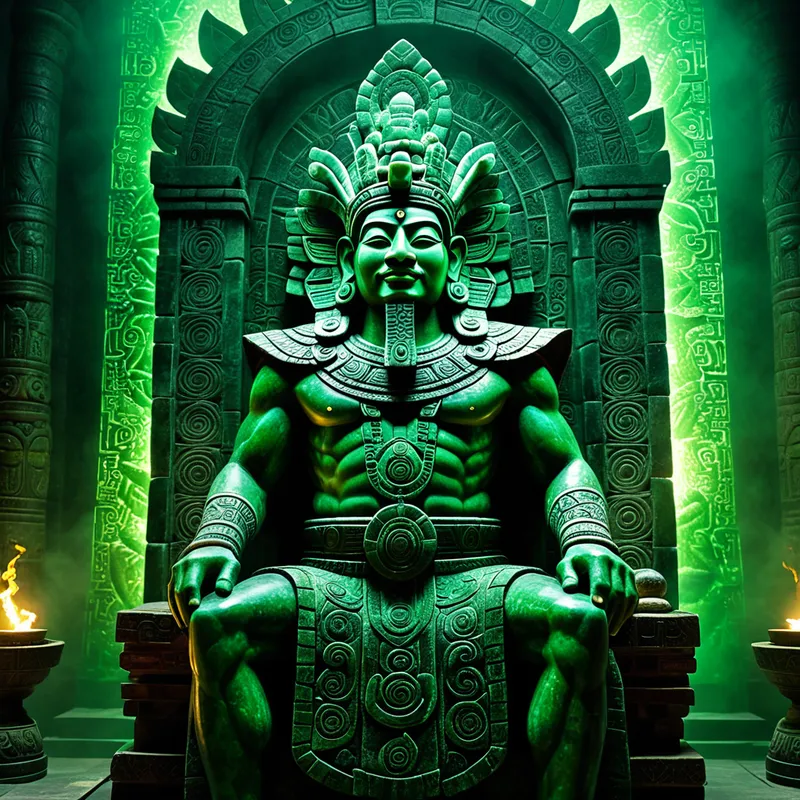
Jade Masks Myth Meaning & Symbolism
A myth of a god-king who must craft a mask of living jade to bridge the worlds of flesh and spirit, becoming a vessel for the divine.
The Tale of Jade Masks
In the time before time, when the world was young and the sky still rested upon the shoulders of the first mountains, there was a city of stone that breathed. Its name was K'uhul Ajawil, the Divine Seat. Its king was not merely a man, but a vessel. He was the K'uh made flesh, the hinge between the world of men and the realm of the gods. Yet, this hinge was rusted. The king, named B'alam K'inich, felt the weight of his office like a physical stone upon his chest. In the mirror of polished obsidian, he saw only a mortal face—weary, flawed, and separate from the terrible, beautiful majesty he was meant to embody.
The people felt this disconnection. The rains were hesitant, the corn grew thin, and a silence fell upon the sacred Pitz court. The priests read the anger in the stars and the whispers in the smoke. The message from the Xibalba was clear: the covenant was fraying. The king’s human face could no longer hold the gaze of the gods.
Driven by despair and duty, B'alam K'inich descended not into the earth, but into the deepest chamber of his own spirit. He fasted, bled, and dreamed. In the dream, the great Feathered Serpent, K'uk'ulkan, coiled around the Wakah Chan. Its voice was the sound of wind through jade chimes. "You are a cracked cup, meant to hold the storm. To be the bridge, you must be unmade and remade. You must surrender your face and receive ours."
The king awoke with the vision burning behind his eyes. He summoned the greatest artisans, the keepers of stone and fire. "You will not carve my likeness," he commanded, his voice hollow. "You will build a face that is not a face. A skin of the earth’s bones, a shell for the sky’s breath." The material was to be jade, not for its wealth, but for its soul—the stone of water, of heart’s blood, of eternity.
The work was an agony of precision. Each piece of jade, quarried from the sacred veins of the earth, was shaped and polished under the king’s feverish gaze. As the mask took form—a stern, geometric visage with eyes of obsidian and shell—the king weakened. His mortal vitality, his Ik', seemed to flow into the cold stone. The final ritual was not one of adornment, but of annihilation. On the summit of the tallest pyramid, under the eye of the noonday sun, the high priest lifted the completed jade mask. It was not placed upon the king’s face, but through it. In a moment of transcendent sacrifice, the boundary between man and mask dissolved. The jade did not cover; it incorporated.
Where B'alam K'inich once stood, a new being resided. The Jade Mask was now the face. The eyes that looked out saw not just the city, but the layers of the world—the vibrant Yax Che, the dark roads of Xibalba, the celestial dance of the stars. The voice that spoke was the rustle of leaves and the rumble of distant thunder. The king was gone. In his place was the K'uhul Ahaw, the true Lord. The rains returned, not as weather, but as blessing. The connection was restored, paid for with the coin of a single, mortal self.
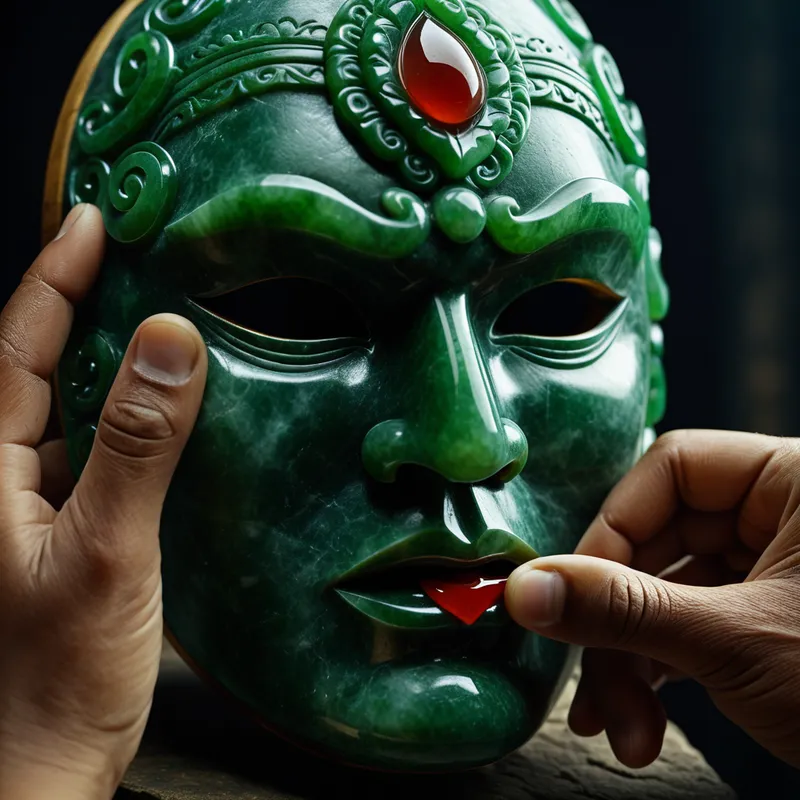
Cultural Origins & Context
The myth of the Jade Mask is not a single story from one codex, but a profound narrative pattern woven into the very fabric of Classic Maya and broader Mesoamerican kingship ideology. It was not "told" in the way of a bedtime story, but performed, enacted, and made materially real. The myth was the underlying script for the ritual of royal accession and the ongoing maintenance of cosmic order.
The societal function was paramount. In a worldview where the gods had sacrificed themselves to create the world and humanity, the king’s primary duty was reciprocity. He was the axis of this sacred exchange. The historical Ajaw did not merely wear jade jewelry; in portraiture on stelae and in temple murals, they are often shown literally transforming into godly beings—their faces merging with the masks of the Chaahk, the K'inich Ajaw, or the Jaguar God of the Underworld. The funerary jade mosaic masks placed over the faces of elite rulers, like the famous mask of K'inich Janaab' Pakal, were not mere death goods. They were permanent, petrified versions of this transformative ritual, designed to fix the king’s identity as a divine being for his journey through the underworld and his rebirth among the ancestors. The myth was the theology made visible, a continuous loop of sacrifice and renewal that held the universe in balance.
Symbolic Architecture
At its core, the Jade Mask myth is about the paradox of the vessel. It explores the terrifying and necessary process of becoming a container for something greater than the individual ego.
The mask does not hide the true self; it reveals the true function. The face of personality is sacrificed to become the face of purpose.
The Jade itself is the first key symbol. More precious than gold, it represented water, vegetation, life force, and the soul. It was the stone of the heart, both physically and metaphorically. To be masked in jade is to have one’s mortal, ephemeral nature ("flesh") replaced by an eternal, sacred substance ("spirit"). The Mask is the second symbol. It is not a disguise, but an interface. It is the persona in its most profound, ritual sense—the sacred face one must develop to engage with the numinous, to mediate between the human and the divine, the personal and the transpersonal.
The psychological conflict is the king’s initial, flawed humanity—his personal fears, weaknesses, and limitations. This is the "cracked cup." The triumph is not the destruction of the self, but its radical re-contextualization. The individual ego (B'alam K'inich) is not erased; it is subsumed as the necessary foundation for a larger, archetypal identity (the K'uhul Ahaw). The myth maps the journey from being a person who has a role to becoming a role that inhabits a person.
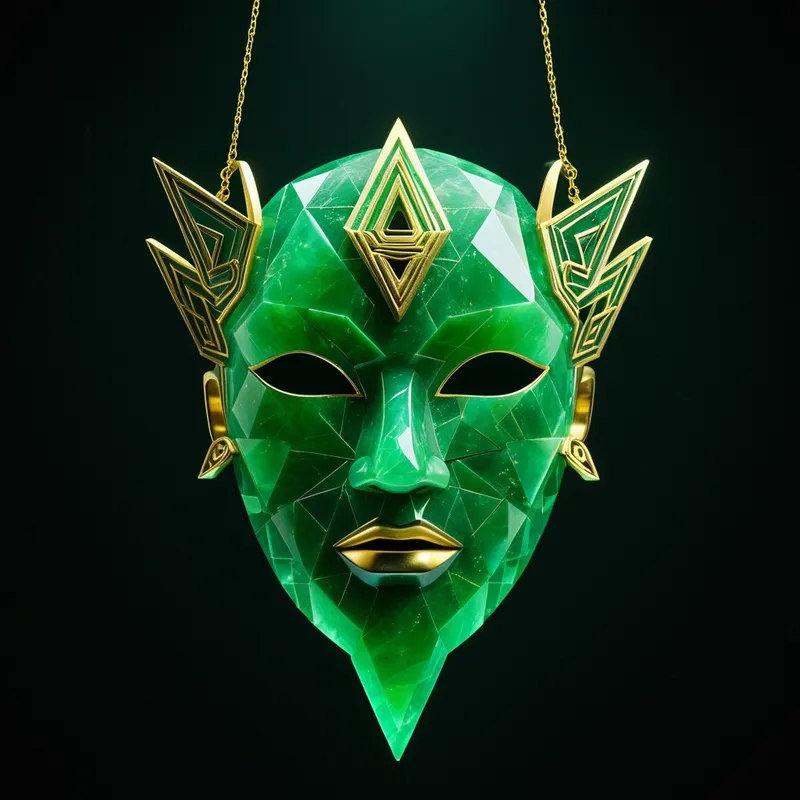
The Dreamer's Resonance
When this myth stirs in the modern unconscious, it rarely appears as a literal Maya king. Instead, it manifests as dreams of profound, often anxious, transformation of identity. One might dream of their own face feeling like clay, being reshaped by unknown hands. They may dream of looking in a mirror and seeing a face that is both theirs and not theirs—a face of stone, metal, or mosaic that is stern, powerful, yet strangely impersonal.
The somatic experience is often one of pressure, constriction, or a chilling sensation around the head and face, signaling the psyche’s labor in forging a new "mask" or adaptive identity. This is the process of what Jung called "building the Persona," but at a depth far beyond social convention. It is the persona required not for fitting in, but for stepping up—into a role of great responsibility, into a stage of life that demands a new kind of maturity (parenthood, leadership, artistic mastery, spiritual vocation).
The dreamer is undergoing the psychological death of an old self-concept that is no longer sufficient for the tasks of their life. The dream is the ritual chamber where the sacrifice of the comfortable, familiar "face" is performed, preparing the dreamer to receive the heavier, more majestic, and more demanding mask of their own potential.

Alchemical Translation
The alchemical process mirrored in the Jade Mask myth is the solve et coagula—dissolve and coagulate—applied to the psyche. It is a blueprint for a specific kind of individuation: one where the goal is not simply self-discovery, but conscious self-sacrifice to a supra-personal value or function.
The first stage is the Nigredo, the blackening. This is King B'alam K'inich’s despair, the feeling of being a "cracked cup," the failure of the old personality. It is the painful, necessary acknowledgment of one’s limitations in the face of a calling.
The second stage is the Albedo, the whitening. This is the vision from K'uk'ulkan, the clear, chilling insight that one must be unmade. It is the conscious decision to submit to the transformative process, to gather the "jade" of one’s essential talents, values, and experiences.
The alchemical gold is not found, but forged in the willingness to cease being ore and become the vessel.
The final stage is the Rubedo, the reddening, the achievement of the goal. This is not the king celebrating, but the moment of incorporation. The mortal "red" of blood and life is not lost; it is transfixed within the eternal green of the jade. The new being—the integrated Self that wears the mask of its destiny—is born. For the modern individual, this translates to those moments when duty, talent, and circumstance fuse. The artist disappears into the flow of creation. The caregiver’s personal exhaustion is subsumed by a love that feels ancestral. The leader’s personal anxiety is quieted by the clarity of the role they must fulfill. The individual is not gone; they have become the living mask for an archetypal force—the Creator, the Caregiver, the Sage—and in doing so, achieve a paradoxical, profound form of freedom. They have traded the small face of the ego for the majestic, if heavier, countenance of the Self.
Associated Symbols
Explore related symbols from the CaleaDream lexicon: