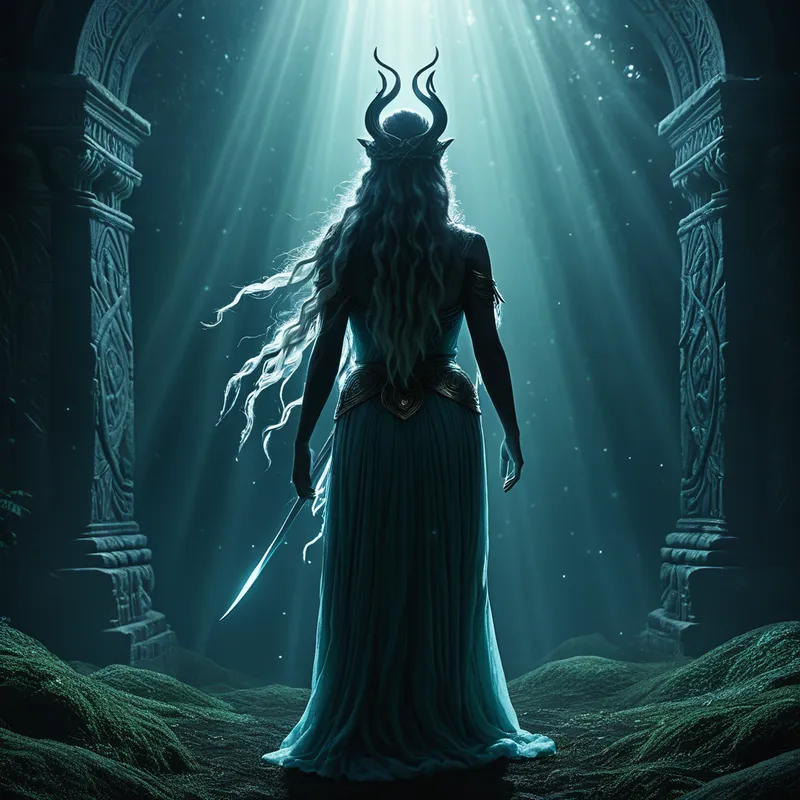
Issatok Spirit of Open Water
An Inuit spirit embodying the vast, perilous open waters, guiding and challenging those who navigate the Arctic's treacherous seas.
The Tale of Issatok Spirit of Open Water
In the time when the world was ice and breath, when the great ice shelf groaned and the sky was a pale, endless bowl, there lived the spirit of the open water, Issatok. He was not a spirit of the shore, nor of the safe, frozen bays. His domain was the vast, dark, liquid heart of the sea, the imarpik, where the ice gave way to the terrifying and necessary unknown.
It is said that Issatok appears not as a man or a beast, but as the water itself given consciousness—a sudden, intelligent calm within a raging storm, a deceptive patch of open water in a field of ice that leads either to salvation or to a slow, cold death. He is the whisper on the wind that tells of seals, and he is the sudden fog that swallows landmarks whole. Hunters in their qajaq know him. They feel his presence when the horizon melts into sky, when all directions look the same, and the only truth is the rhythm of their own paddling and the fragile shell of skin and bone between them and the abyss.
One tale, told when the lamps are low, speaks of a great hunter named Ataata. Renowned for his skill, Ataata grew proud. He boasted that he feared no spirit of the water, that his own strength and knowledge were shield enough. He paddled far, farther than any had before, seeking the greatest of seals to feed his people through the deepest dark. For days, the weather held. Then, Issatok came.
It began not with a storm, but with a perfect, windless silence. The sea became a mirror, reflecting a featureless grey sky. Every horizon vanished. Ataata was trapped in a circle of water and mist, a world without edge or marker. He paddled with all his might, but the circle moved with him. He shouted, but his voice fell dead on the water. Fear, cold and sharp as a harpoon point, entered his heart. His pride evaporated like mist. In that profound isolation, he understood his smallness.
He ceased struggling. He laid his paddle across his qajaq and bowed his head. "Issatok," he whispered to the water. "I see you. I have been a fool. My strength is nothing without respect. My knowledge is blind without humility. Show me the way, not because I command it, but because I ask."
For a long time, nothing changed. Then, a single ripple moved across the glassy surface, not from the wind, but from something deep below. It moved in a direction. With no other guide, Ataata followed the subtle path of ripples. For hours he paddled, his arrogance stripped away, his senses acutely attuned to the slightest sign. The ripples led him to a breathing hole, and there, waiting, was a great seal. He took it with gratitude. As he made his offering of thanks to the sea, the mist on the horizon parted, just enough to reveal the distant, dark line of the shore. Issatok had tested him, taken him to the brink of the void, and returned him not just with food, but with the true knowledge necessary for survival: that to navigate the open water, one must first navigate the open spaces within oneself.
Cultural Origins & Context
Issatok emerges from the Inuit relationship with the Arctic marine environment, a worldview where the sea is not a mere resource but a sentient, powerful entity. In a landscape dominated by ice, the open water (imarpik) is a complex symbol. It is the source of life—the realm of seals, whales, and walrus, the primary sustenance for coastal Inuit groups. Yet, it is also the realm of extreme peril: of hypothermia, of storms, of becoming hopelessly lost in a featureless expanse. This duality is embodied in Issatok.
The spirit belongs to the category of inua—the indwelling spirit or essence of a thing. While many inua are tied to specific animals or rocks, Issatok is the inua of a condition: openness, liquidity, and navigational ambiguity. He is not a deity to be worshipped in a temple, but a presence to be acknowledged and negotiated with through correct action, humility, and ritual observance. His "mythology" is less a set of epic tales and more a collection of lived experiences and cautionary narratives shared to encode survival wisdom. Understanding Issatok was a matter of life and death, a spiritual technology for navigating a capricious world.
Symbolic Architecture
Issatok represents the archetype of the sage, but a sage of a particular kind. His wisdom is not offered freely; it is earned through ordeal and the surrender of ego. He is the teacher whose classroom is the edge of annihilation.
Issatok is the psychological embodiment of the necessary unknown. He is not chaos itself, but the conscious interface with chaos—the moment one must venture from the solid, known "ice" of dogma, habit, or pride into the fluid, uncertain "open water" of a new reality or a profound challenge.
His medium is paradox. He is the guide who manifests as being lost, the provider culture.") who first induces lack, the clarity that appears as obscuring fog. To encounter Issatok is to have one's mental maps erased, forcing a deeper, more intuitive form of navigation to surface. He dissolves the illusion of control, forcing the individual to rely on a different kind of intelligence—one rooted in observation, humility, and attunement to subtle signs. In this, he guards not just the physical open water, but the open water of the psyche, the transitional, liminal space where old identities drown and new understandings are born.

The Dreamer's Resonance
To dream of Issatok’s domain—of vast, calm, or treacherous open water, of being adrift, or of finding a path across a featureless sea—is to dream of a critical transition in the psyche. The dream-ego in such a landscape is at a threshold. The familiar shores of a known attitude, relationship, or self-concept have receded.
The profound stillness and disorientation reflect a state of potent, if terrifying, potential. The ego’s usual tools—willpower, logic, force—are useless here. The dream calls for a shift in consciousness akin to Ataata’s surrender: a release of the need to control the journey and an opening to guidance from a deeper, more authentic self (the ripples from the deep). The danger is real—the threat of psychic dissolution, of drowning in anxiety or meaninglessness. But the opportunity is the discovery of a new inner compass, a way of navigating life not by external landmarks, but by an internal, soul-directed sense of direction. The "seal" that appears is the nourishing insight or new life that emerges only after this surrender.

Alchemical Translation
In the alchemy of the soul, Issatok presides over the stage of solutio—dissolution. This is not destruction, but the necessary breaking down of rigid, outworn structures (the ice of the ego) into a fluid, receptive state. It is a terrifying but vital process, for nothing new can be formed from something rigidly solid.
The spirit’s challenge is an initiatory ordeal. He forces the psyche into its own open water, where all certainties melt. The goal is not to escape this state, but to learn to float within it, to trust the buoyancy of the soul itself until a new, more authentic form begins to coalesce from the primal waters.
Psychologically, this translates to those periods of life when one feels profoundly lost, adrift from old goals and identities. The modern mind often pathologizes this state as depression or crisis. The myth of Issatok reframes it as a sacred, if severe, curriculum. The spirit does not promise safe passage; he promises the possibility of transformation if one can endure the dissolution without panic, if one can replace arrogance with inquiry and fear with a humble attentiveness. The wisdom gained is not intellectual, but embodied—a knowing in the bones and breath, the kind that allows one to navigate future darkness not because they know the way, but because they have learned how to find it.
Associated Symbols
Explore related symbols from the CaleaDream lexicon:
- Ocean — The vast, primal source and abyss, representing the collective unconscious, boundless potential, and profound mystery.
- Journey — The essential process of traversal through unknown realms, both external and internal, demanding courage and yielding transformation.
- Fear — The primal emotional response to the unknown, a guardian at the threshold that must be acknowledged and moved through for growth.
- Spirit Guide — A non-physical entity or inner wisdom that offers direction, protection, and teaching, often in subtle or challenging ways.
- Bridge — A structure spanning a dangerous or dividing space, symbolizing transition, connection, and the link between known and unknown shores.
- Fog — An obscuring veil that dissolves boundaries and landmarks, representing confusion, the unknown, and the necessity of navigating by faith or intuition.
- Mirror — A surface for reflection, revealing the true self, often showing what is beneath the surface of conscious awareness.
- Key — An instrument for unlocking, representing the solution, insight, or specific action required to move from confinement to openness.
- Dream — The nocturnal realm where the soul navigates its own inner landscapes, encountering symbols and guides like Issatok for integration and wisdom.
- Roots in Water — A symbol of nourishment and stability drawn from the unconscious or emotional realm, representing grounding in the fluid, intuitive self.
- Open Door — A threshold of opportunity and transition, marking the choice to leave the known and enter a new, undefined space of possibility.
- Contemplative Waters — Still, deep water that invites introspection and reveals hidden depths, symbolizing the meditative state necessary to hear inner guidance.