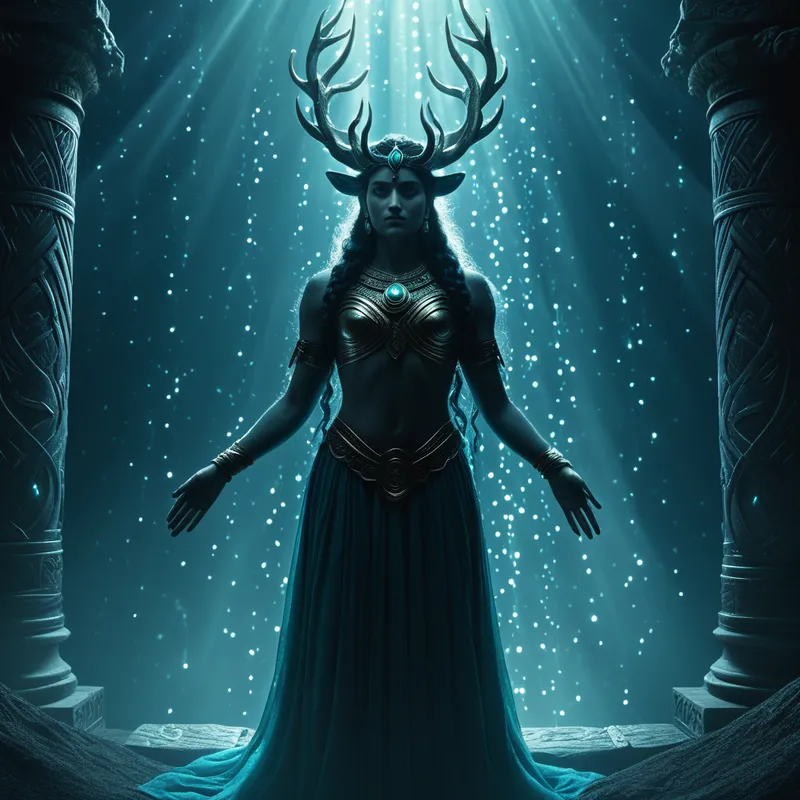
Inanna and the Huluppu Tree
The goddess Inanna plants a magical huluppu tree in her garden, only to face unexpected threats that reveal deeper cosmic struggles.
The Tale of Inanna and the Huluppu Tree
In the first days, when [the world](/myths/the-world “Myth from Tarot culture.”/) was still being shaped, the goddess [Inanna](/myths/inanna “Myth from Sumerian culture.”/), Queen of Heaven and Earth, walked along the banks of the great Euphrates. [The river](/myths/the-river “Myth from Buddhist culture.”/), a pulsing vein of life, carried a gift upon its waters. A young huluppu tree, uprooted by a southern storm, drifted northward. Moved by its solitary journey, [Inanna](/myths/inanna “Myth from Sumerian culture.”/) reached into the sacred waters and lifted the sapling. She saw in its delicate form a latent majesty, a potential for beauty and purpose. With care, she carried it to her holy garden in the city of Uruk, a place where the divine and earthly realms touched.
She planted the tree with her own hands, watering it not with common [water](/myths/water “Myth from Chinese culture.”/) but with the waters of life from her own divine vessel. She spoke to it, a whisper of intention: “Grow tall, huluppu. In your shade, I shall place my shining throne and my restful bed.” The tree took root in the fertile soil of her sanctuary, and Inanna waited. She waited as years compressed into moments, watching the slender trunk thicken, the branches stretch toward [the sky](/myths/the-sky “Myth from Persian culture.”/), the roots plunge deep into the dark earth. It became a magnificent, towering presence in her garden.
But the garden was not a walled paradise; it was a [crossroads](/myths/crossroads “Myth from Celtic culture.”/). As the tree grew, so too did the attention of forces that dwell in the liminal spaces of the world. Into its high branches, the Anzu-bird, a creature of tempest and thunder, set its nest. The bird’s fledglings filled the air with chaotic cries, and its vast wings cast a shadow not of peace, but of impending storm. At the base of the great trunk, where the roots formed a dark and tangled hollow, the serpent who knows no charm—a creature of the deep, chthonic earth—coiled itself, immune to spell or song. And in the very heart of the tree, in a hollow carved by time and decay, the dark spirit [Lilitu](/myths/lilitu “Myth from Mesopotamian culture.”/) made her home, a restless and solitary presence that chilled the air.
Inanna, the goddess of love, war, and sovereignty, looked upon her tree, now occupied and defiled. The throne and bed she envisioned were impossible. Her creation was held captive. A profound sorrow and a fiercer resolve took hold of her. She, who faced down mountains and descended to [the underworld](/myths/the-underworld “Myth from Greek culture.”/), would not be thwarted in her own sacred grove. Yet, the adversaries were formidable, each representing an aspect of the cosmos resistant to order.
She turned for aid, but not to her father, Enki, or her brother, Utu. First, she went to her brother, the hero [Gilgamesh](/myths/gilgamesh “Myth from Mesopotamian culture.”/). Hearing his sister’s plight, the king of Uruk took up his bronze axe, a tool of civilization and force. He entered the sacred garden. With the might of a bull, he struck the serpent who knows no charm, ending its reign at the root. The Anzu-bird, seeing the fate of the serpent, fled with its young to the distant mountains, its chaotic presence banished from the ordered space. Lilitu, terrified by the sound of the axe and the clearing of her refuge, shattered her dwelling and fled into the wild, desolate places from whence she came.
With the tree cleansed of its invaders, Gilgamesh did not stop. For Inanna, he worked the tree itself. From its vast trunk, he carved her a throne and a bed, fulfilling her original, sacred intention. From the roots and branches, he fashioned for himself a pukku and a mikku—a drum and drumstick, sacred instruments of kingship and community ritual. The tree, once a vessel of [chaos](/myths/chaos “Myth from Greek culture.”/), was transformed through heroic action into the very instruments of culture, sovereignty, and divine presence.
Cultural Origins & Context
The myth of Inanna and [the Huluppu Tree](/myths/the-huluppu-tree “Myth from Mesopotamian culture.”/) is preserved in the prologue to the Sumerian epic Gilgamesh, [Enkidu](/myths/enkidu “Myth from Sumerian culture.”/), and the Netherworld, dating to the early second millennium BCE. It functions as an etiological narrative, explaining the origins of Inanna’s sacred furniture and Gilgamesh’s ritual objects, thereby grounding his heroic and kingly identity in a divine, foundational act. The setting is profoundly Sumerian: the life-giving Euphrates, the walled city-garden of Uruk, and the tangible, immanent presence of the gods in the material world.
Inanna’s role is central. She is not a passive nurturer but an active, willful deity who instigates transformation. Her act of planting is an act of cosmic ordering, an attempt to integrate a wild, elemental force (the tree) into the civilized, sacred space of her garden. The subsequent invasion represents the perpetual struggle in Mesopotamian thought between the ordered world of the city (the ki-en-gi) and the untamed, chaotic forces that constantly threaten to encroach upon it. The tree becomes a microcosm of the world, attracting beings from the sky (Anzu-bird), the [underworld](/myths/underworld “Myth from Greek culture.”/) (the serpent), and the psychosocial wastes (Lilitu).
Symbolic Architecture
The huluppu [tree](/symbols/tree “Symbol: In dreams, the tree often symbolizes growth, stability, and the interconnectedness of life.”/) is the [axis](/symbols/axis “Symbol: A central line or principle around which things revolve, representing stability, orientation, and the fundamental structure of reality or consciousness.”/) of the myth, a nascent World [Tree](/symbols/tree “Symbol: In dreams, the tree often symbolizes growth, stability, and the interconnectedness of life.”/). It is a living [conduit](/symbols/conduit “Symbol: A passage or channel that transfers energy, information, or substance from one place to another, often hidden or structural.”/) between realms, which is precisely why it attracts such potent inhabitants. Its verticality symbolizes [connection](/symbols/connection “Symbol: Connection symbolizes relationships, communication, and bonds among individuals.”/); its roots in the dark [earth](/symbols/earth “Symbol: The symbol of Earth often represents grounding, stability, and the physical realm, embodying a connection to nature and the innate support it provides.”/), its [trunk](/symbols/trunk “Symbol: The trunk in dreams typically denotes the core structure or foundation of one’s identity, values, or beliefs.”/) in the [human](/symbols/human “Symbol: The symbol of a human represents individuality, complexity of emotions, and social relationships.”/) world, and its branches in the sky mirror the Mesopotamian layered [cosmos](/symbols/cosmos “Symbol: The entire universe as an ordered, harmonious system, often representing the totality of existence, spiritual connection, and the unknown.”/).
The invaders are not mere monsters but archetypal occupants of the tree’s different zones: the serpent (chthonic, unconscious), the storm-bird (celestial, chaotic power), and the lone spirit (psychic, alienated femininity). Their presence is not inherently evil but represents the raw, untamed aspects of reality that must be confronted and integrated for the tree to fulfill its sacred purpose.
Inanna’s initial [vision](/symbols/vision “Symbol: Vision reflects perception, insight, and clarity — often signifying the ability to foresee or understand deeper truths.”/)—a [throne](/symbols/throne “Symbol: A seat of authority, power, and sovereignty, representing leadership, divine right, or social hierarchy.”/) and bed in its shade—is a vision of [integration](/symbols/integration “Symbol: The process of unifying disparate parts of the self or experience into a cohesive whole, often representing psychological wholeness or resolution of internal conflict.”/). The [throne](/symbols/throne “Symbol: A seat of authority, power, and sovereignty, representing leadership, divine right, or social hierarchy.”/) represents stable, sovereign [authority](/symbols/authority “Symbol: A symbol representing power structures, rules, and control, often reflecting one’s relationship with societal or personal governance.”/); the bed represents intimacy, [fertility](/symbols/fertility “Symbol: Symbolizes creation, growth, and abundance, often representing new beginnings, potential, and life force.”/), and rest. Together, they signify a balanced, ruling [consciousness](/symbols/consciousness “Symbol: Consciousness represents the state of awareness and perception, encompassing thoughts, feelings, and experiences.”/) at home in the world. The failure of this [vision](/symbols/vision “Symbol: Vision reflects perception, insight, and clarity — often signifying the ability to foresee or understand deeper truths.”/) without conflict underscores a profound psychological [truth](/symbols/truth “Symbol: Truth represents authenticity, honesty, and the quest for knowledge beyond mere appearances.”/): [the ego](/myths/the-ego “Myth from Jungian culture.”/)’s conscious [intention](/symbols/intention “Symbol: Intention represents the clarity of purpose and direction in one’s life and can symbolize motivation and commitment within a dream context.”/) (to plant a beautiful tree) inevitably stirs up contents from the personal and [collective unconscious](/symbols/collective-unconscious “Symbol: The Collective Unconscious refers to the part of the unconscious mind shared among beings of the same species, embodying universal experiences and archetypes.”/) that must be addressed.
The Dreamer’s Resonance
For the modern dreamer or [psyche](/myths/psyche “Myth from Greek culture.”/), this myth maps the process of nurturing a nascent potential—an idea, a relationship, a creative project, a new phase of life. We plant our “tree” with hope and clear intention. Yet, as it grows, it inevitably attracts “inhabitants.” These are the unforeseen challenges, the latent fears, the old complexes, and the chaotic emotions that take root in the project, threatening to distort or consume it.
The serpent may represent a deep, instinctual fear or a “poisonous” thought-pattern that undermines from below. The storm-bird might be sudden, disruptive anxiety or external chaos that shatters peace. Lilitu could symbolize a sense of isolation, a haunting alienation, or a repressed aspect of [the self](/myths/the-self “Myth from Jungian culture.”/) that dwells in the heart of our endeavors. The myth assures us that this invasion is not a sign of failure, but a natural stage in the growth of anything meaningful. The garden is not a sealed bubble; it is part of a living, contested cosmos.

Alchemical Translation
The myth describes a full alchemical cycle: planting (the [nigredo](/myths/nigredo “Myth from Alchemical culture.”/), or first matter), infestation (the putrefaction and confrontation with shadow), cleansing (the [albedo](/myths/albedo “Myth from Alchemical culture.”/), or whitening, through heroic action), and fashioning (the [rubedo](/myths/rubedo “Myth from Alchemical culture.”/), the reddening, creating a lasting, useful product of the spirit).
Gilgamesh’s axe is the tool of discernment and decisive action. It is not wielded in blind rage but in service to a sacred purpose. The act of carving is crucial—the raw, infested wood does not disappear; it is transformed. The same substance that housed chaos becomes the throne of sovereignty and the instruments of cultural rhythm. This is the core of alchemy: the base material, through ordeal, becomes the gold.
Inanna does not perform the final act herself but empowers her brother to do so. This reflects a psychological movement from a state of being possessed by a problem (the infested tree) to witnessing its resolution through an allied aspect of the self—the inner hero or active will (Gilgamesh). The resulting objects—throne, bed, drum—are symbols of a psyche that has successfully engaged with its depths and emerged with greater structure, capacity for relationship, and creative power.
Associated Symbols
Explore related symbols from the CaleaDream lexicon:
- Tree — The fundamental axis of life, connection, and growth, serving as a conduit between the heavens, earth, and underworld.
- Serpent — A primal symbol of the chthonic earth, instinct, healing, and the transformative power of the deep unconscious.
- Thunder — The disruptive, awakening force of the storm-bird, representing chaotic power, divine voice, and the shattering of stagnation.
- Goddess — The divine feminine principle as active, willful creator and sovereign, embodying love, war, and the drive for manifestation.
- Hero — The archetypal figure who confronts chaos and shadow with decisive action, serving a purpose greater than himself.
- Axe — A tool of civilization, discernment, and transformative force, used to clear, shape, and carve order from raw nature.
- Throne — A symbol of established sovereignty, rightful authority, and the stable center of consciousness or a kingdom.
- Drum — An instrument of ritual, community, and sacred rhythm, translating raw power into ordered, meaningful vibration.
- Garden — A cultivated, sacred space where nature and intention meet, representing the psyche or a domain of potential and care.
- River — The flowing source of life and time, carrying gifts and possibilities from the unknown to the known world.
- Shadow — The repressed, feared, or untamed aspects of the self or the world that must be confronted for wholeness.
- [Yggdrasil](/myths/yggdrasil “Myth from Global/Universal culture.”/) ([World Tree](/myths/world-tree “Myth from Global culture.”/)) — The cosmic tree linking all realms of existence, a parallel to the huluppu tree’s function as a microcosmic axis.