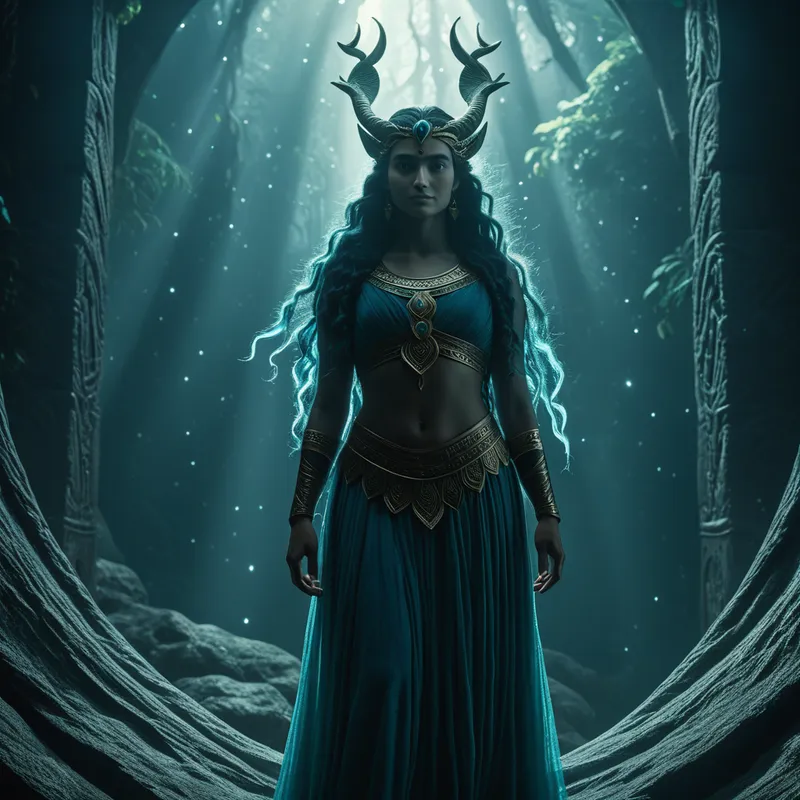
Inanna and Enki
The Sumerian goddess Inanna cunningly steals the sacred me—divine decrees of civilization—from the wise god Enki, transforming cosmic order through trickery.
The Tale of Inanna and Enki
The story begins not in open conflict, but in the deep, still waters of the Abzu. Here, in his watery sanctuary at Eridu, the god Enki, the holder of the me, slumbers. The me are not mere objects; they are the sacred, immutable decrees that establish the very fabric of civilization and cosmic order: kingship, priestly office, truth, the art of the carpenter, the craft of the scribe, even the conditions for war and peace. They are the foundational codes of reality, and Enki is their solemn guardian.
[Inanna](/myths/inanna “Myth from Sumerian culture.”/), Queen of Heaven and Earth, the luminous and ambitious goddess of love, war, and political power, fixes her gaze upon Eridu. She desires the me. Not for destruction, but for possession, for the elevation of her own city, Uruk, from a mighty city to the very axis of the civilized world. She does not come with an army, but with a plan woven from audacity and charm. She journeys to the Abzu, to the very seat of wisdom, and attends a grand feast in her honor. Enki, perhaps disarmed by her radiance, perhaps underestimating the depth of her ambition, welcomes her. The šem (beer) flows like the Tigris.
As the divine alcohol loosens Enki’s vigilance, the careful boundaries of his wisdom soften. In the warm haze of camaraderie, Enki begins to generously, recklessly, bestow gifts upon his illustrious guest. One by one, he hands over the me. The sacred decrees for lordship and the divine queen-ship, for the weapon and the art of song, for judgment and decision—over a hundred fundamental powers are transferred from his keeping to hers. Inanna, with perfect composure, accepts each one. She does not pocket them; she loads them onto her “Boat of Heaven,” a celestial vessel waiting to carry this staggering cargo to Uruk.
As dawn breaks and the fog of drink recedes, Enki awakens to a profound emptiness. The me are gone. A cold clarity reveals the magnitude of the transaction. He turns to his minister, Isimud: “Where are the holy me?” The truth is undeniable. Inanna has taken them, and her boat is already on the waters of the Euphrates, heading home.
Thus begins a desperate chase. Enki, the source of order, now unleashes [chaos](/myths/chaos “Myth from Greek culture.”/) to retrieve it. He sends a series of monstrous pursuers—creatures from the deep, warriors of [the river](/myths/the-river “Myth from Buddhist culture.”/)—to seize the Boat of Heaven. Each time, Inanna’s loyal vizier, Ninshubur, and the goddess herself, now imbued with the authority of the me she carries, fight them off. They are not merely defending cargo; they are defending a new distribution of cosmic authority. Finally, as Inanna approaches Uruk, Enki himself sends a final, terrible creature. Yet, as the boat docks at the quay of Uruk, Inanna triumphantly unloads the me before the awestruck citizens. The chase ends at her gates. The powers are now manifest in her city, woven into its walls and temples. Enki, witnessing this fait accompli, ultimately relents. He blesses Uruk and, in a stunning reversal, formally bestows the me upon Inanna, transforming theft into sanctioned inheritance. The cosmic ledger has been irrevocably altered.
Cultural Origins & Context
This myth, known from the Sumerian narrative “Inanna and Enki: The Transfer of the Arts of Civilization from Eridu to Uruk,” is not a simple fable of theft. It is a profound theological and political document etched in clay. It originates in the dynamic and often competitive world of early Mesopotamian city-states, each under the patronage of a deity. Eridu, the oldest city, was the cult center of Enki, god of fresh [water](/myths/water “Myth from Chinese culture.”/), craft, wisdom, and the deep foundations of [the world](/myths/the-world “Myth from Tarot culture.”/). Uruk, which would rise to unprecedented prominence in the Early Dynastic period, was the domain of Inanna.
The story serves as a divine charter for Uruk’s ascendancy. It explains how the primordial, foundational powers (the me) housed in ancient Eridu were rightfully transferred to the rising star of Uruk. It legitimizes a historical shift in cultural and political hegemony through divine narrative. Inanna’s method—trickery followed by successful defense—does not diminish her victory; in the Mesopotamian worldview, cleverness and efficacy were divine attributes. The myth acknowledges that the transition of supreme cultural authority is rarely peaceful or purely logical; it is often achieved through a disruptive, cunning, and ultimately transformative act that reshapes the established order.
Symbolic Architecture
The myth’s power lies in its dense symbolic [structure](/symbols/structure “Symbol: Structure in dreams often symbolizes stability, organization, and the framework of one’s life, reflecting how one perceives their environment and personal life.”/), where every element resonates with psychological and cosmic meaning.
The Abzu is not just Enki’s home; it is the unconscious, primordial source of all potential forms and laws. Enki is the archetypal Old King who hoards the treasures of the deep, the wisdom that structures consciousness but can become stagnant if not challenged and redistributed.
Inanna’s journey is an audacious raid on the unconscious. She ventures into the watery depths of the foundational psyche and extracts the codes that govern reality. Her trickery is the necessary catalyst that the overly-stable, self-contained system of Enki’s wisdom requires to be vitalized and made manifest in a new form.
The feast and the beer symbolize the dissolution of boundaries. Enki’s inebriation represents the temporary suspension of rational, guarding consciousness, creating an opening where deep contents can be transferred. It is a sacred carelessness that enables a necessary revolution.
The Boat of Heaven is the vessel of transformation, the conscious vehicle (Inanna’s will and purpose) that carries the raw, foundational powers (me) from the depth (Abzu) to the surface (Uruk), from the unconscious to the manifest world.
The Dreamer’s Resonance
To encounter this myth in a dream or deep reflection is to confront a pivotal inner drama. It asks: Where in my [psyche](/myths/psyche “Myth from Greek culture.”/) does the “Old King” reside? What foundational laws, inherited wisdom, or deep creative potentials have I left slumbering in an inaccessible, watery abyss within myself? The Enki aspect may represent a wise but passive intellect, a tendency to understand the codes of life but not live them fully, or an inner authority that has become rigid.
The Inanna impulse is the irrepressible call to claim those powers. It is the part of [the self](/myths/the-self “Myth from Jungian culture.”/) that is ambitious, cunning, and willing to risk divine disfavor to bring latent capacities into the light of day. The ensuing “chase” mirrors the inner conflict that follows any bold act of self-empowerment: the old order’s monsters of doubt, guilt, and fear rise up to reclaim what has been taken. The dreamer’s task, like Inanna’s, is to protect the nascent cargo, to fight for the right to integrate these stolen treasures into the fabric of their own “Uruk”—their conscious identity and life—until the inner Enki finally blesses the new arrangement.

Alchemical Translation
Psychologically, the narrative maps the arduous process of integrating unconscious contents into consciousness, a theft from the Self for the benefit of [the ego](/myths/the-ego “Myth from Jungian culture.”/), which must then be reconciled.
The me are the archetypal patterns of meaning and function. To possess them is not to own static objects, but to have the capacity to enact kingship, craft, justice, and love in one’s own life. Inanna’s theft is the ego’s necessary, arrogant, and ultimately fruitful seizure of these patterns from their dormant state in the collective unconscious.
The myth illustrates that wisdom (Enki) alone is inert. It must be wedded to desire and will (Inanna) to become culturally and personally creative. The union is not a peaceful marriage but a dramatic, destabilizing transfer of energy that unleashes chaos before establishing a new, richer order.
Enki’s final blessing is crucial. It represents the Self’s acquiescence to the ego’s daring. True empowerment is not a permanent state of rebellion, but a hard-won realignment where the central, ordering principle of the psyche ultimately sanctions the new configuration of power. The circle closes, not where it began, but on a higher level of complexity and manifestation.
Associated Symbols
Explore related symbols from the CaleaDream lexicon:
- Water — The primordial, formless source of all potential and wisdom, represented by Enki’s Abzu, from which the structured me are drawn.
- Trick — The necessary, disruptive act of cunning that bypasses established order to facilitate a transfer of power and instigate transformation.
- Goddess — The active, ambitious, and multifaceted feminine principle (Inanna) that executes the will to power and manifestation.
- God — The foundational, wise, and generative masculine principle (Enki) who is the deep source and guardian of cosmic laws.
- Chaos — The turbulent state unleashed by the theft, the chaotic chase that is the inevitable birth-pangs of a new order.
- Order — The sacred, structured decrees of the me themselves, and the cosmic system they uphold, which is dismantled and reconstituted.
- Journey — The perilous voyage from the deep source (Abzu) to the city of manifestation (Uruk), carrying a transformative cargo.
- Boat — The conscious vessel or vehicle (the Boat of Heaven) that safely transports sacred contents across dangerous, transitional waters.
- Key — The me function as metaphysical keys that unlock the capacities of civilization; Inanna seizes the keyring to the world.
- Crown — The symbol of legitimized authority and lordship, one of the paramount me that Inanna claims for her city and herself.
- Power Dynamics — The central theme of the myth: the shifting balance of sacred authority between deities, mirroring earthly political and psychological realities.
- Transformation Cocoon — The entire narrative arc serves as a cocoon, where the old structure of power is dissolved so a new configuration of cultural and divine authority can emerge.