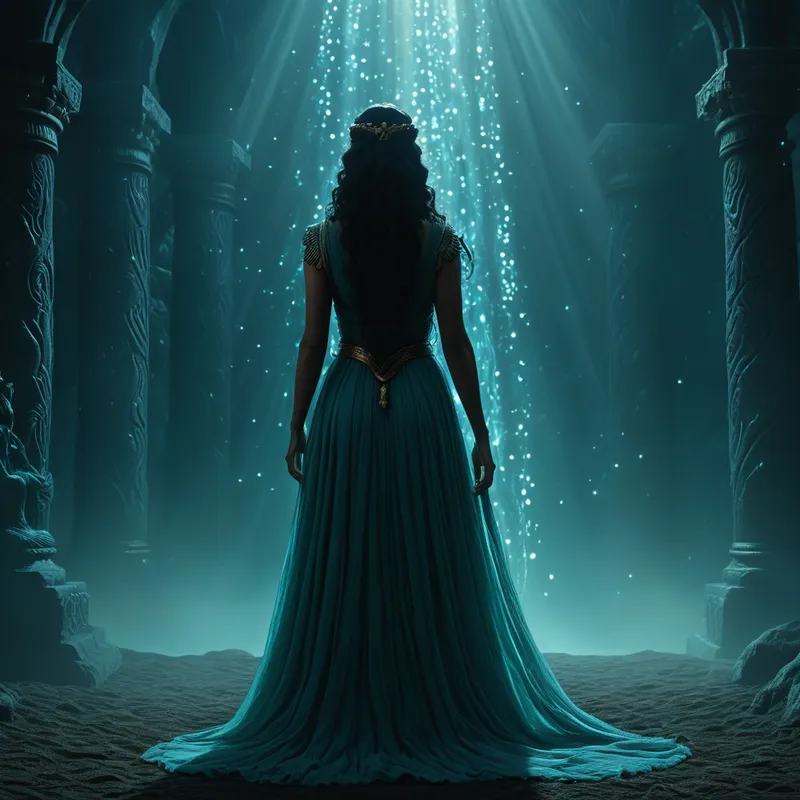
Ijiraq the Shape Shifter
An Inuit shape-shifting spirit that deceives children, teaching survival through cautionary tales of wilderness dangers and cultural boundaries.
The Tale of Ijiraq the Shape Shifter
In the vast, breathing silence of the tundra, where the snow holds the memory of every footfall and the wind speaks in a language older than words, there walks a being of shifting edges. The Ijiraq does not have a single form. It is the flicker at the corner of the eye when a rock seems to move, the sudden, familiar shape of a loved one seen across the ice field where no one should be. It is the whisper that sounds like your mother calling you home, but from the direction of the deep, trackless barrens.
The tale is told of children at play near the edge of the known world, where the safe circle of the camp gives way to the immense, watchful wilderness. The Ijiraq watches them, its essence a pool of liquid shadow and intention. To one child, it becomes a plump, curious lemming, darting just beyond reach. To another, it takes the gentle face of a departed grandparent, smiling from behind a willow shrub. Lured by these comforting, familiar illusions, the children follow, step by trusting step, away from the hearth-smoke and the voices of their kin.
The world begins to soften and warp. The path they thought they knew dissolves. The friendly lemming is gone; the grandparent’s face melts into the grey bark of a distant tree. They are suddenly, terribly alone in a landscape that has turned strange. The hills rearrange themselves; familiar landmarks become mocking, alien shapes. This is the Ijiraq’s true magic: not to snatch, but to disorient. It weaves a prison not of walls, but of confusion, a labyrinth spun from the children’s own perceptions. The wilderness, once a known quantity full of specific dangers, becomes an endless, echoing sameness—a psychological tundra from which they cannot plot an escape. They are lost not merely in space, but in meaning itself.
Yet the story does not always end in despair. Sometimes, the keen eyes of a hunter, attuned to the subtle discord in the land, will sense the Ijiraq’s work. He will not chase the spirit, for to pursue a shape-shifter is to chase the wind. Instead, he speaks to the land. He makes offerings, uttering words of respect to the forces that dwell there. He acknowledges the boundary he has approached. In doing so, he untangles the illusion. The spell breaks not with a clash, but with a sigh. The world clicks back into place. The distant smudge becomes a known hill; the confusing gully resolves into a path. The children, weeping with relief, are found shivering not a mile from camp, the Ijiraq’s laughter fading into the rustle of dry grass.
Cultural Origins & Context
The Ijiraq emerges from the Inuit worldview, a cosmology where the physical and spiritual landscapes are inextricably woven, and survival is a sacred, conscious practice. This is not a world divided into the natural and the supernatural, but one unified field of intelligent forces—animals, spirits, weather, and humans—all engaged in a complex web of relationship and reciprocity.
In this context, the wilderness (the land) is not a passive backdrop but a sentient, powerful entity. It provides life—caribou, seal, fish, berries—but it also holds profound danger. The Ijiraq is a personification of one specific aspect of that danger: the psychological and spiritual disorientation that precedes physical peril. It guards the thresholds, the liminal zones between the human camp (order, society, culture) and the untamed wild (chaos, potency, the unknown). Its primary targets are children, not out of malice, but because they are the most culturally vulnerable. They have not yet fully internalized the intricate mental maps, the survival lore, and the profound respect required to navigate the land safely.
Thus, the Ijiraq narrative functions as a critical pedagogical tool. It is a myth taught not to frighten, but to instruct. It engraves a vital lesson upon the young psyche: the world is not always as it appears; trust must be tempered with vigilance; and the most dangerous thing is to lose your way in your own mind. The Ijiraq enforces cultural boundaries, teaching that safety lies in knowing where you belong and understanding the protocols for venturing beyond.
Symbolic Architecture
The Ijiraq is a masterful symbol of the psyche’s own capacity for self-deception and the terror of ontological collapse. It represents the moment when the inner map—our constructed understanding of reality—fails to match the territory. Its shape-shifting is not merely a physical trick but a metaphor for the fluid, deceptive nature of perception under stress, fear, or unresolved longing.
The Ijiraq does not create monsters from nothing; it mirrors back fragments of the children’s own world—a beloved face, a tempting curiosity. Its power lies in reflection, not invention. It shows us that the most potent traps are baited with pieces of our own heart.
Its realm is the psychological "barren ground," the featureless inner tundra where all landmarks of identity and meaning vanish. To be "Ijiraq-lost" is to experience a rupture in the narrative of the self, where memory, desire, and fear blur into a paralyzing fog. The spirit, therefore, is an embodiment of the shadow of the wilderness itself—not its physical dangers, but its capacity to dissolve the ego’s constructs.
The resolution—the hunter’s respectful intervention—is equally profound. It signifies that the way out of such a psychic labyrinth is not through forceful confrontation (which would only deepen the confusion), but through realignment. It is an act of humility, of re-establishing right relationship with the larger, ordering principles of the world. One must speak to the disorientation, acknowledge its power, and thereby reclaim one’s own place within the cosmic order.
The Dreamer's Resonance
To encounter the Ijiraq in a dream is to touch a profound archetypal anxiety: the fear of losing your way in the landscape of your own life. It appears in dreams of being lost in endless, repeating hallways; of familiar streets becoming alien; of loved ones whose faces morph into strangers. It is the spirit of the crossroads where every path looks the same, and all choices feel meaningless.
Psychologically, the Ijiraq activates when we stand at a life threshold—adolescence, a career change, a spiritual crisis, grief—where our old identities and maps no longer serve. The comforting, familiar shapes it offers are the seductive pull of regression: the desire to return to a simpler, known version of the self or to be lured by an illusion of security. To follow these illusions is to risk becoming spiritually lost, adrift in a life that feels empty and directionless, a prisoner of indecision and false comforts.
The Ijiraq dream is a call to cultivate the inner hunter: the part of the psyche capable of discernment and respectful navigation. It demands we ask: What comforting illusions am I following? Where have I failed to honor the true boundaries and realities of my life? The dream’s terror is ultimately instructional, pushing the dreamer toward a more authentic, grounded, and conscious orientation. It is a severe but necessary teacher of psychological survival.
Alchemical Translation
In the alchemy of the soul, the Ijiraq represents the crucial, terrifying stage of dissolution or nigredo—the "blackening." This is the process where fixed forms (identities, beliefs, life structures) must break down and become fluid before they can be reconstituted at a higher level. The Ijiraq is the agent of this necessary dissolution. It lures the childish, unformed, or outworn aspects of the self (the "children") away from the familiar camp of the conscious ego and into the wilderness of the unconscious.
The Ijiraq’s disorienting landscape is the prima materia—the formless, chaotic base matter of the psyche. One must be lost in it, must experience the death of old certainties, to access the raw material for transformation.
This is not a gentle process. It involves confusion, fear, and the feeling of being utterly undone. Yet, within this alchemical framework, it is a sacred ordeal. The hunter who intervenes symbolizes the emerging Self, the central, organizing principle of the psyche that can engage with chaos without being consumed by it. His "offerings" and "words of respect" are the acts of consciousness—journaling, therapy, ritual, meditation—that begin to name and relate to the inner chaos, thereby beginning to order it.
The ultimate goal is not to slay the Ijiraq, but to integrate its function. The transformed individual learns to navigate shifting inner landscapes without becoming lost. They develop a "sixth sense" for illusion, recognizing when they are being lured by a shape-shifting desire or fear. The Ijiraq’s lesson, fully metabolized, grants the ability to hold form and formlessness in tension, to dwell at the threshold without panic, and to find the true path through an honest relationship with all the forces within and without.
Associated Symbols
Explore related symbols from the CaleaDream lexicon:
- Shapeshifter — The archetypal embodiment of fluid identity and the deceptive, transformative nature of reality and the self.
- Trickster — A boundary-crosser who uses deception and chaos to disrupt order, ultimately provoking necessary growth and wisdom.
- Forest — A symbol of the deep, unknown unconscious mind, a place of potential discovery, danger, and getting lost.
- Mirror — Represents reflection, illusion, and self-examination; it can show truth or a distorted image, much like the Ijiraq’s deceptive forms.
- Mask — The persona or false face presented to the world; a tool for transformation that can both conceal true identity and reveal deeper truths.
- Journey — The fundamental process of movement through life or the psyche, often involving trials, disorientation, and the search for the true path.
- Shadow — The hidden, rejected, or unconscious aspects of the self that can manifest in deceptive or disruptive ways.
- Transformation Cocoon — A state of contained dissolution and potential, where old forms break down so new ones can emerge.
- Dream — The inner wilderness where logic dissolves and the shapeshifting dramas of the psyche play out, offering guidance and warning.
- Threshold — The liminal space between known and unknown, order and chaos, where the Ijiraq resides and transformation becomes possible.
- Survival Instinct — The deep, primal drive to navigate danger and preserve the self, honed by encounters with deceptive challenges.