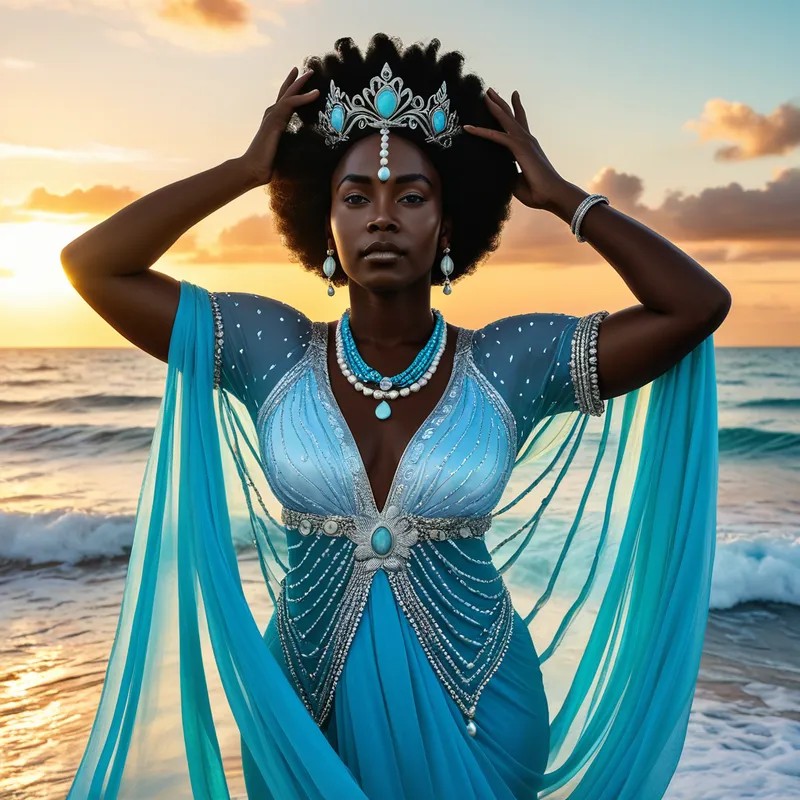
Iemanja in Brazil Myth Meaning & Symbolism
The story of the Yoruba sea goddess who crossed the Atlantic to become the mother of Brazil's waters, embodying creation, grief, and boundless love.
The Tale of Iemanja in Brazil
Listen. The story begins not on the shores you know, but in the memory of salt and sorrow. It begins in the hold of a ship, a wooden belly groaning across a starless sea. Here, in the darkness, a people carried a goddess in their hearts. They whispered her name into the damp wood: Iemanja. She was the great mother, the queen of all waters, and they were being torn from her. The ocean, which was her body, had become a monster of separation.
When the chains fell on a new, strange land, the memory did not break. It bent. It transformed. The people looked upon the vast, green coast of Brazil and saw not an alien shore, but the long, curving arm of their mother. They heard her voice in the crash of the Atlantic waves. They felt her tears in the tropical rain. Iemanja had made the journey too. She had poured herself into this new ocean, waiting for her children to find her again.
For generations, they called to her from the edges of the world. They offered songs that mixed Yoruba with Portuguese, rhythms born of the forest with the pulse of the sea. And she answered. Not with a roar, but with a sigh that smoothed the waves. She became Nossa Senhora da Conceição, dressed in celestial blue, her statue facing the water. On the last night of the year, her children would gather at the beach, their feet in her foam.
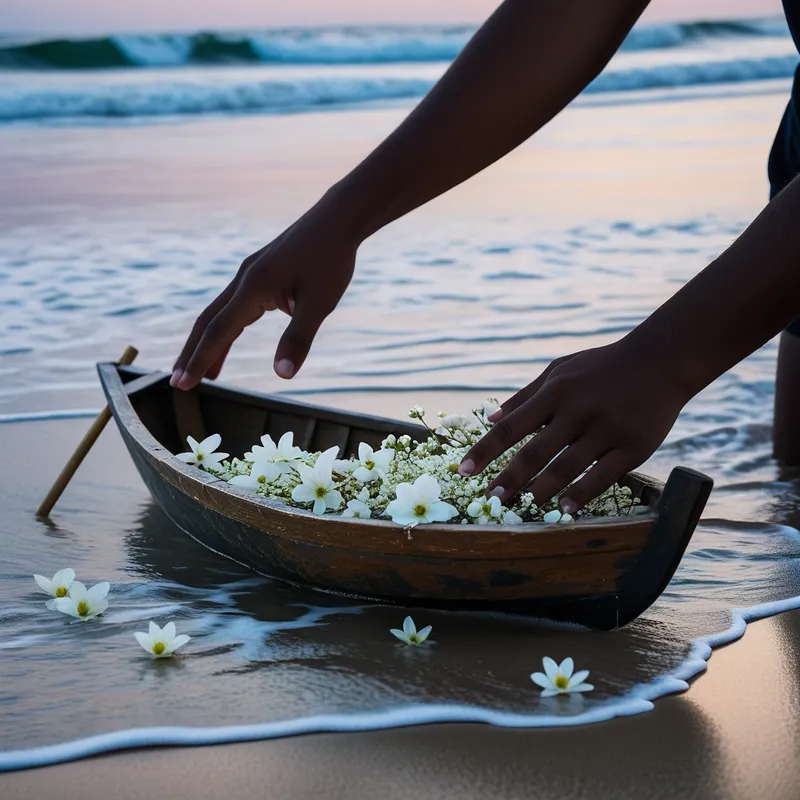
They would bring gifts for the mother: white flowers for her purity, mirrors so she might see her own beauty, sweet perfumes for her grace. One by one, they would step into the surf, their small boats of offering cradled in their hands. They would speak their secrets, their hopes, their deepest griefs into the shell of a seashell before casting it all upon the waters. "Odò Iyá!" they would cry. "Mother of the River!"
And if the offering was accepted, the boat would be drawn gently out to sea, swallowed by the embrace of the deep. If it washed back to shore, it was a sign to try again, to speak a truer word from the heart. But when accepted, it meant she listened. It meant that the great, salty womb of the world held their prayers, that the mother who had witnessed the Middle Passage now witnessed their dreams, that the line between the lost homeland and the new home was not a line at all, but a current, forever flowing within her.
Cultural Origins & Context
The myth of Iemanja in Brazil is a profound testament to the resilience of the spirit in the African Diaspora. Her origins lie with the Yoruba people of West Africa, where she is known as Yemoja, a powerful Orisha of the Ogun River and motherhood. The violent displacement of the transatlantic slave trade could not erase her; instead, her worship was preserved in secret, often disguised within the framework of imposed Catholicism—a process known as syncretism.
This was not a loss of identity, but a strategy of cultural survival. Iemanja became associated with Our Lady of the Conception, allowing her devotees to venerate their mother goddess under the watchful eyes of colonizers. The myth was passed down not in written texts, but in the body: in the rhythms of Capoeira, in the songs of Candomblé ceremonies, in the cooking pots that remembered ancestral flavors. Her societal function was multifaceted: she was a healer of the trauma of dislocation, a symbol of unbreakable matrilineal strength, and a divine witness to the creation of a new, Afro-Brazilian identity. She provided a spiritual anchor in a world designed to make her children feel rootless.
Symbolic Architecture
At her core, Iemanja symbolizes the primordial, creative, and containing feminine. She is not a gentle pond, but the dynamic, life-giving, and sometimes terrifying totality of the aquatic realm.
The ocean does not distinguish between a tear and a storm; to Iemanja, all emotions are currents in the same vast body.
Psychologically, she represents the unconscious itself—deep, mysterious, fertile, and the source of all life. Her waters are the amniotic fluid of psychic birth. The act of sending offerings out to sea is a profound symbolic gesture: it is the conscious ego surrendering its burdens, its wishes, and its unresolved material to the care of the larger, wiser Self. The mirror offered to her is a key symbol—it asks us to see our true reflection not in the shallow pools of persona, but in the deep, honest waters of the soul. Her rejection of an offering that washes back is not cruelty, but an insistence on authenticity; the unconscious will not accept a falsehood.
The Dreamer's Resonance
When the archetype of Iemanja stirs in modern dreams, it often signals a profound process of emotional and psychic cleansing. To dream of a vast, calm, maternal ocean suggests a need for nurturance and a return to one's emotional source. Dreaming of turbulent, overwhelming waves may point to repressed emotions—a Wound of grief, Guilt, or ancestral sorrow—threatening to flood the conscious mind.
A dream of placing an object into the water and watching it float away or sink is a classic image of ritual surrender. The dreaming psyche is enacting its own offering, attempting to release what no longer serves it into the care of a larger, healing intelligence. Somatic sensations often accompany these dreams: a feeling of weightlessness, the sound of waves, or the physical sensation of being rocked or held. This is the body remembering its most primal state, held in the womb of the world-mother, participating in a Ritual of Healing that bypasses the intellect and speaks directly to the soul.

Alchemical Translation
The myth of Iemanja models the alchemical process of solutio—dissolution in the waters of the unconscious—as a necessary precursor to Transmutation. The modern individual's journey toward wholeness (individuation) often requires a similar voyage.
First, one must recognize the Wound of separation—from one's true nature, from emotional truth, from the mothering principle within. This is the slave ship on the dark sea. The next step is the courageous offering: the conscious decision to bring one's hidden pains, shameful secrets, and fervent hopes (the flowers, the mirror, the perfume) to the edge of the vast unknown within. This is the walk to the beach at midnight.
The sacrifice demanded is not of something external, but of the ego's illusion of control. One must let the little boat go.
The acceptance of the offering by the deep—the feeling of being received, held, and understood by a power greater than one's conscious self—marks the beginning of psychic Rebirth. Salt water, the medium of tears and the sea, becomes the agent of purification. What returns from this dissolution is not the same person who made the offering. A new, more fluid, and resilient consciousness is formed, one that understands itself as both a distinct individual and an inseparable part of the great, salty, creative matrix of life. One becomes, in a sense, a child of Iemanja—forever connected to the source, yet free to navigate the surface world.
Associated Symbols
Explore related symbols from the CaleaDream lexicon:
- Ocean — The primary body and domain of Iemanja, representing the vast, unconscious feminine, the source of all life, and the emotional depths of the human psyche.
- Mother — Iemanja is the supreme mother archetype, embodying unconditional nurture, creation, protection, and the primal source to which all things eventually return.
- Mirror — Offered to Iemanja so she may admire herself, it symbolizes the quest for true self-reflection and authenticity when facing the deep, often hidden, waters of the soul.
- Goddess — She is the divine feminine principle manifest as a specific, approachable deity who listens to personal prayers and participates in human emotional life.
- Journey — Represents the traumatic Middle Passage, the spiritual crossing of the Atlantic by the Orisha, and the individual's inner voyage to confront and heal deep wounds.
- Wound — The foundational trauma of the Diaspora and the personal, emotional injuries that devotees bring to Iemanja's waters for cleansing and healing.
- Healing — The core function of the myth and its rituals, representing the psychic and emotional purification achieved through surrender to a greater, containing power.
- Ritual — The structured practice of offerings on the beach, modeling the conscious act of engaging with the unconscious to facilitate transformation and release.
- Rebirth — The promised outcome of the ritual surrender; emerging from the symbolic waters with a renewed spirit, cleansed of old burdens.
- Tears — The human expression of grief and release that finds its ultimate home and meaning in the salt waters of the maternal ocean.
- Moon — Often associated with Iemanja as a ruler of tides and cycles, governing the ebb and flow of emotions, fertility, and intuitive knowing.
- Fish — The children of Iemanja, symbols of fertility, the contents of the unconscious, and beings perfectly adapted to the emotional and psychic depths she rules.