Hwanung Descends from Heaven Myth Meaning & Symbolism
A heavenly prince descends to a sacred mountain, bringing divine law and culture, and fathers the legendary founder of the first Korean kingdom.
The Tale of Hwanung Descends from Heaven
Listen, and hear the tale from the time before time, when the world was raw clay and the sky was a breath away.
In the highest vault of Heaven, where the Heavenly Bodies wheel in perfect silence, dwelled the God Hwanin. His son, the Prince Hwanung, gazed not upon the static perfection of the heavens, but downward. His heart stirred with a profound yearning for the world below—a realm of mist and mountain, of chaotic potential and untamed spirit. He saw the suffering of its creatures, their lives governed by instinct without principle, and he longed to bring the harmony of the celestial to the tumult of the earthly.
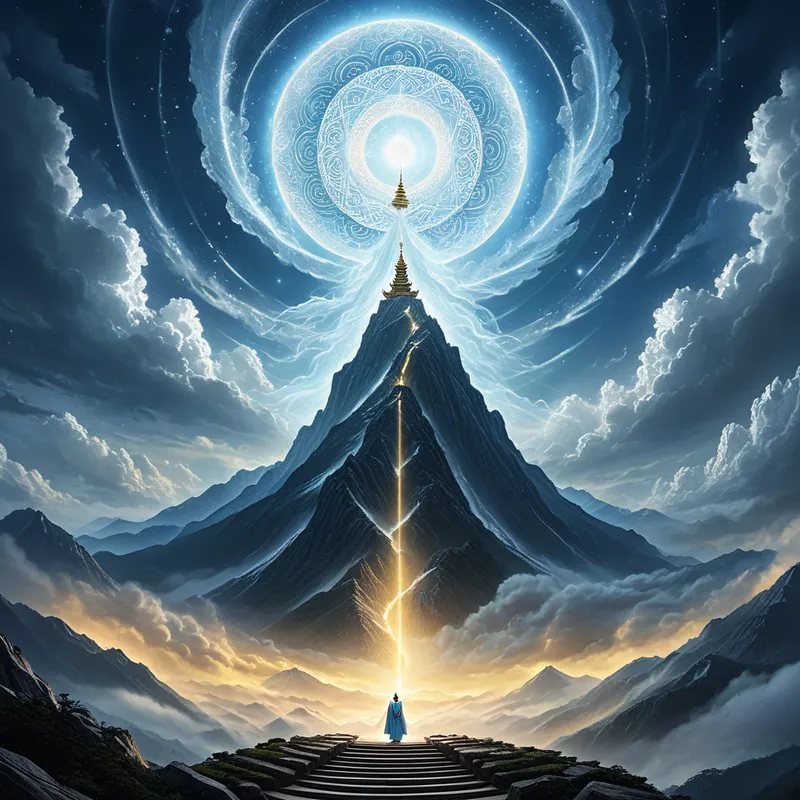
With a father’s understanding of a son’s sacred duty, Hwanin granted his plea. He opened the gates of the Nine Heavens. And so, the Prince descended. He did not fall, but processed in solemn, glorious state. Three thousand ministers of wind, of rain, and of cloud formed his retinue. Their passage was the first weather, the first distinction between storm and calm. They alighted upon the crown of the world, the sacred Mountain Taebaek.
There, at the peak where earth touched sky, Hwanung planted the Tree of the Altar. He named the place Sinsi, the City of God. And from this navel of the world, he began his divine rule. He gave laws of conduct—three hundred sixty affairs of life, encompassing morality, agriculture, medicine, and justice. He taught the people to distinguish good from ill, to heal the sick, to plant in season. The wind, rain, and cloud ministers served at his command, bringing order to the wild elements.
Yet, the story of foundation requires not just law, but life. In a cave at the base of that holy mountain, a Tiger and a Bear dwelled. They were primal souls, yearning to become more. They came before Hwanung’s altar and prayed with the only language they possessed: a deep, unwavering desire. The heavenly prince heard them. He gave them a sacred test: twenty cloves of garlic and a bundle of mugwort. "Eat only this," he decreed. "Shun the light for one hundred days. If you endure, you shall be granted human form."
The cave became a womb of darkness and discipline. The tiger, its spirit fierce but impatient, soon fled the confinement, its hunger for the old ways too strong. But the bear, in her steadfastness, held to the vow. She endured the bitter herbs, the darkness, the crushing wait. On the twenty-first day, a miracle of will—her form shimmered and transmuted. The bear was no more. In her place stood a woman, Ungnyeo. Her body was human, but her eyes held the ancient patience of the forest and the deep, resonant wisdom of the earth.
Ungnyeo gave thanks at the altar, but a new longing arose in her human heart—a longing for Child. Hwanung, moved by her devotion and completion of the ordeal, took her as his bride. From their union, a son was born upon that mountain. He was named Dangun Wanggeom. This child, born of heavenly sovereign and earthly perseverance, would become the priest-king, the founder of a nation, and the seed of a people. The clay of the world had been imprinted with the seal of heaven.

Cultural Origins & Context
This foundational myth is recorded in the 13th-century Samguk Yusa (Memorabilia of the Three Kingdoms), a collection of legends, folktales, and histories compiled by the Buddhist monk Iryeon. Its transmission is older, rooted in the oral traditions of the ancient Gojoseon confederacy. The myth served as a divine charter, legitimizing the ruling lineage by tracing it directly to the celestial realm. It was not merely a story of origin, but a cosmological blueprint that explained the Korean people’s place in the universe: a chosen people, governed by heavenly principles, born from the sacred marriage of cosmic order (Heaven) and resilient earthly substance (Earth). The myth functioned to instill a sense of collective identity, sacred geography centered on Taebaek Mountain, and a moral framework derived from divine decree.
Symbolic Architecture
The myth is a profound allegory for the structuring of consciousness itself. Hwanung’s descent represents the incarnation of a governing principle—logos, order, culture—into the chaos of the undifferentiated psyche (the primal world).
The descent of spirit into matter is not a fall, but a sacred mission to make the latent potential of the world conscious of itself.
The Mountain is the axis mundi, the point where the vertical dimension of spirit meets the horizontal plane of human life. The three thousand ministers—wind, rain, cloud—symbolize the elemental forces of the psyche being organized and directed toward life-giving purposes. The ordeal of the tiger and the bear is the central alchemical drama. The tiger embodies untamed instinct and raw yang energy that cannot yet submit to the transformative discipline. The bear symbolizes the potent, enduring yin principle—the receptive, patient, and earthy aspect of the soul capable of enduring the dark night of incubation. Garlic and mugwort, pungent and purifying, represent the bitter medicine of initiation, the harsh but necessary conditions for metamorphosis. Ungnyeo is the successful result: the instinctual nature refined into a vessel capable of receiving divine seed and giving birth to a new, integrated consciousness (Dangun).
The Dreamer's Resonance
When this myth stirs in modern dreams, it signals a profound process of psychic reorganization. Dreaming of a majestic descent from a radiant sky onto a personal "mountain" (a challenging career peak, a spiritual quest, a new life phase) suggests the ego is being contacted by a superior ordering principle from the Self. It is the call to establish "divine law"—one’s own authentic ethics and purpose—in a previously chaotic inner landscape.
Conversely, dreaming of being in a dark cave with animal companions, presented with a test of endurance, speaks directly to the "bear ordeal." This is the somatic experience of shadow-work. The dreamer is in the incubation cave of the unconscious, tasked with digesting the "bitter herbs" of repressed material, shame, or old patterns (the garlic and mugwort). The impatience of the tiger may manifest as a temptation to abandon the difficult inner work for old, instinctual comforts. To dream of successfully becoming Ungnyeo is to experience the profound relief and new potential born of having endured this psychic austerity, emerging with a more authentic, humanized identity.

Alchemical Translation
The myth models the complete arc of individuation: from celestial potential to embodied, cultured existence. The first stage is the Descent of the Ruler Archetype. This is the moment one consciously decides to impose order on inner chaos—to commit to therapy, a creative discipline, or a spiritual path. Hwanung establishing Sinsi is the ego building a stable, conscious structure (the "City of God") from which to govern the psyche.
The core of the alchemy is the Transmutation of the Primal Substance (the bear). This is the grueling, often lonely work of confronting the unconscious.
One does not become human by denying the animal, but by subjecting its immense power to a sacred, transformative discipline.
The hundred days in the cave are the period of sustained introversion, where one must feed only on the "bitter" truths of oneself, shunning the easy "light" of distraction and persona. This is the nigredo, the blackening, where the old form dissolves.
The final stage is the Sacred Marriage and Divine Child. The successful integration of the instinctual (Ungnyeo) with the newly established conscious ordering principle (Hwanung) produces Dangun—the symbolic "divine child." This is the nascent, whole personality, the Self that can rule a kingdom (one’s own life) with both heavenly mandate and earthly wisdom. The myth teaches that our highest potential is not a rejection of our earthy, animal nature, but its glorious transformation through conscious, disciplined engagement with a higher calling.
Associated Symbols
Explore related symbols from the CaleaDream lexicon:
- Heaven — The realm of pure order, potential, and the divine father principle from which the structuring consciousness (Hwanung) originates.
- Mountain — The sacred axis where heaven meets earth, representing the lofty goal, the challenging path of ascent, and the site of spiritual transformation.
- Bear — The primal, earthy, and patient aspect of the psyche capable of enduring the dark incubation necessary for metamorphosis into a conscious being.
- Cave — The womb of the unconscious, the place of incubation, ordeal, and profound inner transformation where the old self is dissolved.
- God — The sovereign, ordering principle of the cosmos (Hwanin) and its active emissary (Hwanung) who instills law and culture into chaos.
- Child — The divine child (Dangun), symbol of the new, integrated consciousness born from the union of celestial order and transformed earthly substance.
- Tree — The world tree or altar tree planted by Hwanung, representing the living connection between realms and the rooted, growing structure of a new moral order.
- Ritual — The sacred test of garlic and mugwort, a disciplined ordeal designed to transmute base instinct into a vessel for higher consciousness.
- Order — The core gift of Hwanung: the 360 laws and principles that structure chaotic nature into a civilized, ethical human society.
- Earth — The raw, material world and feminine principle that yearns for and receives the imprint of heavenly order, culminating in the birth of Ungnyeo.