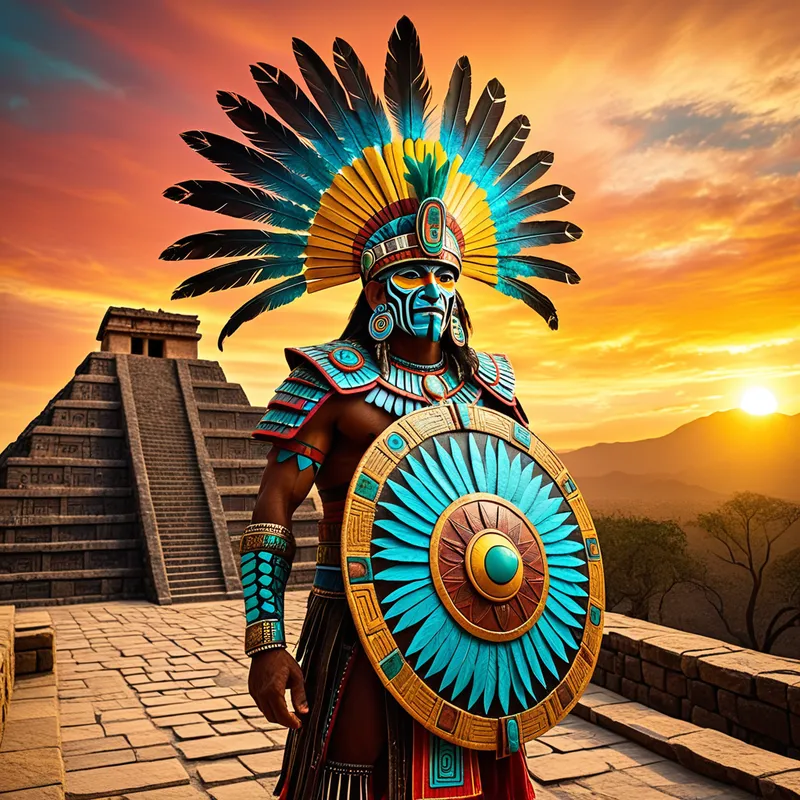
Huitzilopochtli Myth Meaning & Symbolism
A divine son, born fully armed to defend his mother from celestial betrayal, becomes the relentless sun demanding sacrifice to stave off cosmic darkness.
The Tale of Huitzilopochtli
Hear now the tale of the Left-Handed Hummingbird, the sun born of betrayal, the god who carved a nation from the wilderness with a will of flint.
In the time of mists, on the sacred mountain Coatepec, there lived a pious woman, Coatlicue. She swept the temple steps, a humble keeper of sanctity. One day, as she labored, a single, miraculous ball of shimmering hummingbird feathers drifted from the heavens and settled upon her breast. In that instant, she was with child—a child of divine portent.
But this sacred conception was a spark in a powder-keg of stars. Coatlicue already had children: her daughter, Coyolxauhqui, a fierce and beautiful warrior of the night sky, and her four hundred sons, the Centzon Huitznahua. When they learned of their mother’s pregnancy, shame and fury ignited in their celestial hearts. To them, this was a profound dishonor, a stain upon their stellar lineage. Led by Coyolxauhqui, they resolved to march upon Coatepec and slay their own mother.
The mountain grew heavy with the drumbeat of their approach. Coyolxauhqui, her face a mask of cold lunar fury, led the charge up the slopes, her star-brothers a glittering, murderous host behind her. Coatlicue, cradling her unborn child, could only wait, her heart a trapped bird. The air grew thick with the promise of matricide.
Then, from the womb, a voice rang out, clear as a war-horn. “Do not fear, Mother. I am here. I know what must be done.”
In that moment of ultimate peril, Huitzilopochtli was born. But this was no mewling infant. He emerged into the world fully armed and armored, a warrior-god painted for battle, his left leg feathered like the hummingbird, his face streaked with the yellow of dawn. In one hand, he held the Xiuhcoatl, and in the other, a mighty shield.
He saw his sister, Coyolxauhqui, at the vanguard of the traitorous host. Without a word, he raised the Xiuhcoatl. A beam of pure solar fire lanced out, striking her down. He then fell upon his star-brothers, the Centzon Huitznahua, with the relentless fury of the noonday sun scattering the stars. He drove them from the mountain, pursued them across the sky, and shattered their celestial order. As for Coyolxauhqui, he severed her head and cast her body down the mountainside, where it broke upon the rocks below—a fallen moon, dismembered and still.
Thus, from betrayal and defense, the sun was born at dawn, and the moon was cast down, destined to forever chase him, broken, across the night sky.

Cultural Origins & Context
This myth was the sacred heart of the Mexica people, more commonly known as the Aztecs. It was not merely a story but a foundational charter, recited by priests and elders during immense state ceremonies, particularly the feast of Panquetzaliztli. The Aztecs saw themselves as the “People of the Sun,” chosen by Huitzilopochtli to fulfill a terrible, cosmic duty.
The myth served multiple vital functions. It justified the staggering scale of human sacrifice central to Aztec statecraft. The sun, born in battle, required the sacred energy of tonalli—found in human blood—to win his daily battle against the forces of darkness (the stars and moon) and continue his journey across the sky. Failure meant the end of the world. It also legitimized the Mexica’s own rise to power: Huitzilopochtli was their patron, a divine guide who led them on their long migration from the mythical Aztlan to the Valley of Mexico, where they founded Tenochtitlan. The victory on Coatepec mirrored their own perceived destiny to dominate their “sibling” city-states.
Symbolic Architecture
At its core, the myth of Huitzilopochtli is a profound drama of psychic differentiation and the violent birth of consciousness.
Coatlicue represents the primordial, all-containing Great Mother, the unconscious from which all life and psyche emerge. Her humble sweeping signifies a state of potential, a quietude before the influx of the numinous—the ball of feathers, a symbol of divine inspiration or a sudden, fateful idea. The hostile siblings, Coyolxauhqui and the Centzon Huitznahua, symbolize the contents of the personal and collective unconscious that resist the emergence of a new, centralizing psychic authority. They are the established complexes, the familial loyalties, the “way things have always been,” which rise up in murderous rage when the status quo is threatened by a new, transformative potential.
The birth of the conscious Self is often perceived by the psyche as a act of treason against the old, familiar order of the family soul.
Huitzilopochtli is the archetypal Self in its most militant, solar form. He is the will to individuate, born fully formed in a crisis. His weapons are not just tools of war but symbols of focused, discriminating consciousness (the shield) and transformative, purging energy (the Xiuhcoatl as lightning or fire). His defeat of Coyolxauhqui represents the necessary dismemberment of a powerful, lunar complex—perhaps one tied to emotion, reflex, or passive identification with the mother—so that a solar, directed consciousness can take the helm.

The Dreamer's Resonance
When this myth stirs in the modern dreamer, it often heralds a profound internal schism and a call to psychic self-defense. One may dream of a cherished family home becoming a fortress under siege by familiar faces. Or of being pregnant with a glowing, powerful object while one’s own relatives plot against them. The somatic sensation is one of tightness in the solar plexus, a gathering of fierce, protective energy.
This is the psyche’s enactment of a critical threshold. The dreamer is at a point where a nascent identity, a true vocation, or a hard-won insight (the divine child) is facing annihilation by internalized voices of criticism, shame, or familial expectation (the star-siblings). The dream is not a prescription for literal violence, but a symbolic depiction of the intense, inner conflict required to defend one’s nascent selfhood from being swallowed back into the unconscious collective of “what the family expects.”

Alchemical Translation
The alchemical journey modeled here is that of separatio and coagulatio—the violent separation of the precious from the worthless, followed by the hardening of the new substance.
The first stage is the nigredo, the descent into the conflict on Coatepec. The dreamer feels betrayed by their own inner “family” of habits, beliefs, and loyalties. The old, lunar way of being (Coyolxauhqui) must be confronted and dismembered—not annihilated, but its power redirected. Its light is reintegrated not as ruler, but as a reflective component of the new whole.
The sacrifice demanded is not of others, but of one’s own allegiance to the constellations of the past that would keep the sun from rising.
Huitzilopochtli’s daily battle is the ongoing work of consciousness. For the modern individual, the “sacred war” is the daily effort to assert the value of one’s authentic life, work, and relationships against the relentless pull of entropy, distraction, and self-abnegation. The “nourishment” the sun requires is not blood, but focused attention, disciplined action, and the courage to live one’s own myth, not the myth assigned by the tribe. The triumph is not eternal peace, but the hard-won right to make the journey across your own sky, day after day, scattering the stars of doubt so that your world may continue to exist.
Associated Symbols
Explore related symbols from the CaleaDream lexicon: