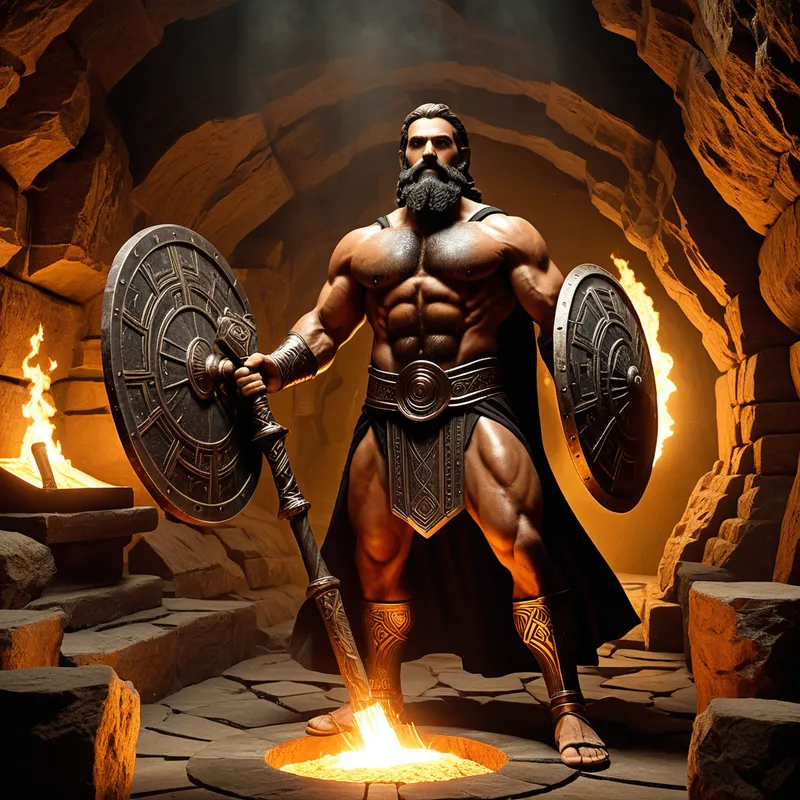
Hephaestus/Vulcan Myth Meaning & Symbolism
The myth of the divine smith, cast from heaven yet whose sacred forge in the world's depths creates the cosmos's most potent artifacts and beauty.
The Tale of Hephaestus/Vulcan
Hear now the tale of fire born from water, of the maker cast out, whose hands shaped the very pillars of the world. It begins not with a cry, but with a silence. On the sun-drenched heights of Mount Olympus, where the air is nectar and the light is gold, a child was born to the queen of heaven, Hera. But this was no perfect, laughing babe. He was twisted in his limb, his foot turned, a flaw in the divine perfection. And in a moment of shame or rage, the queen herself took the infant and hurled him from the celestial gates.
He fell for a day and a night, a tiny, burning ember through the vault of heaven, past the chariot of the sun, through the realm of winds, down, down to the wine-dark, waiting sea. The ocean, Thalassa, received him with a cold embrace. But he did not drown. The sea-nymphs Thetis and Eurynome found him in the coral deeps, and in a grotto veiled by kelp, they raised the castaway god. There, in the submarine gloom, the first sparks were kindled. He found shells that held the echo of thunder, volcanic stones that remembered the earth’s core. With patient, clever hands, he began to craft—first trinkets for his foster mothers, then wonders that had no name.
Years flowed like the ocean current. On Olympus, a throne of unparalleled beauty appeared for Hera, a gift from an unknown artisan. She sat upon it in triumph, and instantly, invisible, unbreakable bonds snapped shut, holding her fast. No god could loose them. Only the maker could free her, and he was summoned from the deep. The lame god ascended, not as a supplicant, but as a power. He freed his mother, and for his price, he demanded a place among the immortals and the hand of Aphrodite, the most beautiful. His forge was established not in the bright halls above, but within the smoking heart of volcanoes, on islands like Lemnos or under Mount Aetna.
There, in the world’s dark womb, amid the roar of bellows and the song of hammer on anvil, the rejected one became the indispensable one. His hands wrought Zeus's thunderbolts, Aphrodite's girdle, Achilles's armor. He fashioned living automata of gold to serve him, and with the earth-mother Gaia, he sculpted the first woman, Pandora, from clay. His fire was the secret heartbeat of the cosmos, his lameness the price and the proof of a creativity born not from grace, but from the profound, transformative depths.

Cultural Origins & Context
The figure of the divine smith is a primordial archetype found across Indo-European cultures, but in the Greek world, Hephaestus (adopted by the Romans as Vulcan) held a uniquely complex position. His myths are primarily preserved in the epic poetry of Homer and the later compilations of poets like Hesiod. He was not just a handy god; he was a civic deity, particularly revered in Athens alongside Athena as a patron of craftsmen and artisans.
His worship was practical and deeply embedded in the social fabric. Blacksmiths, potters, and weavers invoked him. The annual festival of the Hephaestia involved torch races and craft displays. His Roman counterpart, Vulcan, had his major shrine, the Volcanal, in the Roman Forum, and the Volcanalia festival in August saw sacrifices thrown into fires to appease the god of destructive flame and avert fires in the grain stores. The myth served a dual societal function: it explained the presence of creative skill (techne) and destructive fire in the world, and it provided a divine model for the artisan—often physically marked by labor, working in soot and grime, yet whose work upheld civilization itself. He was the god who validated labor, transformation of raw material, and the dignity found not in perfect beauty, but in potent utility.
Symbolic Architecture
Hephaestus/Vulcan is the archetype of the wounded creator. His lameness is not a mere physical defect; it is the symbolic wound that precipitates his descent and defines his genius. Cast from the realm of perfect forms (Olympus) into the chaotic, fluid realm of the unconscious (the sea), he undergoes a necessary incubation. His creativity is not innate divinity expressing itself effortlessly; it is forged in response to trauma, in the isolation of the underworld/workshop.
The most profound creation often begins with a fracture. The rejected part of the self, exiled to the depths, becomes the crucible where raw experience is transmuted into conscious artifact.
His forge, located in volcanic depths, represents the psychic basement—the chthonic, instinctual layer of the psyche where primal energies (fire, earth, metal) are raw and potent. The anvil is the stable, enduring consciousness upon which these chaotic forces are shaped. His marriage to Aphrodite, goddess of beauty and erotic love, is a profound alchemical symbol: the union of craft (techne) with beauty (charis), of arduous making with enchanting form. That this marriage is famously discordant speaks to the eternal tension between the labor of creation and the effortless allure of its finished product. He is the god of the process, not just the outcome.
The Dreamer's Resonance
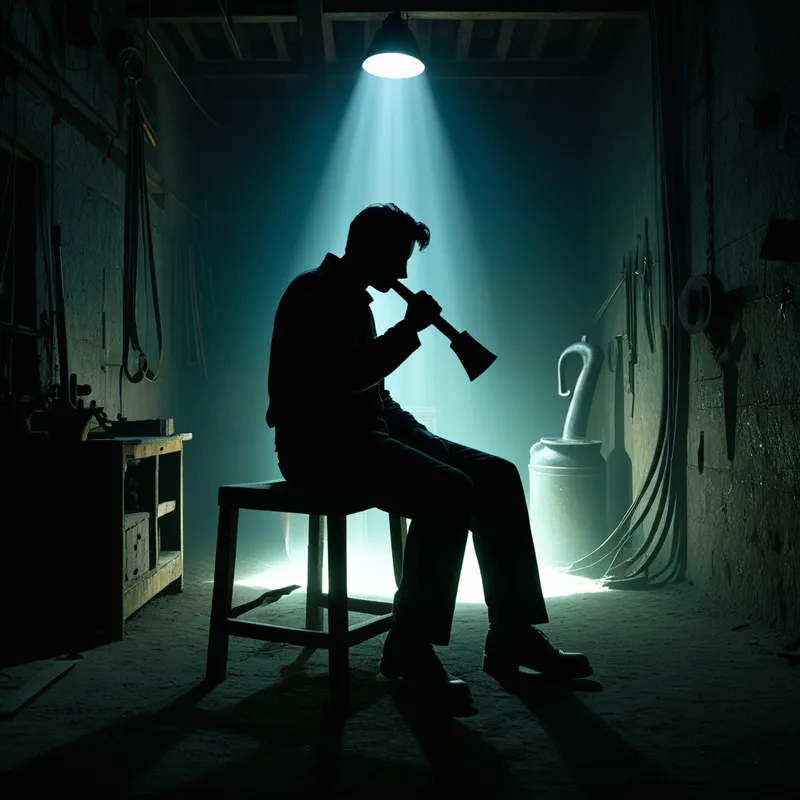
When the pattern of Hephaestus stirs in modern dreams, it often signals a profound engagement with one's own creative wound. The dreamer may find themselves in a basement, a garage, a cavern, or any isolated, utilitarian space—the psychological equivalent of the subterranean forge. There, they are tasked with fixing a broken object, forging a tool, or tending a hidden fire.
Somatically, this can correlate with feelings of heaviness, particularly in the legs or feet—a sense of being "lame" or held back. Psychologically, it is the process of confronting what feels rejected, awkward, or "un-Olympian" within oneself: a talent deemed unworthy, a trauma, a chronic insecurity. The Hephaestian dream is not about immediate escape from this workshop, but about learning to work within it. The automata that serve the god in myth may appear as dream figures of robotic helpers or intricate clockwork mechanisms, symbolizing the development of autonomous psychic functions—habits, skills, or defensive structures—forged in isolation to help the ego manage its world.
Alchemical Translation
The myth of Hephaestus is a masterful map of the alchemical process of individuation—the forging of a coherent, authentic self. The initial castatio (casting down) is the necessary nigredo, the blackening, the descent into the prima materia of one's own suffering and perceived flaws. This is not a failure, but the beginning of the work.
The long incubation under the sea with Thetis and Eurynome represents the solutio—a dissolving of the old, rigid Olympian identity in the waters of the unconscious, allowing for a re-constitution. The return to Olympus, not as a perfect god but as an indispensable craftsman, marks the coagulatio: the re-forming of the personality around the core of one's authentic skill and purpose, the "lame" foot integrated as part of one's unique stance in the world.
The goal is not to heal the wound in order to return to a state of naive wholeness, but to discover the divine craft that the wound itself forces into being. The limp becomes the signature of your walk.
For the modern individual, the alchemical translation is clear: your point of exile, your deepest insecurity, the thing that makes you feel "cast out" from conventional realms of grace or success, is the very location of your forge. The work is to descend into it, to light the fire there, and to begin, with patient, repetitive hammer-blows, to shape the raw ores of your experience—the grief, the anger, the passion—into something of utility and beauty. You do not become Hephaestus by being born perfect on Olympus. You become him by falling, finding the deep workshop, and learning to wield the hammer.
Associated Symbols
Explore related symbols from the CaleaDream lexicon: